Is intermittent fasting safe with IBS?






Intermittent fasting is not automatically safe for everyone with IBS, and it is not an established IBS treatment. Regular meals are the better starting point; fasting needs individual medical review if you have unstable symptoms, difficulty eating enough, diabetes treatment, or a history of disordered eating.
- Is intermittent fasting safe with IBS? Not for everyone; regular meals remain the better starting point.
- Large meals after fasting can trigger IBS symptoms, even when the foods are low FODMAP.
- Casa de Sante low FODMAP supplements are not a treatment for fasting-related symptoms.
- Stop fasting if symptoms worsen, and review medication timing with your clinician.
Why this matters
Eating less often is not the same as treating IBS. If you feel better while skipping meals but develop pain or urgency when you eat again, the schedule has not necessarily improved your underlying symptoms.
In 2026, your decision should center on adequate nutrition, manageable bowel symptoms, and medication safety—not reaching a fasting target. The same distinction applies to Casa de Sante: low FODMAP supplements and meal timing address different questions.
Do not use fasting to avoid eating because food has become frightening. A registered dietitian with IBS experience can help you identify tolerable meals without adding another layer of restriction.
Is intermittent fasting safe with IBS?
There is no fasting schedule that is established as safe and effective for everyone with IBS. NICE guidance for adults with IBS advises regular meals, taking time to eat, and avoiding missed meals or long gaps between eating.
That guidance supports a practical starting point: stabilize your eating pattern before experimenting with restriction. It does not mean every delay between meals causes harm, or that everyone needs frequent snacks.
| Eating pattern | Best for | Practical advantage | Main limitation |
|---|---|---|---|
| Regular meals | People establishing a manageable IBS routine | Supports consistent intake without compensatory large meals | Food choices and portions still need individual adjustment |
| Usual overnight break | People whose existing routine already works | Does not require deliberately skipping daytime meals | Extending it can interfere with breakfast, medication, or adequate intake |
| Restricted eating window | People considering fasting for a separate health goal after clinical review | Provides a defined eating schedule | Can compress food intake, encourage large meals, and complicate medication timing |
Choose regular meals first when IBS symptoms are active. A fasting plan that repeatedly worsens pain, constipation, diarrhea, or food anxiety is not a useful plan for you.
Regular meals: the starting point for IBS management
Regular meals give you a consistent setting in which to assess symptoms. You can examine portion size, ingredients, stress, and bowel patterns without also changing the length of time you spend without food.
This is especially useful when you are adjusting fiber, reviewing medication, or working through a low FODMAP diet. Changing several variables together makes it difficult to identify what helped or hurt.
Regular eating does not require eating continuously. Build meals around your appetite, nutritional needs, work schedule, and treatment plan, then adjust with your clinician or dietitian.
For your 2026 IBS plan, prioritize a routine you can maintain on ordinary days. A schedule that only works when you have no work, travel, or social commitments is difficult to evaluate fairly.
Restricted eating windows: more planning, not proven IBS relief
A shorter eating window changes when you eat; it does not remove the ingredients or meal characteristics that trigger symptoms. Large portions, high-fat meals, caffeine, and poorly tolerated carbohydrates still matter.
Some people report less bloating while they are not eating. That observation alone does not establish that fasting improves IBS, because symptoms after the next meal and total daily intake also count.
If you are considering fasting for a goal other than IBS management, separate those decisions. Ask whether the intended benefit justifies disrupting a meal pattern that currently controls your bowel symptoms.
Do not lengthen a fast to compensate for symptoms after eating. Review the meal and the overall pattern instead of assuming your gut needs progressively less food.
Why fasting tolerance varies with IBS
Your response depends on more than the clock. These factors explain why the same schedule does not suit everyone:
- IBS pattern: Constipation, diarrhea, and mixed bowel habits create different practical concerns when meals become less predictable.
- Meal size: Compressing food into fewer meals can mean larger portions that provoke discomfort or urgency.
- Food composition: Fat, caffeine, lactose when poorly tolerated, and fermentable carbohydrates can affect symptoms regardless of timing.
- Fluid intake: Drinking less because you are eating less can complicate constipation or fluid losses from diarrhea.
- Medication requirements: Some medicines need food, while glucose-lowering treatment can require changes before fasting.
- Nutritional vulnerability: Unintentional weight loss, low intake, and restrictive eating make further restriction a poor starting point.
Use these factors to guide a discussion, not to diagnose the cause of every symptom yourself. A persistent change in bowel habits deserves assessment rather than repeated schedule adjustments.
Does fasting affect IBS-C and IBS-D differently?
Fasting is not an established treatment for either constipation-predominant IBS or diarrhea-predominant IBS. The concerns differ, so advice should reflect your actual bowel pattern rather than the IBS label alone.
If constipation is your main problem
Eating stimulates activity in the colon through the gastrocolic reflex. Skipping a usual meal can remove a familiar opportunity to use the bathroom, particularly if your routine normally includes a bowel movement after breakfast.
Reduced food, fluid, or fiber intake can also complicate constipation. Check those changes before attributing harder stools entirely to the fasting interval.
If diarrhea or urgency is your main problem
Avoiding food can postpone meal-related urgency without resolving its cause. Breaking the fast with a large meal can then create another difficult period of symptoms.
Plan manageable portions and access to a bathroom rather than relying on prolonged food avoidance. Persistent watery diarrhea, nighttime symptoms, or a major change from your usual pattern needs medical review.
How should you assess fasting before trying it?
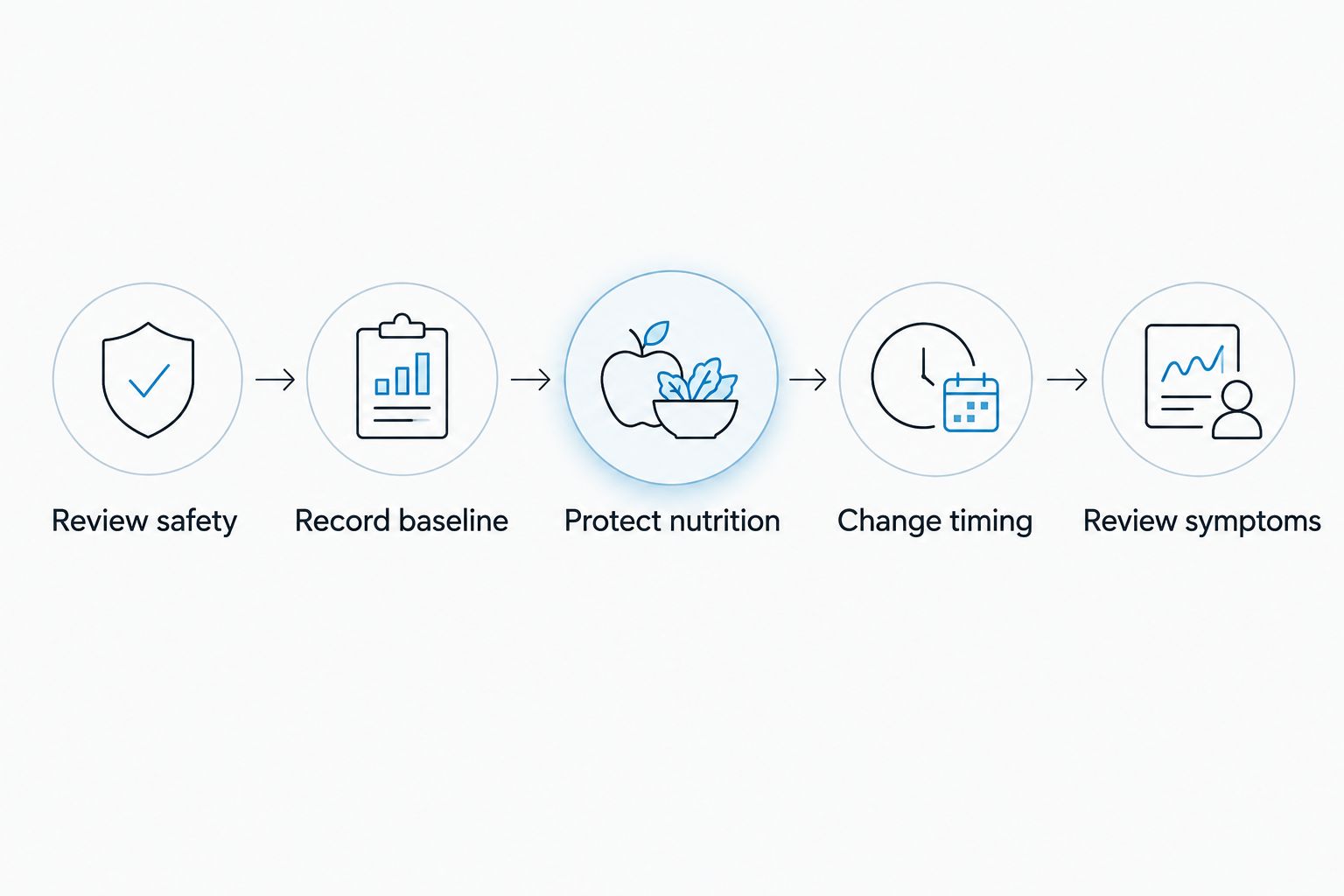
The safest next move is a review of your current routine, not an aggressive fasting experiment. Use this sequence with your clinician or dietitian before changing meal timing in 2026.
- Review safety. Discuss diagnoses, pregnancy or breastfeeding, eating-disorder history, weight changes, and medicines that interact with food or blood glucose.
- Record baseline. Note your usual meal timing, pain, bloating, bowel movements, urgency, and energy before making changes.
- Protect nutrition. Confirm that your proposed schedule leaves room for adequate food and fluid without uncomfortable portions.
- Change timing. If clinical review supports a trial, avoid simultaneously starting a restrictive diet or several supplements.
- Review symptoms. Compare the whole day, including symptoms after eating, and return to your previous routine if the change makes things worse.
The purpose of tracking is to make a decision, not to create a perfect diary. Record enough detail to distinguish a manageable routine from one that repeatedly leaves you unwell.
What should you eat when you break a fast with IBS?
Break a fast with a manageable meal made from foods and portions you already tolerate. There is no special food that makes an otherwise unsuitable fasting schedule safe.
Eat slowly rather than rushing through a large meal. Include a tolerated protein source and other foods that meet your nutritional needs, rather than treating the first meal as a test of how little you can eat.
If you use a low FODMAP approach, remember that serving size matters. Combining several foods that are tolerated separately can change the total fermentable carbohydrate load of the meal.
Coffee, rich foods, alcohol, and sugar alcohols deserve attention if they are established triggers for you. Do not remove all of them automatically; use your symptom history to guide changes.
The first meal should support your day, not repay a food deficit in one sitting. If that is impossible within your chosen eating window, reconsider the window.
Who should not start fasting without medical review?
Do not start a self-directed fasting plan if you are pregnant or breastfeeding, underweight, experiencing unintentional weight loss, or have a current or previous eating disorder. Children and adolescents also need individualized advice rather than an adult fasting plan.
Diabetes requires particular care, especially with insulin or medicines that can cause hypoglycemia. Do not skip food or change doses independently to fit a fasting schedule.
If you take a GLP-1 medication and already struggle with nausea, vomiting, or low appetite, discuss additional restriction with your prescriber. Difficulty eating enough is a reason to review treatment and nutrition, not to narrow your eating window further.
In 2026, medication instructions still take priority over a fasting routine. Ask a pharmacist whether each medicine requires food and what to do if your eating schedule changes.
When should you stop fasting or seek care?
Stop the fasting trial if it causes worsening bowel symptoms, persistent dizziness, weakness, or difficulty eating enough. Returning to a tolerable meal pattern is a practical adjustment, not a failure.
Seek prompt medical attention for blood in your stool, black tarry stool, persistent vomiting, unexplained weight loss, or symptoms that repeatedly wake you from sleep. Do not assume these are routine IBS symptoms.
Severe or sudden abdominal pain, fainting, confusion, or an inability to keep fluids down requires urgent assessment. If you have diabetes and symptoms of low blood glucose, follow your prescribed hypoglycemia treatment plan immediately rather than continuing the fast.
Where low FODMAP supplements fit—and where they do not
Casa de Sante is best suited to people seeking low FODMAP supplements, not a fasting treatment for IBS. Its physician-formulated supplement range serves people managing digestive sensitivities, but supplements do not establish that a fasting schedule is safe.
For example, Elemental Vegan Protein Powder | Low FODMAP Plant-Based Nutrition Support is described as dairy-free and made without pea or soy isolates, inulin, or chicory root. That makes its ingredient profile relevant to a nutrition discussion when those exclusions matter to you; it does not make the powder a complete meal or guarantee symptom tolerance.
The benefit of considering Casa de Sante low FODMAP supplements is access to options designed around that dietary need. The limitation is equally important: a supplement cannot replace adequate meals, individualized medication advice, or evaluation of persistent symptoms.
Do not add a product simply to continue a fasting schedule that makes you feel worse. First resolve the eating-pattern problem, then assess whether a specific nutritional gap remains.
FAQ
Is intermittent fasting safe with IBS in 2026?
Intermittent fasting is not automatically safe for everyone with IBS in 2026. Regular meals remain the better starting point, and medication use, nutritional intake, and symptom stability need individual review.
Can intermittent fasting cure IBS?
Intermittent fasting is not an established cure or treatment for IBS. Feeling better while not eating does not demonstrate improved symptoms after meals or adequate daily nutrition.
Is skipping breakfast bad if I have IBS-C?
Skipping breakfast can disrupt a useful bowel routine if eating normally prompts a bowel movement. Review total food, fluid, and fiber intake as well as timing when constipation worsens.
Should I fast during an IBS flare?
Do not use prolonged fasting as a self-directed treatment for an IBS flare. Prioritize tolerable meals and fluids, and seek medical advice for severe symptoms or a change from your usual pattern.
Can I combine intermittent fasting with a low FODMAP diet?
Combining fasting with a low FODMAP diet adds another restriction and needs individualized assessment. A dietitian can help protect adequate intake and prevent the elimination phase from becoming unnecessarily restrictive.
Do protein shakes break an intermittent fast?
A protein shake contains calories and breaks a calorie-free fast. If you need nutrition or food with medication, meeting that need takes priority over maintaining the fast.
Should I change my medication time to fit fasting?
Do not change medication timing or doses independently to fit fasting. Ask your pharmacist or prescriber about food requirements and blood-glucose risks before changing your eating schedule.
One last thing
A bowel movement after breakfast can be part of normal digestive physiology, not evidence that breakfast is harming you. Eating activates the gastrocolic reflex, which can move stool already in your colon; it does not mean the meal you just ate has passed straight through.
For your 2026 routine, distinguish manageable post-meal bowel activity from painful urgency. The goal is tolerable eating and adequate nutrition—not the longest possible stretch without food.