Is a low FODMAP diet safe long term?






A personalized low FODMAP diet can be suitable long term, but the strict elimination phase is not intended to last indefinitely. Long-term safety depends on restoring tolerated foods, meeting your nutritional needs, and reviewing persistent symptoms with a clinician. Keep the symptom relief, not every restriction.
- Is a low FODMAP diet safe long term? Personalization is the goal; indefinite strict elimination is not.
- Monash University recommends restriction, reintroduction, and personalization—not permanent avoidance of every high-FODMAP food.
- Review fiber, calcium, overall intake, and food anxiety with a registered dietitian.
- Reintroduce tolerated foods; supplements do not replace dietary variety or medical evaluation.
Is a low FODMAP diet safe long term?
Yes, when the long-term diet is personalized rather than permanently restrictive. Monash University's low FODMAP approach has 3 phases: restriction, reintroduction, and personalization. Each phase serves a different purpose; remaining in the first phase is not the intended endpoint.
Monash University describes an initial restriction period of 2–6 weeks, followed by structured food challenges. Its reintroduction guidance uses challenges over 3 days to explore tolerance to particular FODMAP groups. These are assessment tools, not instructions to keep eliminating foods whenever symptoms return.
If you are still following your original exclusion list in 2026, review whether you have completed reintroduction. The guide to how to reintroduce foods after a low FODMAP diet explains the next step.
| Phase | Best for | Main benefit | Main limitation |
|---|---|---|---|
| Restriction | A supervised, time-limited trial for IBS symptoms | Tests whether reducing FODMAP intake helps | Reduces food choice and requires nutritional planning |
| Reintroduction | Identifying food-group and portion tolerance | Replaces broad avoidance with individual information | Challenges can temporarily reproduce symptoms |
| Personalization | Ongoing eating after challenges | Keeps tolerated foods while managing specific triggers | Requires adjustments as symptoms and circumstances change |
The distinction matters: a diet that excludes only your demonstrated triggers is different from a diet that excludes every food on an elimination list. Neither approach guarantees freedom from symptoms, but personalization avoids restrictions that your challenge results do not support.
Why this matters
Symptom improvement can make restriction feel protective. When you finally have fewer episodes of pain, bloating, or diarrhea, testing a previously avoided food can feel like risking that progress.
However, symptom control and nutritional adequacy are separate questions. You need enough food, fiber, protein, vitamins, and minerals even when a restricted menu feels comfortable. A registered dietitian can assess both without treating dietary variety as more important than your symptoms.
For your 2026 diet review, use two measures of progress: whether symptoms are manageable and whether your food choices are expanding. A shorter exclusion list is useful only when the foods you restore are tolerated and help you eat adequately.
Restriction: a short assessment, not a permanent menu
The initial phase reduces high-FODMAP foods while you assess your response. It should still include balanced meals and suitable replacements for foods you remove. Low FODMAP does not mean eating as little as possible.
During the 2–6-week restriction period described by Monash University, agree on what improvement would look like with your clinician or dietitian. Track the symptoms that brought you to treatment rather than judging the diet by whether digestion feels completely silent.
Do not extend unsuccessful restriction indefinitely. If symptoms have not meaningfully improved, ask whether the approach was appropriate, whether portions or substitutions need review, or whether another diagnosis or treatment needs attention.
Removing more foods without a clear reason makes the diet harder to assess. It also increases the practical burden of shopping, cooking, and eating outside your home.
Reintroduction: test tolerance before deciding what to avoid
Reintroduction asks a narrower question than whether a food is good or bad: which FODMAP groups and amounts trigger symptoms for you? Keep the background diet consistent so that a challenge gives you useful information.
Monash University's approach includes 3-day challenges with increasing amounts of a selected food. A dietitian should help choose suitable challenge foods, portions, and recovery periods, especially when symptoms are severe or your diet is already limited.
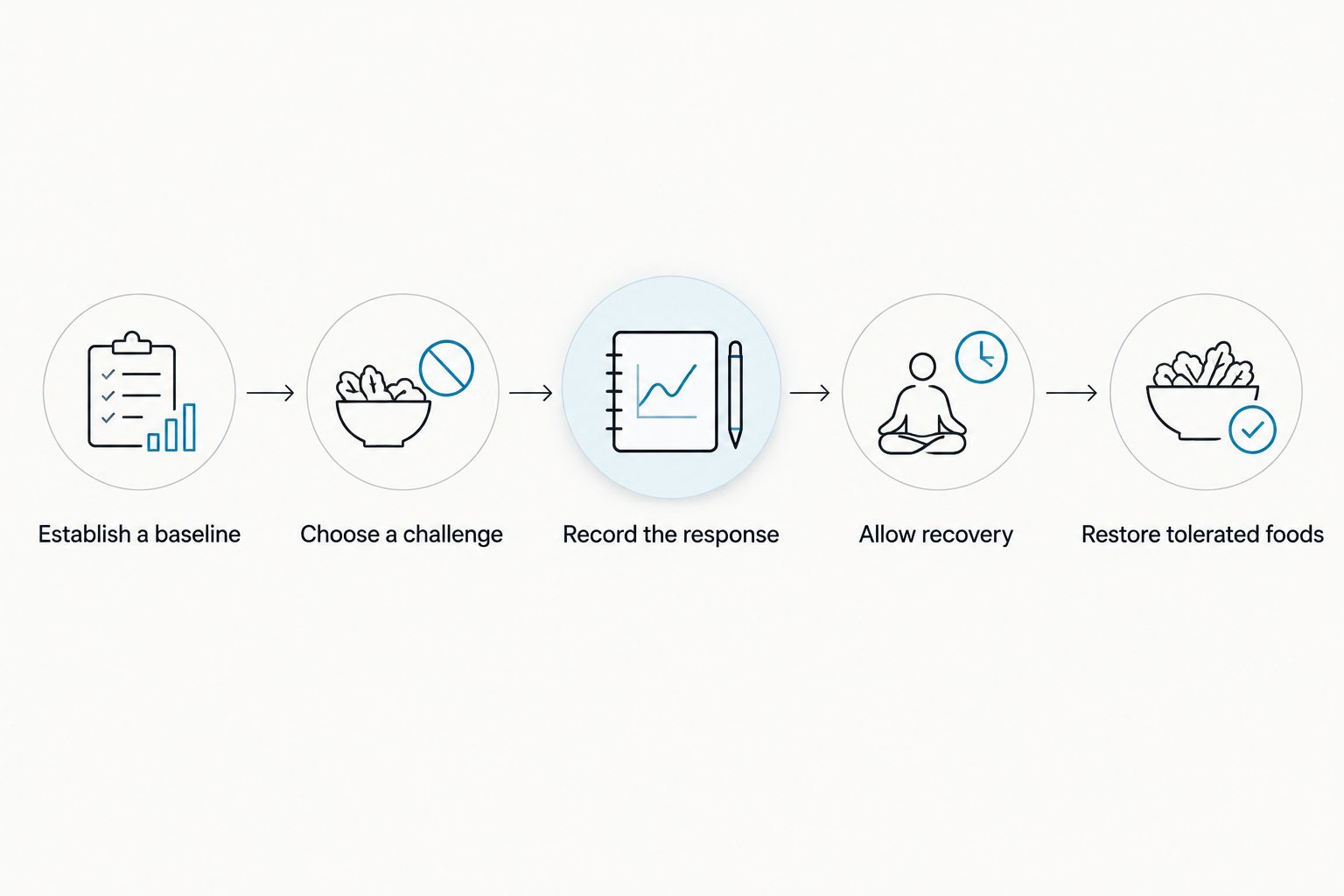
Use this sequence:
- Establish a baseline. Begin when symptoms are sufficiently settled to recognize a change.
- Choose a challenge. Select a food that tests the intended FODMAP group.
- Record the response. Note the food, portion, symptoms, and bowel changes.
- Allow recovery. Let symptoms settle before moving to another challenge.
- Restore tolerated foods. Carry useful results into your everyday eating plan.
Do not start several supplements and several food challenges together. Changing multiple variables makes it harder to identify what caused improvement or discomfort.
A difficult challenge does not prove you must avoid that food forever. Review the portion, the food selected, and the surrounding circumstances before turning one experience into a permanent rule.
Personalization: the long-term eating pattern
Personalization retains the foods and amounts you tolerate while limiting those that reliably cause troublesome symptoms. You do not need to eat every high-FODMAP food. You also do not need to exclude a food simply because someone else's IBS plan excludes it.
Your personalized plan should cover ordinary life: breakfast, work meals, restaurant choices, travel, and meals with other people. A plan that works only when you prepare every ingredient yourself deserves another discussion with your dietitian.
Make your 2026 maintenance plan specific. Record what you tolerate, what needs a smaller portion, and what you currently avoid, rather than keeping one undifferentiated list of forbidden foods.
The long-term goal is the least restrictive diet that provides acceptable symptom control and adequate nutrition. Revisit the plan when your appetite, medications, health, or symptoms change.
Why long-term safety varies
Long-term suitability depends on what you actually eat, not whether your meals carry a low FODMAP label. Review these factors:
- Breadth of restriction. Avoiding demonstrated triggers is different from excluding entire food groups without suitable replacements.
- Energy and protein intake. Smaller meals and fewer choices can leave you eating less than you need.
- Fiber sources. Removing familiar grains, legumes, fruits, or vegetables requires attention to tolerated alternatives.
- Calcium intake. Avoiding dairy without replacing its nutrients creates a different problem from choosing suitable lactose-free options.
- Food-related anxiety. Fear of symptoms can make reintroduction and adequate eating difficult.
- Medical context. Pregnancy, childhood, low body weight, eating disorders, and additional medical diets require individualized professional assessment.
These factors are reasons to review the diet, not proof that every low FODMAP eater develops a deficiency. Do not assume that a restricted diet is adequate because symptoms improved—or inadequate solely because it is restricted.
Protect fiber and dietary variety
Some FODMAP-containing carbohydrates also act as prebiotics, providing substrates for gut microbes. Strict restriction changes that intake. This is one reason to restore tolerated foods rather than treat all fermentation as harmful.
Microbiome changes do not automatically establish long-term clinical harm. Avoid claims that the diet inevitably damages your gut, and avoid the opposite claim that supplements cancel out every consequence of restriction.
Review the fruits, vegetables, grains, nuts, seeds, and legumes you can tolerate in appropriate portions. Increase fiber with professional guidance if constipation or bloating complicates the process; a sudden large change can make symptoms harder to interpret.
Check nutrients through food first
Look at the replacement whenever you remove a staple. If you stop drinking ordinary milk, consider whether your alternative supplies calcium and protein rather than assuming all milk alternatives are nutritionally equivalent.
Lactose-free dairy can remain an option for people who tolerate dairy proteins. A low FODMAP diet is not automatically dairy-free, and restricting wheat for fructans is not the same as treating celiac disease with a gluten-free diet.
Ask about celiac testing before removing gluten if your clinician suspects celiac disease. Starting a gluten-free diet first can interfere with the diagnostic process.
Watch for restriction becoming the main problem
Seek support when your accepted foods keep shrinking, meals cause marked anxiety, or you routinely skip eating to prevent symptoms. These problems deserve treatment even if some digestive symptoms have improved.
People with an eating disorder or significant malnutrition risk should not undertake strict elimination without appropriate specialist assessment. A less restrictive dietary approach or a different IBS treatment can be more appropriate.
Can I stay in the elimination phase if I feel better?
Feeling better is a reason to plan reintroduction, not an automatic reason to continue strict elimination. The initial response shows that dietary changes helped; it does not identify every food you need to avoid. Use structured challenges to separate necessary limits from unnecessary ones.
If fear is preventing that next step, tell your dietitian directly. Reintroduction can be paced around your symptom burden rather than treated as a test you must pass despite significant discomfort.
Does a low FODMAP diet cure IBS or SIBO?
A low FODMAP diet manages symptoms; it does not establish a cure for IBS or eradicate SIBO. Persistent symptoms need assessment rather than progressively stricter food avoidance. Dietary improvement alone does not confirm either diagnosis.
IBS management can include approaches beyond food restriction. Your clinician can review bowel habits, medications, stress-related symptom patterns, and other treatment options without assuming that every flare reflects a dietary mistake.
Do I need supplements to follow a low FODMAP diet long term?
Supplements are not automatically necessary for long-term low FODMAP eating. Choose them for an identified dietary need or clinical reason, not simply because you have IBS. A multivitamin does not replace fiber, sufficient energy, or the process of reintroducing foods.
Casa de Sante low FODMAP supplements are best suited to people who need a supplement option compatible with their dietary restrictions—not a substitute for reintroduction.
For an identified micronutrient gap, Casa de Sante offers Vitamin & Mineral Gummies | Low FODMAP & GLP-1 Daily Essential Nutrition. The supplied product information describes a chewable multivitamin and mineral made without high-FODMAP fillers such as inulin or chicory.
The practical benefit is an option designed around those ingredient restrictions. The limitation is that a multivitamin does not supply everything a restricted diet can lack; check the nutrient amounts against your needs and other supplements with your clinician. Casa de Sante low FODMAP supplements do not make indefinite strict elimination the appropriate endpoint.
When should you seek medical care instead of changing the diet?
Do not attribute every digestive symptom to FODMAPs. Blood in your stool, unexplained weight loss, persistent vomiting, fever, or new and worsening symptoms require medical assessment.
Severe abdominal pain, black tarry stools, or signs of significant dehydration warrant urgent care. Do not use further food restriction to manage these symptoms at home.
For routine follow-up in 2026, bring your current food exclusions, symptom record, medication list, and supplement labels. That information helps your clinician distinguish dietary questions from symptoms that need further investigation.
FAQ
Is a low FODMAP diet safe long term if I have IBS?
A personalized low FODMAP diet can be suitable long term for IBS, but indefinite strict elimination is not the intended approach. Review nutritional adequacy and restore tolerated foods with a registered dietitian.
How long should I stay on strict low FODMAP elimination?
Monash University describes an initial restriction phase of 2–6 weeks. Review your response and plan reintroduction rather than automatically extending restriction.
What if I get symptoms when I reintroduce a food?
Symptoms during reintroduction provide information about tolerance, not proof that a food must be banned permanently. Review the challenge portion and allow symptoms to settle before another challenge.
Can staying low FODMAP cause nutrient deficiencies?
A poorly planned restrictive diet can leave nutritional gaps, but deficiencies are not inevitable. Review overall intake, fiber sources, calcium, and other nutrients with a dietitian.
Will a probiotic make permanent elimination safe?
A probiotic does not replace food variety or make permanent strict elimination nutritionally adequate. Its suitability depends on the specific product, your symptoms, and your medical circumstances.
Do Casa de Sante supplements replace food reintroduction?
Casa de Sante supplements do not replace food reintroduction. Consider a supplement only for a specific need while continuing to assess tolerated foods and nutritional adequacy.
Should I restart strict elimination every time I feel bloated?
Bloating alone is not a reason to restart full elimination. Review portions, bowel habits, recent dietary changes, and persistent symptoms before removing more foods.
One last thing
A low FODMAP label describes a food's suitability in a dietary framework, not the nutritional completeness of your day. You can eat only low FODMAP foods and still miss important nutrients, just as you can tolerate some higher-FODMAP foods within a personalized plan.
Before adding another restriction in 2026, review your challenge results and identify one tolerated food you have not restored. Discuss its return with your dietitian. The useful endpoint is a workable diet—not a perfectly followed elimination list.