Is it normal to feel bloated after starting digestive enzymes?




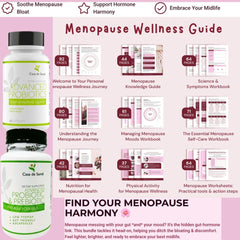
Bloating can occur after you start digestive enzymes, but new or worsening bloating is not something to dismiss as a normal adjustment. The supplement, other ingredients, the meal, or an underlying digestive condition can explain the change; bloating alone does not identify the cause. In 2026, the practical response is to review what changed—not increase the dose or assume discomfort means the enzymes are working.
- Is it normal to feel bloated after starting digestive enzymes? It can happen, but worsening symptoms deserve review.
- Casa de Sante offers physician-formulated Low FODMAP supplements; persistent bloating still needs assessment beyond a product choice.
- Check digestive enzyme ingredients, meal triggers, constipation, and medication changes before adding another supplement.
- Severe abdominal pain, repeated vomiting, or swelling with inability to pass gas requires urgent medical care.
Is it normal to feel bloated after starting digestive enzymes?
Bloating after starting digestive enzymes is possible, but it is not proof of a harmless adjustment period. The timing makes the supplement worth reviewing; it does not establish that the enzyme itself caused the symptom.
Use this sequence to decide what needs attention:
- Check severity. Severe pain, repeated vomiting, or marked abdominal swelling with inability to pass stool or gas needs urgent assessment.
- Identify the product. Separate an over-the-counter supplement from prescribed pancreatic enzyme replacement therapy. Do not independently stop or change prescribed treatment.
- Review the whole formula. Read active ingredients, other ingredients, serving instructions, and warnings—not just the word enzymes.
- Compare the circumstances. Note the meal, dose, timing, bowel pattern, and any medication changes.
- Choose the next step. For a nonessential over-the-counter supplement that clearly worsens symptoms, pause it and discuss the reaction with a pharmacist or clinician.
The guide to how to take digestive enzymes for best results covers the timing question. Correct timing does not make an unsuitable ingredient or unexplained symptom safe to ignore.
Why this matters
The reason you started digestive enzymes matters as much as the reaction. Trouble digesting lactose, constipation, IBS, and pancreatic enzyme insufficiency are different problems; a product intended for one does not automatically address another.
For your 2026 supplement review, separate the goal from the result. If the goal was less bloating and the result is more discomfort, that is a reason to reassess—not evidence that you need a stronger formula.
An enzyme helps break down a particular food component. It does not automatically correct slowed stomach emptying, stool retention, or the heightened sensitivity to gut stretching that can occur with IBS.
Why bloating after digestive enzymes varies
These factors help explain why a supplement helps with one meal but disappoints with another:
- Enzyme–food match. Lactase acts on lactose. An enzyme that does not target the troublesome food component will not solve that digestion problem.
- Additional ingredients. Some formulas include probiotics, prebiotic fibers, or sweeteners. Certain fermentable ingredients can contribute to gas independently of the enzymes.
- Meal composition. A larger meal, carbonated drinks, or a change in fermentable carbohydrates can affect bloating even when the supplement stays the same.
- Dose and timing. Instructions differ between products. Taking extra capsules or taking them separately from the relevant meal is not a reliable way to improve results.
- Bowel pattern. Constipation can contribute to abdominal fullness and bloating. An enzyme does not replace treatment directed at constipation.
- Underlying conditions and medicines. IBS, food intolerances, and medicines that affect gastrointestinal movement can complicate the picture. A symptom that starts near a supplement change still needs context.
Do not treat every episode of bloating as evidence of enzyme deficiency. Symptoms alone cannot establish that diagnosis.
Does the type of digestive enzyme matter?
Yes. A targeted enzyme and a broad digestive blend are not interchangeable, and prescribed pancreatic enzymes have a different clinical role from general digestive supplements.
The comparison below explains intended uses and limitations. It does not identify which treatment you personally need.
| Option | Best for | Potential benefit | Limitation |
|---|---|---|---|
| Lactase | People with lactose intolerance eating lactose-containing foods | Helps break down lactose | Does not treat milk allergy or every cause of dairy-related symptoms |
| Alpha-galactosidase | People whose gas relates to certain carbohydrates in beans and similar foods | Helps break down some gas-producing carbohydrates | Does not digest every FODMAP or address all causes of bloating |
| Multi-enzyme supplement | People reviewing a formula for a specific food-digestion need | Combines enzymes with different targets | More ingredients make an unwanted reaction harder to trace |
| Prescription pancreatic enzyme replacement | People with diagnosed pancreatic enzyme insufficiency | Replaces enzymes needed for digestion | Requires clinician-directed treatment; an OTC blend is not a substitute |
The National Institute of Diabetes and Digestive and Kidney Diseases explains lactase use in its lactose-intolerance guidance and prescription enzyme treatment in its pancreatic-insufficiency guidance. These are condition-specific uses, not a general instruction to take enzymes whenever you feel bloated.
Check the label beyond the enzyme list
A bottle marketed for digestion can contain more than digestive enzymes. Read the complete label before deciding that the reaction comes from the enzyme component.
Look for added inulin, fructooligosaccharides, sugar alcohols, probiotics, and ingredients you already know you do not tolerate. Their presence does not prove they caused your symptoms, but it gives your pharmacist or clinician something specific to review.
Also check allergen information and the serving instructions. Bring the actual container or a clear label photograph to the conversation; a product category alone does not describe the formula.
A Low FODMAP description does not guarantee that every person with IBS will tolerate a supplement. Food sensitivity, ingredient reactions, and the underlying reason for bloating still matter.
What should you do if an OTC enzyme makes you more bloated?
Do not increase the dose to overcome new bloating. First decide whether the product is necessary and whether your symptoms need medical attention.
For a nonessential over-the-counter supplement, pausing it while seeking advice is more useful than adding another digestive product. Keep prescribed medicines unchanged unless your prescriber directs otherwise.
Use this 2026 symptom-review checklist to make the discussion concrete:
- Record the product: exact name, ingredients, serving taken, and when you started.
- Describe the symptom: pressure, visible swelling, pain, gas, nausea, or a combination.
- Record the context: meal contents, capsule timing, bowel movements, and recent medication changes.
- Describe the impact: whether symptoms interrupt eating, sleep, work, or usual activity.
- Note the pattern: whether symptoms occur only after the supplement or also on days without it.
You can rate discomfort from 0 to 10, with 0 meaning no discomfort and 10 meaning the worst discomfort you can imagine. This is a tracking aid, not a diagnostic test or a threshold for deciding whether to seek help.
Avoid changing your diet, enzyme, probiotic, and fiber supplement together. Multiple simultaneous changes make the pattern harder to interpret, and deliberate re-exposure is inappropriate after a suspected allergic reaction.
How long should bloating last after starting digestive enzymes?
There is no single waiting period that makes new bloating acceptable for every digestive enzyme product. Do not rely on a promised adjustment window when symptoms are worsening or disrupting normal activities.
A food-targeted enzyme acts in relation to the food it helps digest. It is not a treatment that must cause increasing gas before it can work.
If mild symptoms settle after you stop a nonessential supplement, tell your clinician what happened before trying it again. Improvement helps describe the pattern, but it does not prove which ingredient was responsible.
Does bloating mean digestive enzymes are working or causing die-off?
Bloating does not demonstrate that digestive enzymes are working, and it does not establish microbial die-off. Digestive enzymes break down food components; they are not automatically antimicrobial treatment.
Do not use a die-off explanation to justify escalating the dose or tolerating progressively worse symptoms. Describe the actual reaction instead: when it started, what you took, and what else changed.
Should you take digestive enzymes if you have IBS, SIBO, or use a GLP-1 medicine?
IBS, SIBO, and GLP-1 treatment require different decisions. The shared symptom of bloating does not make the same supplement appropriate for all of them.
With IBS, discuss meal triggers and bowel patterns with a clinician or dietitian rather than assuming broad enzyme replacement is needed. With suspected SIBO, bloating alone does not confirm the diagnosis, and digestive enzymes do not replace evaluation or indicated treatment.
GLP-1 medicines can slow gastric emptying and cause gastrointestinal symptoms. If fullness, nausea, vomiting, or constipation began after starting treatment or changing the prescribed dose, contact the prescriber; do not adjust the medicine yourself or assume enzymes will correct the problem.
This distinction matters during a 2026 medication review: a new supplement and a recent prescription change can overlap. Your prescriber needs both pieces of information.
Where a Low FODMAP enzyme supplement fits
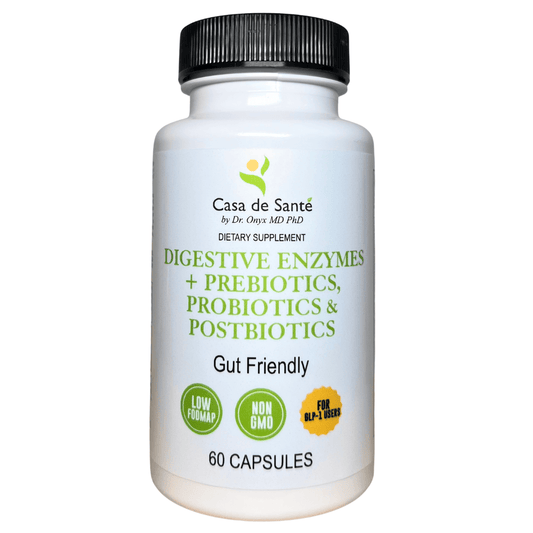
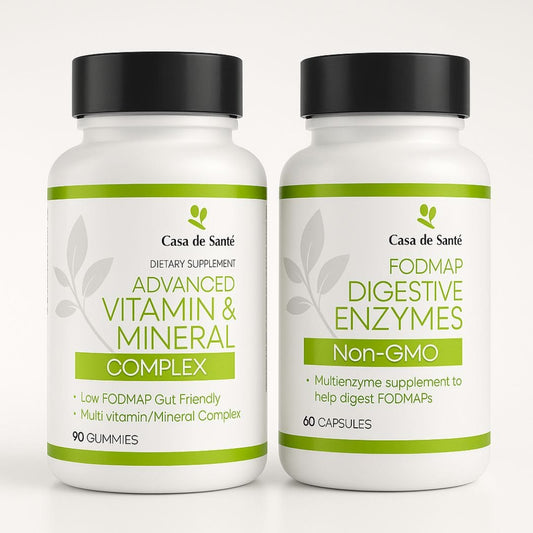
Casa de Sante is best for shoppers seeking physician-formulated Low FODMAP supplements, not a diagnosis for new bloating. Its FODMAP digestive enzymes are relevant to a discussion about supplement selection, but product selection comes after checking the symptom pattern and intended use.
The benefit of considering Casa de Sante digestive enzymes is the brand's focus on Low FODMAP digestive health supplements. The limitation is equally important: that focus cannot establish why you are bloated or guarantee individual tolerance.
Before choosing an enzyme supplement in 2026, review its current label with your pharmacist or clinician. Confirm the food component you are trying to digest, whether the formula addresses it, and whether a supplement is appropriate at all.
When should you get medical help?
Seek urgent medical care for severe or rapidly worsening abdominal pain, repeated vomiting, or a markedly swollen abdomen with inability to pass gas or stool. Trouble breathing or swelling of the lips, tongue, or throat after a supplement requires emergency care.
Arrange medical review for persistent or recurring bloating, unexplained weight loss, blood in the stool, black tarry stools, or ongoing greasy stools. These symptoms deserve assessment rather than repeated changes between digestive supplements.
If you take prescribed pancreatic enzymes, contact the prescribing team about new bloating or inadequate symptom control. Do not replace prescribed treatment with an over-the-counter formula or adjust the prescribed dose independently.
FAQ
Can digestive enzymes make bloating worse?
Bloating can occur after you start a digestive enzyme supplement. Review the full formula, meal, bowel pattern, and medication changes rather than assuming the enzyme itself is the cause.
Should I stop digestive enzymes if they make me bloated?
Pause a nonessential over-the-counter supplement that clearly worsens symptoms and ask a pharmacist or clinician for advice. If the enzymes are prescribed, contact your prescribing team before changing treatment.
How many days should I wait for enzyme bloating to go away?
There is no universal waiting period for bloating after starting digestive enzymes. Worsening symptoms, disrupted eating, or warning signs should prompt assessment rather than waiting for an assumed adjustment period.
Can I take a higher enzyme dose to prevent bloating?
Do not increase an enzyme dose to treat unexplained new bloating. Follow the label or prescription and review whether the product matches the problem you are trying to address.
Is bloating after digestive enzymes a sign of SIBO die-off?
Bloating after digestive enzymes does not establish SIBO die-off. Enzymes help break down food components, and symptoms alone do not confirm SIBO or a response to antimicrobial treatment.
Are Casa de Sante digestive enzymes guaranteed not to cause bloating?
No digestive enzyme supplement is guaranteed to prevent bloating in every person. Casa de Sante's Low FODMAP focus does not replace an individual review of ingredients, symptoms, and the reason for taking enzymes.
Can digestive enzymes replace prescribed pancreatic enzymes?
Over-the-counter digestive enzyme supplements are not substitutes for prescribed pancreatic enzyme replacement therapy. People with diagnosed pancreatic enzyme insufficiency need clinician-directed treatment.
One last thing
The most useful question is not whether bloating is normal; it is whether the enzyme matches a defined need. If you cannot identify the food component or diagnosed condition the product is intended to address, review that before taking more.
Bring the label and your symptom notes to a pharmacist or clinician. A clear account of what changed is more useful than another supplement added on top.