Is it safe to take digestive enzymes long term?






Taking digestive enzymes long term is appropriate for some diagnosed conditions, but daily over-the-counter use is not automatically safe or necessary. Prescription pancreatic enzymes can be essential ongoing treatment for pancreatic enzyme deficiency; supplements for unexplained bloating require a different assessment. The safest long-term plan matches the enzyme to a confirmed need, checks the complete formula, and reviews whether treatment still helps.
- Is it safe to take digestive enzymes long term? Prescription treatment and over-the-counter supplements require different safety assessments.
- Prescription pancreatic enzymes are appropriate ongoing treatment when pancreatic enzyme deficiency requires replacement.
- Casadesante digestive enzymes are an option for people seeking Low FODMAP supplements, not a substitute for pancreatic prescriptions.
- Persistent bloating, weight loss, or greasy stools need assessment rather than an automatically higher enzyme dose.
Why this matters
An enzyme that helps digest a particular food does not establish why you have ongoing symptoms. Bloating also occurs with constipation, IBS, food intolerance, and other conditions that need different management.
Before committing to daily supplements in 2026, separate timing questions from diagnosis questions. The guide to how to take digestive enzymes for best results addresses practical use; deciding whether you need them indefinitely starts with your medical history and symptoms.
Is it safe to take digestive enzymes long term?
Long-term safety depends on the reason for treatment and the exact product—not simply how many months you have taken it. Prescription pancreatic enzyme replacement therapy, or PERT, has an established role in treating exocrine pancreatic insufficiency. That evidence does not establish indefinite safety or effectiveness for every supplement blend sold for digestive comfort.
| Option | Best for | Main advantage | Main limitation |
|---|---|---|---|
| Prescription pancreatic enzymes | People with diagnosed pancreatic enzyme deficiency | Replace enzymes needed for digestion and nutrient absorption | Require individualized prescribing and monitoring |
| Lactase | People with lactose intolerance eating lactose-containing foods | Targets lactose digestion | Does not treat milk-protein allergy or unrelated symptoms |
| Alpha-galactosidase | People seeking help with certain gas-producing carbohydrates | Targets specific carbohydrates in foods such as beans | Does not address every FODMAP or every cause of bloating |
| Multi-enzyme supplements | People considering targeted meal support after reviewing the formula | Combine enzymes with different digestive functions | Evidence and safety cannot be assumed across different blends |
The National Institute of Diabetes and Digestive and Kidney Diseases describes PERT as treatment for exocrine pancreatic insufficiency. FDA-approved pancrelipase labeling addresses dosing, adverse effects, and precautions for prescription products. Neither source supports treating all digestive enzyme products as interchangeable.
For your 2026 decision, identify whether you are replacing a missing digestive function or trying to reduce a symptom. Those are different treatment goals.
Prescription pancreatic enzymes: ongoing replacement when needed
Prescription pancreatic enzymes are appropriate long-term treatment when your pancreas does not supply enough enzymes. Conditions such as chronic pancreatitis, cystic fibrosis, and certain pancreatic operations can create this need.
Your prescriber adjusts treatment around meals, symptoms, nutritional status, and the underlying condition. Do not stop prescribed pancreatic enzymes just because digestion improves. Improvement can show that replacement is working, not that the deficiency has resolved.
Prescription treatment still needs review. Persistent greasy stools, ongoing weight loss, or continued digestive symptoms warrant reassessment of dosing, administration, and other possible causes.
High-dose pancrelipase has been associated with fibrosing colonopathy, particularly in children with cystic fibrosis. This is a reason to follow prescribed dosing—not a reason to abandon medically necessary treatment or assume that every enzyme supplement carries the same risk.
Food-specific enzymes: use tied to the relevant meal
Lactase supports lactose digestion when you eat or drink something containing lactose. Taking lactase with a meal containing no lactose does not address a lactose-related need.
Alpha-galactosidase helps break down certain carbohydrates associated with gas production. It does not digest every fermentable carbohydrate, so continued symptoms do not automatically mean you need more.
Match the enzyme to the food trigger rather than taking it with every meal by habit. If a product reliably helps with a specific food, discuss whether meal-specific use meets your needs better than routine use.
An enzyme is not protection against a food allergy. Lactase does not make milk safe for someone with a milk-protein allergy, and supplements marketed for gluten digestion do not replace a gluten-free diet for celiac disease.
Multi-enzyme blends: assess the whole formula
A blend's safety depends on more than the word enzymes on the front label. Enzyme sources, activity levels, additional ingredients, allergies, and your medication list all matter.
Combination products also make results harder to interpret. If you start enzymes, prebiotics, and probiotics together, an improvement—or worsening bloating—does not identify which component caused the change.
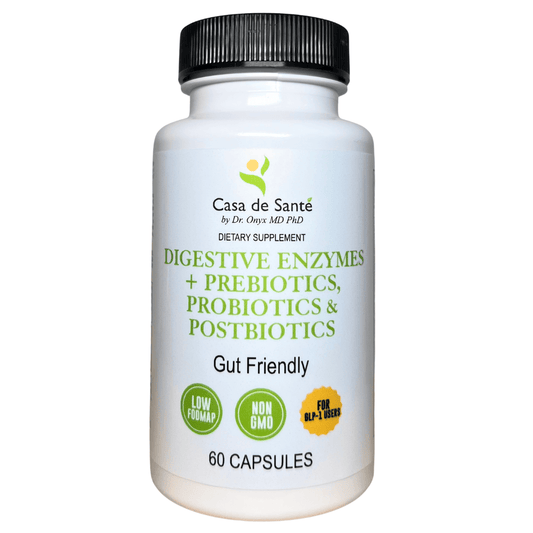
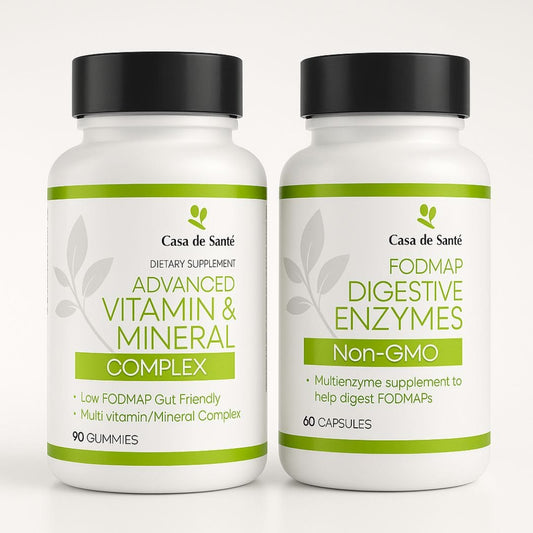
Casadesante offers digestive enzyme supplements for people seeking Low FODMAP options. The following comparison concerns product format, not proof of long-term safety or a recommendation to replace medical treatment.
| Product | Best for | Relevant distinction | Limitation for long-term use |
|---|---|---|---|
| FODMAP Digestive Enzymes | People comparing an enzyme-focused Low FODMAP supplement | The supplied product description states FODMAP Friendly certification, physician formulation, and third-party testing | These attributes do not establish indefinite safety or suitability for your diagnosis |
| FODMAP Digestive Enzymes + Prebiotics + Probiotics + Postbiotics | People specifically considering a combined digestive supplement | Combines enzymes with additional digestive-support ingredients | Multiple components make individual benefits and adverse effects harder to isolate |
Choose a formula because its ingredients fit your needs, not because a longer ingredient list sounds more complete. Review the current label with a pharmacist or clinician before making it a permanent part of your routine.
Why long-term digestive enzyme safety varies
The same daily routine is not appropriate for everyone. Review these factors when deciding whether continued use makes sense in 2026:
- Diagnosis: Confirmed pancreatic insufficiency creates a different need from unexplained bloating or occasional discomfort.
- Enzyme type: Lactase, pancreatic enzymes, and broad blends have different purposes and evidence.
- Dose and activity: Capsule count alone does not describe enzyme strength. Activity units and instructions matter.
- Additional ingredients: Herbs, acidifying ingredients, prebiotics, and probiotics require their own safety assessment.
- Personal risks: Allergies, pregnancy, breastfeeding, other illnesses, and prescription medicines affect suitability.
- Treatment response: Continued symptoms or new adverse effects call for reassessment, not automatic dose escalation.
A product you tolerate today still deserves review when your medication, symptoms, or health status changes. Long-term use should remain a deliberate decision.
How do you decide whether to continue digestive enzymes?
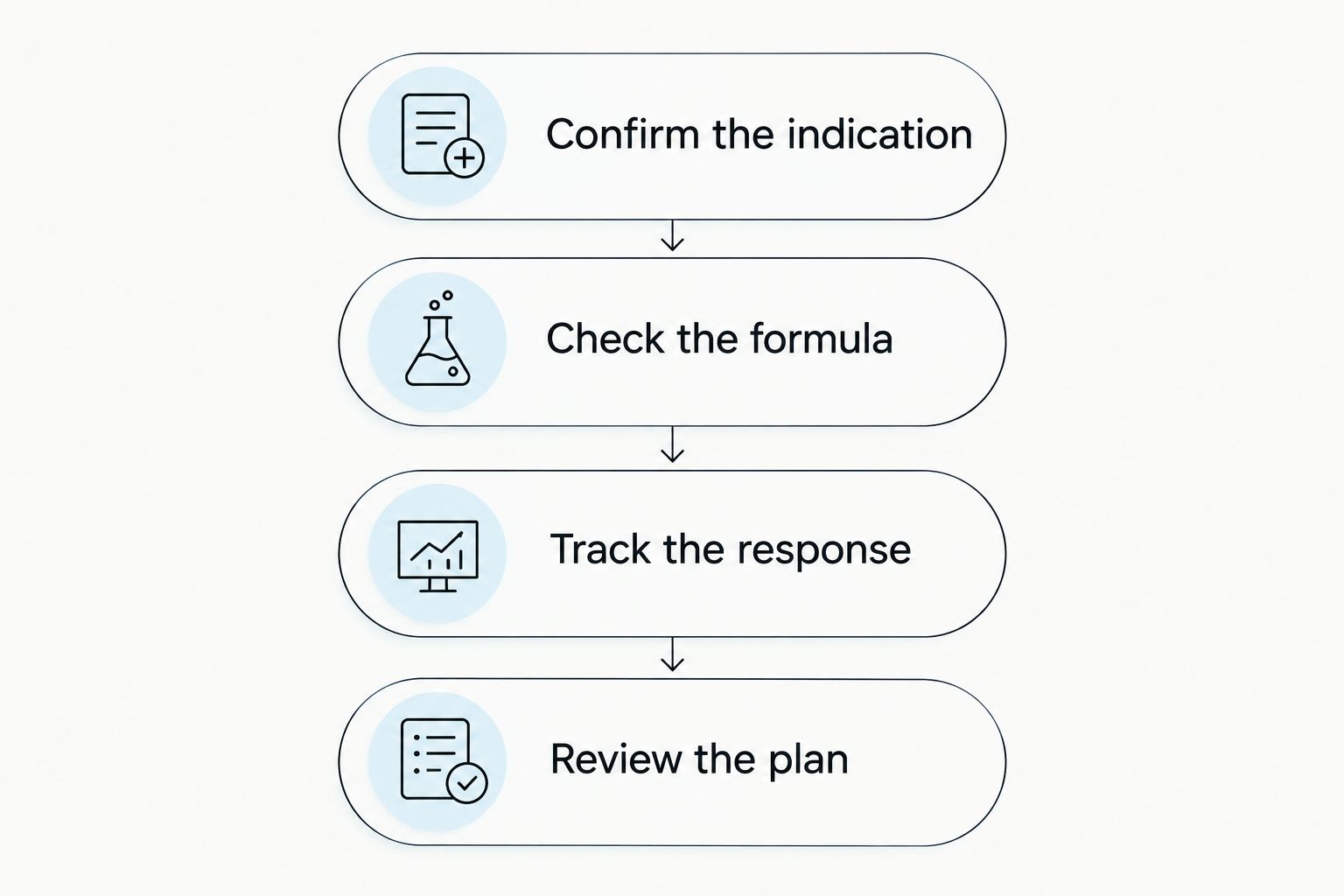
Use a structured review rather than repeatedly renewing a supplement without checking its purpose. Bring the container or a clear photograph of the complete label to your appointment.
- Confirm the indication. State what you are treating: diagnosed enzyme deficiency, a specific food intolerance, or symptoms without a confirmed cause.
- Check the formula. Review enzyme sources, activity units, allergens, other ingredients, and overlapping supplements with a clinician or pharmacist.
- Track the response. Record the meal, product use, digestive symptoms, and stool changes. Keep unrelated changes limited so the pattern remains interpretable.
- Review the plan. Agree on whether to continue, change, or stop a nonprescription product. Keep prescribed treatment changes with your prescriber.
Choose an outcome that matters to you, such as less discomfort after a known trigger meal or improved stool consistency. A vague feeling that you should take something is not evidence that the product is helping.
For your 2026 supplement review, include protein powders and combination gut-health products. Enzymes can appear in more than one formula, making total exposure less obvious.
When do digestive symptoms need testing instead?
Persistent symptoms deserve assessment when they continue despite sensible dietary changes or supplement use. Greasy stools, unexplained weight loss, and signs of poor nutrient absorption are particularly important to report.
The American Gastroenterological Association's clinical practice update on exocrine pancreatic insufficiency identifies fecal elastase as an initial test. Its interpretation includes these findings:
- Below 100 micrograms per gram of stool: Good evidence of exocrine pancreatic insufficiency in the appropriate clinical setting.
- 100–200 micrograms per gram of stool: An indeterminate result that needs clinical interpretation.
- Above 200 micrograms per gram of stool: Generally outside the range suggesting pancreatic insufficiency, but not a diagnosis of another condition or an explanation for every symptom.
The sample should be semi-solid or solid; watery stool can complicate interpretation. Your clinician interprets results alongside symptoms, risk factors, and other investigations.
Feeling better after taking enzymes does not diagnose pancreatic insufficiency. The same AGA guidance states that response to a therapeutic enzyme trial is unreliable for establishing that diagnosis.
Do digestive enzymes make your body stop producing its own?
Digestive enzymes do not have an established addictive effect. The practical distinction is between a continuing medical need and a habit that no longer has a clear benefit.
When symptoms return after stopping prescribed PERT, the original enzyme deficiency can explain the change. Do not interpret that recurrence as proof that treatment damaged your pancreas.
Can you take digestive enzymes every day for IBS or SIBO?
Daily enzyme use is not a universal treatment for IBS or SIBO. A food-specific enzyme can address a particular carbohydrate, but it does not establish or eliminate either diagnosis.
For IBS, discuss your symptom pattern and dietary triggers with your clinician or dietitian. For suspected SIBO, seek an appropriate assessment rather than using supplement response as a diagnostic test.
What if symptoms started after a GLP-1 medication?
Digestive enzymes are not an established treatment for medication-related delayed gastric emptying. If symptoms began after starting or increasing Ozempic, Wegovy, or Mounjaro, contact your prescriber about the medication and symptom-management plan.
Severe or persistent abdominal pain, repeated vomiting, or inability to keep fluids down needs prompt medical assessment. Adding supplements must not delay that assessment.
FAQ
Is it safe to take digestive enzymes long term?
Long-term digestive enzyme use is appropriate for some diagnosed conditions, but over-the-counter supplements need individual review. Safety depends on the enzyme, dose, other ingredients, medical history, and reason for taking it.
Can I take digestive enzymes with every meal?
Take digestive enzymes with every meal only when that matches your prescription or an appropriate product-use plan. Food-specific enzymes are relevant to meals containing the substance they help digest.
Do I need to cycle digestive enzymes or take breaks?
There is no universal cycling schedule for digestive enzymes. Do not interrupt prescribed pancreatic enzyme replacement without discussing it with your prescriber; review nonprescription use according to need and response.
Can digestive enzymes cause side effects?
Digestive enzyme products can cause adverse effects, including digestive symptoms or allergic reactions, depending on the formula. Stop a nonprescription product and seek advice if symptoms worsen; breathing difficulty or facial swelling requires emergency care.
Can I take digestive enzymes while pregnant or breastfeeding?
Review digestive enzyme use with your maternity clinician before starting a nonprescription product during pregnancy or breastfeeding. Do not stop medically necessary prescription enzymes without advice.
Are Low FODMAP digestive enzymes proven safe forever?
Low FODMAP status does not prove lifelong safety. Casadesante digestive enzymes still require review for individual suitability, dose, additional ingredients, and continued benefit.
What symptoms mean I should get medical help instead of taking more enzymes?
Severe abdominal pain, repeated vomiting, black or bloody stools, jaundice, or dehydration require prompt medical attention. Unexplained weight loss and persistent greasy stools also warrant assessment rather than escalating supplements.
One last thing
Symptom relief is not a diagnostic test. An enzyme can appear helpful without proving that your pancreas is deficient, that SIBO is present, or that indefinite supplementation is necessary.
At your next 2026 medication review, ask: What is this treating, how will we judge benefit, and what would change the plan? Those answers are more useful than a universal deadline for stopping.
This article provides general education, not an individualized treatment plan. Keep decisions about prescribed enzyme replacement with your treating clinician.