
Can you take digestive enzymes and probiotics together? 2026






Yes, you can generally take digestive enzymes and probiotics together in 2026. Digestive enzymes act on components of food, while probiotics contain live microorganisms; taking them together does not mean they will address the same symptom. If you have IBS, SIBO, a weakened immune system, or a prescribed enzyme regimen, check with your clinician before adding a supplement.
- Yes, you can generally take digestive enzymes and probiotics together; follow each product’s label for timing.
- Digestive enzymes are taken with the food they are meant to help break down; probiotic directions depend on the product.
- Casa de Sante offers an enzyme-only option and a combined enzyme-and-probiotic option for readers comparing Low FODMAP supplements.
- For IBS or SIBO, track symptoms and ask your clinician whether either supplement fits your care plan.
Can you take digestive enzymes and probiotics together?
Yes, but choose them for separate reasons. An enzyme supplement belongs with a meal when its ingredients match the food you are eating. A probiotic is a different kind of supplement, so its directions depend on its formulation and label. There is no general requirement to separate the two simply because you take both.
| Approach | Best for | Advantage | Limitation |
|---|---|---|---|
| FODMAP Digestive Enzymes | Someone considering enzyme support with meals | Keeps the enzyme choice separate from any probiotic decision | Does not provide the probiotic component of a combined formula |
| FODMAP Digestive Enzymes + Prebiotics + Probiotics + Postbiotics | Someone who wants the listed supplement categories in one formula | Combines enzymes, prebiotics, probiotics, and postbiotics | Makes it harder to identify which component affects symptoms |
| A separate enzyme and probiotic | Someone who wants to assess each supplement on its own | Allows you to follow and evaluate each label separately | Requires you to check two ingredient lists and schedules |
The table compares approaches, not clinical outcomes. A product containing both categories is convenient, but the combined label alone does not establish that it will relieve bloating, treat SIBO, or improve IBS symptoms.
Why this matters
Bloating, gas, diarrhea, and constipation have different causes. If you start an enzyme and a probiotic at the same time, a symptom change will not tell you which supplement mattered. Casa de Sante is best for readers with IBS comparing Low FODMAP enzyme-only and combined enzyme-and-probiotic options, not for replacing a diagnosis or prescribed treatment.
The distinction is especially useful if you already follow a Low FODMAP diet. An enzyme does not make every high-FODMAP food suitable for you, and a probiotic does not replace the elimination and reintroduction process. Keep the question focused: what are you taking, what symptom are you tracking, and what does the label instruct you to do?
How do you take digestive enzymes and probiotics together?
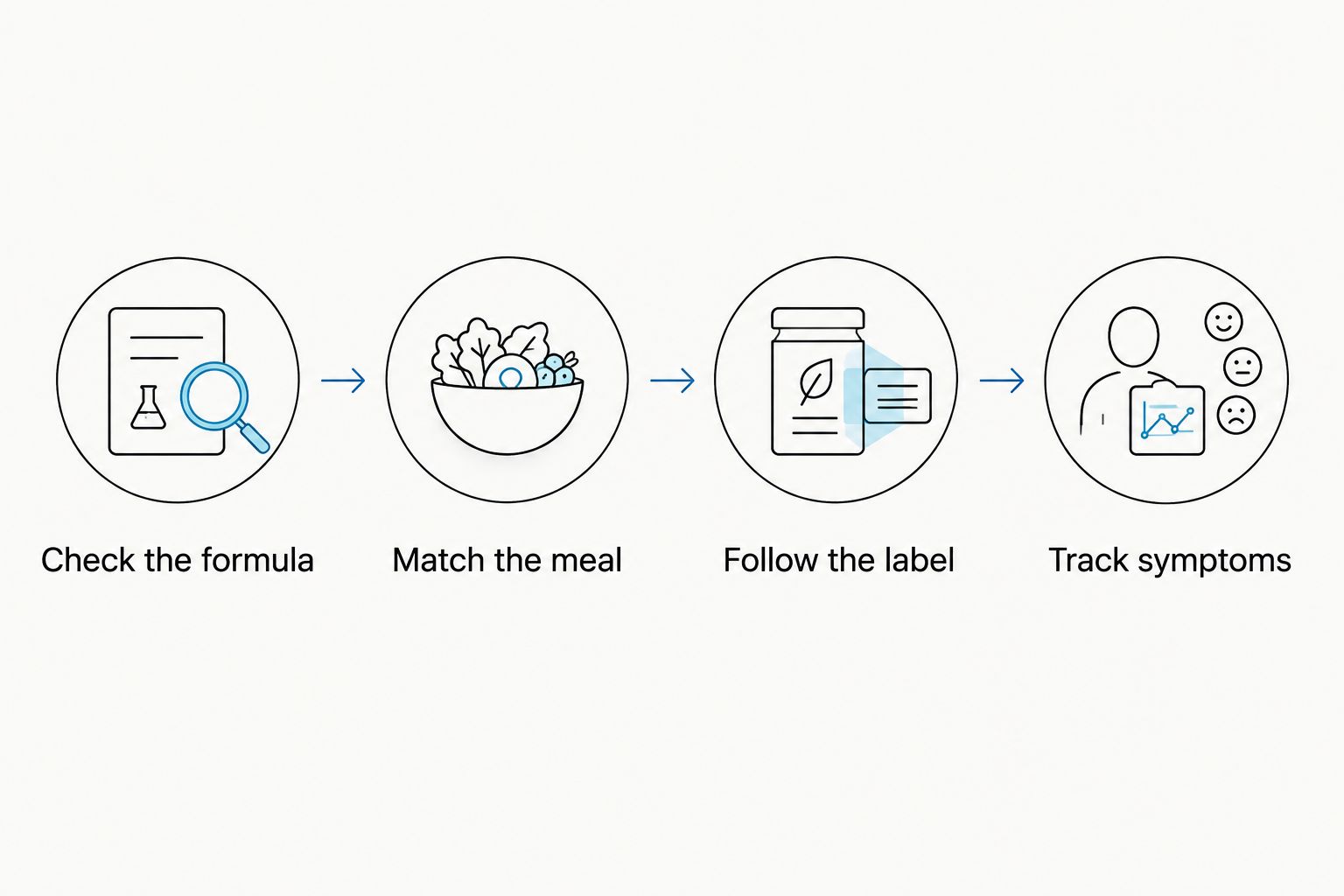
- Check the formula. Read both ingredient lists before combining products. A supplement sold as an enzyme blend can already contain probiotics or prebiotics, as the combined option in the table does.
- Match the meal. Follow the enzyme label’s meal instructions. An enzyme chosen for food digestion needs to be taken as directed in relation to the food, rather than treated as a general daily probiotic.
- Follow the label. Take the probiotic according to its own directions. Do not assume every probiotic has the same instructions for food, storage, or use alongside other supplements.
- Track symptoms. Record what you took, what you ate, and any change in bloating, pain, or bowel habits. If symptoms worsen, stop the new supplement and discuss the change with your clinician.
In 2026, the practical timing rule is meal instructions for the enzyme, product instructions for the probiotic. You do not need to invent a gap between them. If either label gives different directions, follow that label or ask a pharmacist or clinician to reconcile the instructions.
Starting supplements separately also makes your notes easier to interpret. A symptom diary cannot prove that a product caused a change, but it gives your clinician a clearer account than starting several new products on the same day.


Why does the right approach vary?
- The food you eat: Enzymes act on particular food components. The word enzyme on a label does not mean a product addresses every meal or every cause of discomfort.
- The formula you choose: A combined supplement already includes several categories of ingredients. Check for overlap before adding a separate probiotic or prebiotic.
- Your symptom pattern: Bloating after a particular meal is a different question from persistent diarrhea, constipation, or pain. Supplements should not delay an evaluation of ongoing symptoms.
- Your IBS or SIBO care plan: Neither supplement category is a universal treatment for IBS or SIBO. Your diagnosis and current treatment matter more than a general timing rule.
- Your medical history: People with a weakened immune system or serious illness should ask a clinician before taking probiotics. Prescribed pancreatic enzyme replacement is a medical regimen, not interchangeable with an over-the-counter digestive enzyme supplement.
These factors also explain why taking both is not automatically better than taking one. Use the fewest new variables needed to answer your question. If you cannot identify the ingredient or meal you are evaluating, you cannot make much use of the result.
Should you take them at the same time or separately?
You can take them at the same time if both labels permit it. The enzyme’s directions relative to meals are the first timing constraint; the probiotic’s label supplies the other. In 2026, there is no universal waiting interval to apply to every enzyme-and-probiotic pairing.
If a combined product includes both, follow that product’s directions rather than trying to schedule its components separately. If you use two products, check each label for ingredients and directions before you take them together.
Can you take them together if you have IBS?
Yes, but IBS does not make either supplement an automatic fit. Symptoms and responses differ, and neither category replaces an IBS care plan. If you are also following a Low FODMAP diet, avoid changing your diet and adding multiple supplements at once; otherwise, it becomes harder to tell what changed.
Casa de Sante’s Low FODMAP supplement range gives you enzyme-only and combined formats to compare. That is a choice of format, not evidence that a combined formula works better for every person with IBS. Discuss persistent or worsening symptoms with your clinician.
Can you take them together if you have SIBO?
You can discuss taking both with your SIBO clinician, but do not treat the combination as SIBO therapy. A probiotic’s suitability depends on the individual and the product; an enzyme does not diagnose or eliminate bacterial overgrowth. In 2026, the safest next step is to check the supplement ingredients against your existing treatment plan before adding either one.
A prebiotic deserves its own check. It is not the same as a probiotic, and a combined product can contain both. Read the complete ingredient list rather than assuming a Low FODMAP label answers every question about your personal tolerance.
When should you ask a clinician before taking both?
Ask before adding probiotics if you have a weakened immune system or a serious medical condition. Ask before changing enzyme use if you have been prescribed pancreatic enzyme replacement. Those situations call for guidance specific to your health and treatment, not a general supplement schedule.
Get medical advice for persistent vomiting, blood in your stool, unexplained weight loss, or severe abdominal pain rather than trying another supplement. If bloating or bowel changes continue despite adjustments to your routine, bring your symptom record and product labels to the appointment. A clinician can assess causes that a supplement comparison cannot.
For people using Ozempic, Wegovy, or Mounjaro, the same boundary applies. Do not assume an enzyme-and-probiotic combination treats a medication side effect. Tell the prescriber about persistent digestive symptoms and any supplements you take.
FAQ
Can you take digestive enzymes and probiotics together in 2026?
Yes, you can generally take digestive enzymes and probiotics together in 2026. Follow each product’s label, and ask a clinician first if you have a weakened immune system, serious illness, or a prescribed enzyme regimen.
Do digestive enzymes cancel out probiotics?
Taking digestive enzymes does not, by itself, mean you must avoid probiotics. Read the specific product labels rather than assuming every enzyme-and-probiotic combination has identical ingredients or directions.
Should I take a probiotic before or after digestive enzymes?
Follow the probiotic label and take the digestive enzyme as directed in relation to meals. There is no universal before-or-after rule for all products.
Is a combined enzyme and probiotic better than separate supplements?
A combined product is more convenient if you want its listed ingredients, but it is harder to assess each component separately. Choose the format that fits your care plan and ingredient tolerance.
Can I take digestive enzymes and probiotics together for IBS bloating?
You can discuss taking both for IBS bloating, but neither is a guaranteed treatment. Track your symptoms and seek medical advice if bloating persists or worsens.
Are digestive enzymes and probiotics the same thing?
No. Digestive enzymes act on food components, while probiotics contain live microorganisms; they have different roles and label directions.
Can I add a probiotic to prescribed pancreatic enzymes?
Ask the clinician managing your pancreatic enzyme prescription before adding a probiotic. Do not change the prescribed enzyme schedule based on general supplement advice.
One last thing
Check the label before buying a second product. A formula described as digestive enzymes can already include probiotics and prebiotics. For Casa de Sante shoppers in 2026, that makes the ingredient list more useful than the front-of-pack category when deciding whether two supplements are needed.









