
Can digestive enzymes cause constipation? Yes | 2026






Yes, digestive enzymes can cause constipation, and constipation is a listed side effect of prescription pancrelipase; over-the-counter supplements do not all have the same ingredients or side-effect profile. Constipation after starting an enzyme does not prove the enzyme caused it, because medications, reduced food intake, and an existing bowel disorder can also explain the change. This 2026 guide explains how to assess the connection, what to do next, and which symptoms need medical attention.
- Can digestive enzymes cause constipation? Yes; MedlinePlus lists constipation as a possible side effect of prescription pancrelipase.
- Over-the-counter digestive enzymes differ; a prescription side effect does not establish the risk of every supplement.
- Casa de Sante digestive enzymes support meal-related digestion; they are not a substitute for constipation treatment.
- Review new constipation with a clinician; do not stop prescribed pancreatic enzymes on your own.
Can digestive enzymes cause constipation?
Yes, but the answer depends on the enzyme product and your circumstances. MedlinePlus drug information lists constipation among pancrelipase side effects. That finding applies to the prescription medicine, not automatically to every digestive supplement.
For an over-the-counter option such as FODMAP Digestive Enzymes, assess the actual label rather than assuming all enzyme products behave alike.
| Enzyme category | Best for | Main benefit | Limitation when constipation occurs |
|---|---|---|---|
| Prescription pancreatic enzymes | People with diagnosed pancreatic enzyme insufficiency | Replace enzymes needed to digest food | Constipation is a listed pancrelipase side effect; changes need prescriber guidance |
| Targeted enzymes, such as lactase | People with a matching food-digestion problem | Help digest a specific food component | Do not treat slow bowel transit or general constipation |
| Multi-enzyme supplements | People evaluating meal-related digestive symptoms with professional guidance | Combine enzymes directed at different food components | Formulas vary, and a new bowel symptom needs assessment |
The important distinction is a recognized drug side effect versus an individual symptom after taking a supplement. Both deserve attention, but neither justifies assuming that every digestive enzyme causes constipation.
Timing is evidence to discuss, not a diagnosis. A bowel change beginning after a new product strengthens the reason to review that product, particularly if you also changed your meals or medications.
Why this matters
Food breakdown and bowel movement are different jobs. An enzyme can help digest a food component without correcting hard stools, difficult evacuation, or slow movement through the intestine.
That distinction matters if you have IBS with constipation, symptoms attributed to SIBO, or digestive problems while taking a GLP-1 medication. Adding enzymes because you feel bloated does not establish that an enzyme deficiency caused the bloating.
For your 2026 supplement review, separate the original problem from the new one: what were you trying to improve, and what changed afterward? Less post-meal discomfort does not cancel out new straining or harder stools.
NIDDK describes constipation as including fewer than 3 bowel movements per week, hard or lumpy stools, difficult or painful passage, or a feeling that stool remains. You can therefore have constipation even when you still have a bowel movement each day.
Prescription pancreatic enzymes: review changes with your prescriber
Prescription pancreatic enzymes treat a diagnosed digestion problem, such as exocrine pancreatic insufficiency. They are not interchangeable with general digestive supplements.
MedlinePlus identifies constipation as a possible pancrelipase side effect. It also describes other gastrointestinal symptoms, so a new bowel complaint needs a medication review rather than a guess about what is happening.
Do not stop or adjust prescribed pancreatic enzymes without your prescriber's guidance. Inadequately treated enzyme insufficiency can interfere with digestion and nutrient absorption.
Tell your prescriber whether the constipation followed treatment initiation, a dose change, or a change in how you take the medicine with meals. Bring the exact product name and directions; capsule count alone does not describe enzyme activity.
The benefit of prescription therapy is treatment of a documented need. Its limitation is that side effects and dosing questions require clinical management, not substitution with an over-the-counter product.
Over-the-counter enzymes: assess the whole formula
Over-the-counter digestive enzymes vary in their enzyme ingredients, activity, and additional components. A symptom associated with one formula does not establish the same response to another.
Check whether the product contains only enzymes or also includes prebiotics, probiotics, minerals, or other ingredients. A combination formula makes it harder to identify which component coincided with a bowel change.
Casa de Sante digestive enzymes are best suited to people seeking Low FODMAP meal-related digestive support, not a replacement for constipation care. The brand's FODMAP Digestive Enzymes product is described as FODMAP Friendly certified, physician-formulated, and third-party tested; those attributes do not establish that an individual cannot experience constipation.
A Low FODMAP claim is not a bowel-motility claim. It does not show that a supplement softens stool, treats IBS-C, or prevents adverse effects.
The practical advantage of a simpler formula is easier ingredient review. The limitation remains the same: an enzyme supplement is not an established general treatment for constipation, and you should not keep increasing it to chase a bowel movement.
Why constipation after digestive enzymes varies
The useful question is not just whether enzymes can cause constipation. It is which changes explain your symptoms and which require action.
- Product category: Prescription pancrelipase has a documented constipation side effect. An over-the-counter blend needs its own ingredient review rather than borrowing a prescription medicine's risk profile.
- Additional ingredients: Combination products introduce more variables. If several ingredients are new, the timing alone cannot identify the responsible component.
- Other medications: Opioids, some anticholinergic medicines, and iron supplements can contribute to constipation. GLP-1 medications also list gastrointestinal adverse effects, including constipation.
- Food and fluid intake: Eating less, reducing fiber-containing foods, or becoming dehydrated can change stool consistency and frequency. These changes can coincide with starting a supplement.
- Existing bowel problems: IBS-C, pelvic-floor evacuation problems, and other medical conditions can cause constipation independently of enzyme use. Persistent symptoms need assessment of the underlying problem.
For a 2026 medication review, include nonprescription supplements alongside prescriptions. A clinician cannot assess the full picture from the enzyme bottle alone.
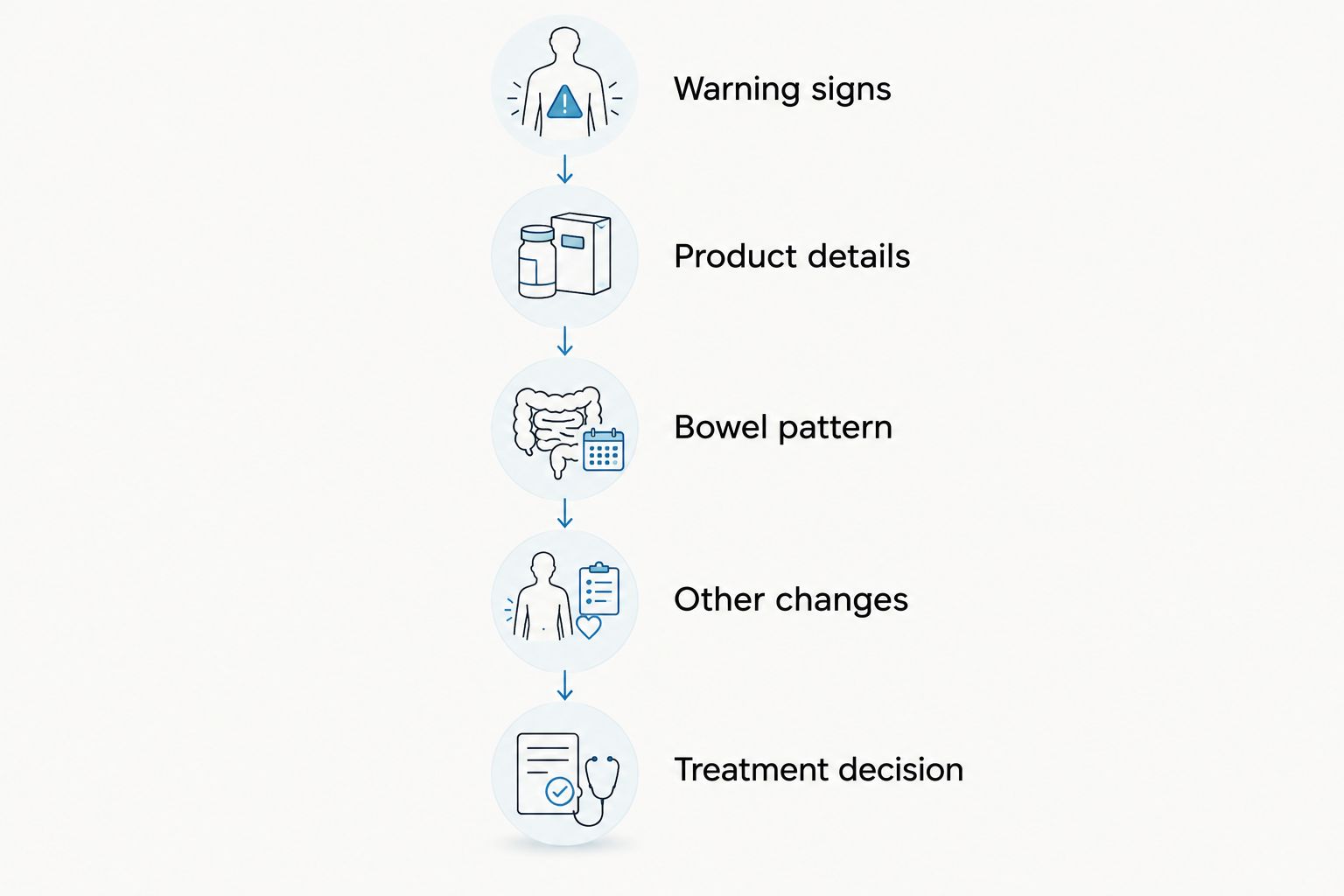
What should you do if constipation starts after enzymes?
Start with safety, then review the timeline. Do not use repeated supplement changes as a substitute for evaluating severe or persistent symptoms.
1. Check for warning signs
Seek urgent medical assessment for constipation with severe or constant abdominal pain, repeated vomiting, marked abdominal swelling, or inability to pass gas. These symptoms can signal a problem that needs more than home treatment.
Blood in the stool, rectal bleeding, unexplained weight loss, fever, or constipation that persists despite self-care also needs medical evaluation. Do not assume a new supplement explains those symptoms.
2. Identify exactly what you started
Record the full product name, ingredient list, serving directions, and whether the product is prescribed. Include any recent changes in the amount taken or the meals taken with it.
Photograph the label for your appointment. This is more useful than describing the product only as a digestive enzyme, because formulas and enzyme activity differ.
3. Compare your bowel pattern
Record stool consistency, straining, incomplete emptying, and bowel frequency before and after the change. Include abdominal pain and whether you can pass gas.
The Bristol Stool Form Scale has 7 stool types; types 1 and 2 describe hard stools commonly associated with constipation. Stool form adds useful information that a count of bathroom visits misses.
4. Review other changes
List new medicines, dose changes, reduced meals, dietary restrictions, travel, and changes in fluid intake. Include products marketed for gut health, not only the enzyme under suspicion.
If you take Ozempic, Wegovy, or Mounjaro, tell the prescribing clinician about constipation and any recent treatment change. Do not assume that a supplement must be responsible simply because it was the last thing you noticed.
5. Ask about the next treatment decision
For a nonessential over-the-counter supplement, ask a pharmacist or clinician whether to pause it while assessing the symptoms. For prescribed enzymes, contact the prescriber before changing treatment.
Avoid deliberately restarting a product to reproduce a severe reaction. Improvement after stopping a supplement can inform the review, but it does not by itself prove causation.
A useful 2026 symptom record connects the product, bowel changes, and other exposures. Keep the record focused; its purpose is to support a treatment decision, not to delay care.
What actually helps constipation?
Treat constipation as a bowel problem, not automatically as a digestion problem. The appropriate treatment depends on stool consistency, medications, medical history, and whether evacuation itself is difficult.
NIDDK gives a general adult fiber target of 22–34 grams per day, depending on age and sex. Increase fiber gradually rather than making a sudden jump, especially if you already experience substantial gas or bloating.
That range is general guidance, not a prescription for every person with IBS, a restricted diet, or a motility disorder. Ask a clinician or registered dietitian how to meet your needs without worsening symptoms.
Drink enough fluid to avoid dehydration, while respecting any medical fluid restriction. Regular activity and responding to the urge to have a bowel movement are also part of standard constipation self-care.
A clinician or pharmacist can advise whether a constipation-specific medicine is appropriate. The 2023 American Gastroenterological Association and American College of Gastroenterology guideline supports polyethylene glycol for chronic idiopathic constipation; that recommendation does not replace evaluation of warning signs or establish the right treatment for every patient.
Do not add several remedies at once without guidance. Changing enzymes, fiber, probiotics, and laxatives together makes it harder to understand both benefit and adverse effects.
Can digestive enzymes help IBS-C constipation?
Digestive enzymes are not an established general treatment for IBS-C constipation. A targeted enzyme can address a matching food-digestion issue, but that is separate from treating hard stools or difficult evacuation.
If constipation is your main complaint, focus the appointment on your bowel pattern and abdominal symptoms. Relief of meal-related gas does not prove that the constipation has improved.
For people managing IBS-C in 2026, a useful plan distinguishes food triggers from stool passage. Both can matter, but they need different treatment decisions.
Is the enzyme or my GLP-1 medication causing constipation?
Either deserves review, but timing alone cannot identify the cause. FDA prescribing information for Ozempic, Wegovy, and Mounjaro lists constipation among gastrointestinal adverse reactions.
Reduced food intake and changes in hydration can also accompany treatment. Share the injection schedule, dose changes, enzyme start date, and bowel symptoms with the prescribing clinician.
Do not stop a prescribed GLP-1 medication on your own or assume enzymes will reverse its effects. Severe abdominal symptoms or inability to pass gas require prompt assessment rather than a supplement adjustment.
Should I switch to probiotics if enzymes make me constipated?
Switching automatically to probiotics is not a reliable way to treat constipation. Probiotics differ by strain and formulation, and they are not interchangeable with either enzymes or constipation medicines.
If your current product combines several ingredients, first review what changed and why you were taking it. A different blend introduces new variables without necessarily addressing the bowel problem.
Casa de Sante offers digestive health supplements for people managing sensitive digestion, but choosing another supplement should follow the symptom assessment. Match the intervention to the problem instead of rotating through products.
FAQ
Can digestive enzymes cause constipation even if they are Low FODMAP?
Yes, a Low FODMAP claim does not rule out constipation or other individual adverse effects. Review the specific formula, other medications, and the timing of symptoms rather than treating the claim as a guarantee.
How do I know whether digestive enzymes caused my constipation?
Timing provides a clue, not proof. A clinician can review the product, other changes, and whether symptoms improve after a medically appropriate pause or adjustment.
Should I stop digestive enzymes if I get constipated?
Do not stop prescribed pancreatic enzymes without contacting your prescriber. If the product is a nonessential over-the-counter supplement, ask a pharmacist or clinician whether to pause it while assessing symptoms.
How many bowel movements count as constipation?
Fewer than 3 bowel movements per week is one sign of constipation, according to NIDDK. Hard stools, straining, painful passage, and incomplete emptying also matter, even with daily bowel movements.
Will taking more digestive enzymes help me have a bowel movement?
Increasing digestive enzymes is not an established treatment for constipation. Follow prescribed or labeled directions and seek advice about treatment aimed at stool consistency and bowel function.
Can I take digestive enzymes while using Ozempic or Wegovy?
Ask your prescribing clinician or pharmacist to review the specific enzyme formula and your symptoms. Ozempic and Wegovy themselves list constipation as an adverse reaction, so enzymes should not replace a medication review.
When is constipation after a supplement an emergency?
Seek urgent assessment for severe abdominal pain, repeated vomiting, marked swelling, or inability to pass gas. Do not wait to see whether another dose or a different supplement resolves those symptoms.
One last thing
A daily bowel movement does not rule out constipation. Hard stool, painful straining, and incomplete emptying can reveal a problem that frequency alone hides.
When you review a Casa de Sante supplement—or any digestive product—judge bowel comfort and stool passage separately from post-meal bloating. The most useful next move is to document the change and address the symptom, not assume that less gas means better bowel function.









