Is rice protein low FODMAP?





Rice protein can fit a low FODMAP diet, but the finished powder and serving size determine whether a particular product is suitable. Rice on the ingredient list is not proof that every scoop is low FODMAP. Choose a powder with product-specific low FODMAP testing when possible, and check added fibers, sweeteners, and smoothie ingredients before using it for IBS.
- Is rice protein low FODMAP? It can be, but the finished formula and tested serving determine suitability.
- Plain rice protein and flavored protein blends need separate ingredient checks; neither name guarantees low FODMAP status.
- Casa de Sante low FODMAP protein powders still require serving, ingredient, and personal-tolerance checks.
- Inulin, chicory root, and certain sugar alcohols deserve attention when choosing an IBS-friendly protein shake.
Why this matters
A protein powder can look suitable because it is vegan, dairy-free, or gluten-free and still contain ingredients that trigger your symptoms. Those labels answer different questions from a low FODMAP assessment. Judge the finished formula, not the dietary claims on the front.
That distinction applies across plant proteins. If you are comparing rice with legumes, the guide to whether pea protein is low FODMAP addresses a separate ingredient question; do not transfer a conclusion about one protein source to another.
For your 2026 shopping decisions, use the current package rather than an old review or a photograph of a previous formula. The ingredient list, serving information, and any testing statement need to describe the powder you will actually drink.
Is rice protein low FODMAP?
Rice protein is not automatically high FODMAP, but its name alone does not establish a low FODMAP serving. FODMAPs are carbohydrates, not protein. Processing changes the balance of protein and other components, while added ingredients change the finished product again.
Use the following distinctions when assessing a powder. These are label-reading categories, not laboratory results for every product in the category.
| Rice protein format | Best for | Practical advantage | Limitation |
|---|---|---|---|
| Plain rice protein powder | People who want a short ingredient list | Fewer ingredients to investigate | A simple formula does not establish a tested low FODMAP portion |
| Flavored rice protein powder | People who prefer a ready-flavored shake | No separate flavoring is necessary | Added fibers and sweeteners require review |
| Rice-containing protein blend | People choosing a mixed-source protein | Combines different protein ingredients | Every ingredient and the finished serving need assessment |
A nutrition panel showing little carbohydrate is relevant, but it is not a FODMAP test. The panel does not identify the amount of each fermentable carbohydrate. Likewise, an ingredient list cannot tell you the exact FODMAP content of an untested serving.
For a 2026 purchase, look for a current low FODMAP certification or a clear testing statement that identifies the product and portion. Do not turn a general statement about rice into a precise scoop recommendation.
Plain rice protein: fewer ingredients to assess
Plain rice protein is the simplest starting point for reading a label because there are fewer additions to investigate. That makes comparison easier. It does not make the product automatically suitable for every person with IBS.
Check whether the label lists rice protein alone or includes other ingredients. The words brown rice, organic, sprouted, or natural do not establish FODMAP content. They describe sourcing or processing rather than a tested tolerance threshold.
Best for: someone who wants to evaluate a straightforward formula without several flavoring ingredients. The limitation is uncertainty: without product-specific testing, there is no defensible universal serving to recommend.
Flavored rice protein: assess the additions
A flavored powder needs a separate assessment from its plain counterpart. Vanilla or chocolate wording does not tell you the full formula. Read the ingredient list for added carbohydrates, fibers, milk ingredients, and sweeteners.
Inulin and chicory root are sources of fructans. Sugar alcohols such as sorbitol and mannitol are polyols, another FODMAP group. Their presence deserves attention, particularly during an elimination phase; ingredient quantity and the portion consumed still matter.
Best for: someone who prefers a flavored drink and has checked the complete formula. The trade-off is a longer ingredient list, which makes identifying the cause of a reaction harder.
Rice protein blends: check every protein source
A rice-containing blend is not nutritionally or digestively identical to plain rice protein. It includes other ingredients that need their own review. A low FODMAP claim about an individual component does not establish the status of the mixture.
Check the blend's complete formula, its stated portion, and any product-specific testing. Do not assume that the first protein listed determines everything else in the tub.
Best for: someone whose dietary preferences favor a mixed-source powder. The limitation is that the word rice gives you only part of the information needed to choose it.
Why rice protein tolerance varies
Your symptoms depend on more than the source of protein. Keep these factors separate when evaluating a shake:
- Finished formula: added ingredients change what you consume beyond rice protein itself.
- Serving size: a suitability statement for a specified portion does not cover an unlimited amount.
- Added fibers: inulin and chicory root contribute fermentable carbohydrates.
- Sweetener choice: sorbitol and mannitol need different consideration from ordinary table sugar.
- Mixing ingredients: milk, fruit, and other additions change the shake's overall FODMAP load.
- Individual response: a low FODMAP designation does not guarantee freedom from every digestive symptom.
Avoid treating every thickener, gum, or unfamiliar ingredient as a FODMAP. Ingredient names alone do not justify a blanket exclusion. Excessive restriction makes it harder to maintain a varied diet and can distract you from the ingredients that actually matter.
How do you choose a rice protein powder for IBS?
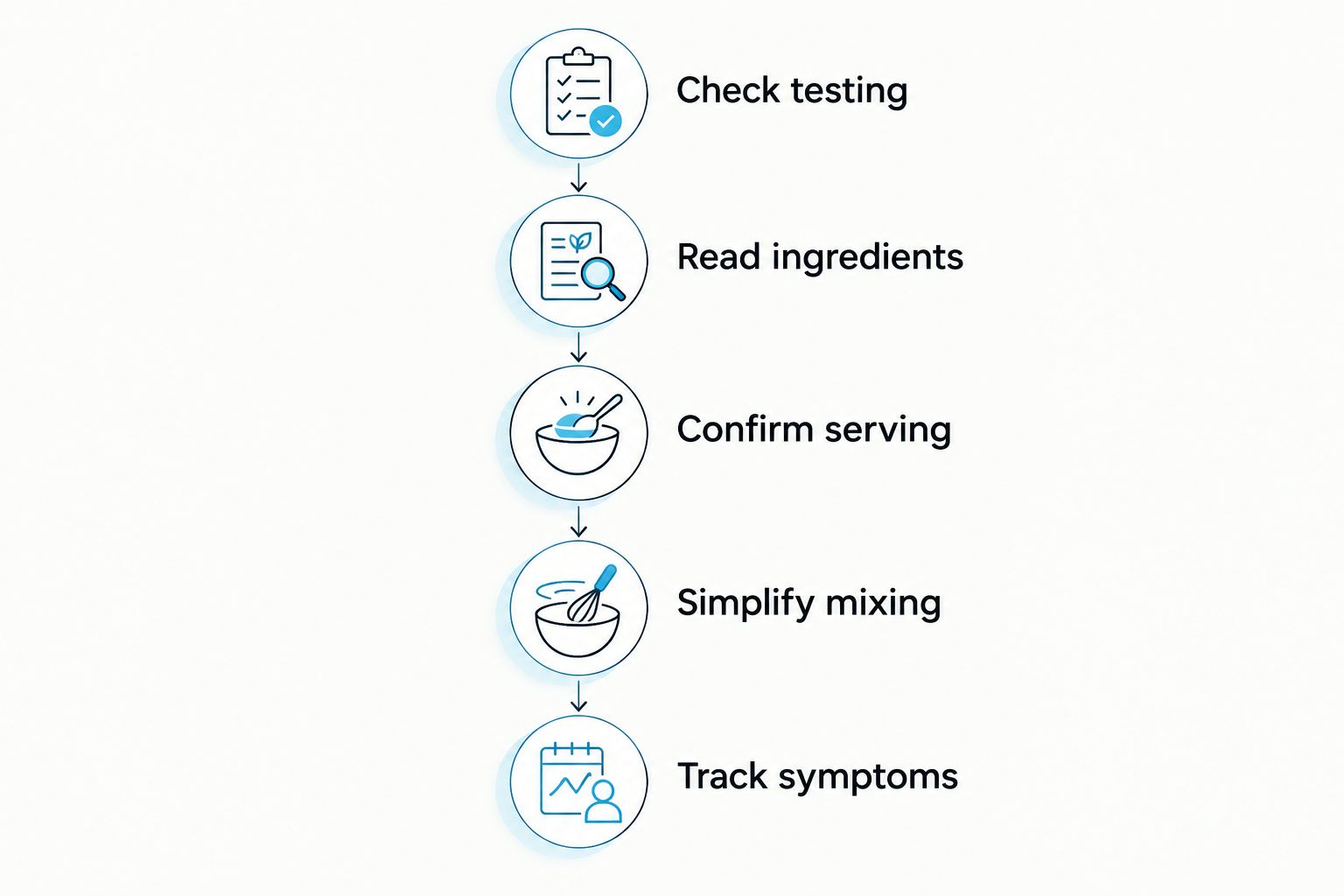
Use this label-checking sequence before buying a new powder in 2026. It separates evidence about the product from your response to drinking it.
- Check testing. Look for product-specific low FODMAP testing or certification, including the portion it covers.
- Read ingredients. Review added fibers, sweeteners, and other protein sources rather than stopping at rice.
- Confirm serving. Match any testing information to the amount you plan to use; scoop sizes are not interchangeable.
- Simplify mixing. Choose a familiar liquid and avoid adding several unfamiliar ingredients at once.
- Track symptoms. Record the powder, portion, mixing ingredients, and symptoms so you can discuss a reaction accurately.
The sequence matters because a reaction to a complicated smoothie does not identify the powder as the cause. Keep your assessment interpretable rather than changing the powder, milk, fruit, and supplements together.
If you are following a dietitian-led elimination phase, keep the trial consistent with that plan. An untested powder is not the best place to introduce uncertainty when you are trying to identify food triggers.
Is rice protein better than other protein powders for IBS?
Rice protein is not universally better for IBS. Dairy avoidance, milk allergy, ingredient tolerance, and the finished formula are separate considerations. Choose according to the problem you need the powder to solve.
The following Casa de Sante options illustrate that distinction. Neither should be described as rice protein based on the information given here.
| Product | Best for | Stated features | Limitation |
|---|---|---|---|
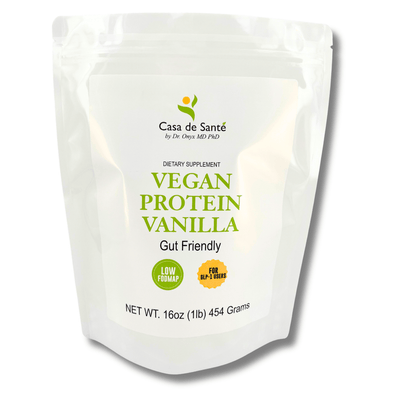
| Elemental Vegan Protein Powder | People seeking dairy-free, plant-based protein | Vanilla formula made without pea or soy isolates, inulin, or chicory root | Those exclusions do not establish that it contains rice protein |
| Elemental Whey WPI Protein Powder + Digestive Enzymes (Vanilla) | People who use dairy-based protein | Listed as providing 26 g protein and 130 calories per 32 g scoop, with ProHydrolase enzymes | Whey is milk-derived and unsuitable for a milk allergy or vegan diet |
Casa de Sante low FODMAP protein powders are best suited to shoppers managing digestive sensitivities who want formulas designed for that dietary need. That positioning is not a promise that every formula will suit your symptoms.
The vanilla whey listing specifies 26 g protein and 130 calories per 32 g scoop. Those figures describe that product, not a standard serving for rice protein. Casa de Sante's vegan formula offers a dairy-free alternative, but confirm its current full ingredient list rather than assuming its protein source.
Does mixing rice protein change whether the shake is low FODMAP?
Yes. A suitable powder does not automatically make the finished shake low FODMAP. Your liquid, fruit, added fibers, and portion sizes all contribute to what you drink.
Start with a mixing liquid you already tolerate. If lactose triggers symptoms, ordinary milk introduces a separate question from rice protein. If you use fruit, assess the specific fruit and portion instead of assuming every smoothie ingredient is interchangeable.
Avoid adding a new powder, a new fiber supplement, and several new smoothie ingredients in the same trial. If symptoms develop, that combination leaves you with several possible explanations and no clear next step.
A protein shake also differs from a mass-gainer drink. When investigating bloating from mass gainers, evaluate the complete formula and amount consumed rather than blaming the protein source alone. Apply the same logic to a rice protein smoothie: assess the whole drink.
Can rice protein cause bloating even if it is low FODMAP?
Yes. Low FODMAP status addresses specific fermentable carbohydrates, not every possible cause of bloating. A symptom after drinking a shake does not prove that rice protein contains excessive FODMAPs.
Review the portion, the finished ingredients, and what else you consumed. Also distinguish bloating from symptoms that need a different assessment, such as repeated vomiting, swallowing difficulty, or signs of an allergic reaction.
For your 2026 symptom record, photograph the current ingredient panel and note the amount used. That gives your clinician or dietitian a specific formula to assess rather than a generic description of a plant-protein shake.
Do not keep drinking a powder that repeatedly causes significant symptoms just because its label says low FODMAP. Stop the trial and discuss persistent problems with a qualified healthcare professional.
Should you avoid rice protein during low FODMAP elimination?
You do not need to exclude all rice protein simply because you are following a low FODMAP diet. Prefer a finished product with a clearly supported serving, and keep its use consistent with your dietitian's elimination plan.
The elimination phase is a temporary assessment tool, not a reason to remove every food with uncertain internet advice. Reintroduction and personalization help you identify which restrictions you actually need.
If your diet is already narrow, discuss protein choices before removing another category. You need a workable eating pattern, not just a longer list of ingredients to avoid.
FAQ
Is brown rice protein low FODMAP?
Brown rice protein can fit a low FODMAP diet, but the name does not establish a suitable serving. Check the finished powder, added ingredients, and product-specific testing.
Is rice protein isolate better for IBS than a protein blend?
Rice protein isolate is not automatically better for IBS than a blend. A shorter ingredient list is easier to assess, but finished-product testing and your tolerance matter more than the category name.
How many scoops of rice protein are low FODMAP?
There is no universal low FODMAP scoop allowance for rice protein powders. Use the portion supported for the specific product, because scoop sizes and formulas differ.
Can rice protein cause gas or diarrhea?
A rice protein shake can be associated with gas or diarrhea, even when the powder is described as low FODMAP. Review added ingredients, the portion, and the mixing liquid, and seek medical advice for persistent symptoms.
Does gluten-free rice protein mean it is low FODMAP?
No, gluten-free rice protein is not automatically low FODMAP. Gluten-free labeling addresses gluten, while FODMAP suitability concerns particular fermentable carbohydrates and portions.
Can I mix rice protein with milk on a low FODMAP diet?
You can mix rice protein with a milk option that fits your lactose tolerance and dietary plan. The finished shake needs assessment separately from the powder.
Is rice protein suitable for someone with a milk allergy?
Rice protein itself is not milk protein, but a finished powder still needs an allergen-label check. Blended ingredients and manufacturing warnings matter; a low FODMAP claim does not establish allergy safety.
One last thing
A low carbohydrate number is not a low FODMAP test. It does not reveal the identity and amount of every fermentable carbohydrate in a scoop. For your next purchase in 2026, prioritize evidence about the finished powder and its portion over assumptions about rice.