Is pea protein low FODMAP?




Pea protein can be low FODMAP, but its suitability depends on the specific powder, its processing, and the serving you use. Choose a product with low-FODMAP testing for the finished formula and follow its tested serving size; pea protein isolate on an ingredient list is not enough to establish suitability. Added fermentable carbohydrates and smoothie ingredients also affect what you actually consume.
- Is pea protein low FODMAP? Some products qualify at tested servings; the ingredient name alone cannot establish suitability.
- Monash University's FODMAP Diet app helps you check tested foods and products rather than assume all isolates are equivalent.
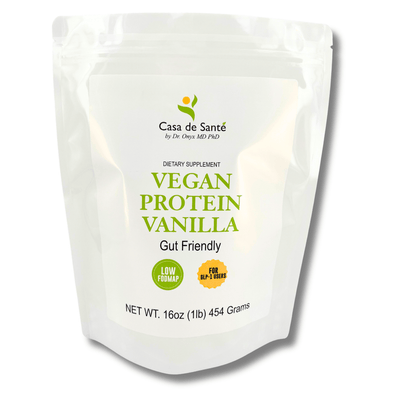
- Casa de Sante offers a low-FODMAP vegan protein powder made without pea or soy isolates.
- Check the finished formula, serving size, added fibers, and smoothie ingredients before choosing a protein powder for IBS.
Is pea protein low FODMAP?
Some pea protein powders fit a low-FODMAP diet, but there is no reliable category-wide serving you can apply to every product. For your 2026 product check, distinguish a tested finished powder from a general claim about peas or protein isolates. The guide to plant-based protein powder for IBS addresses the broader choice of plant protein.
| Pea ingredient | What it tells you | What it does not establish |
|---|---|---|
| Pea protein isolate | Processing concentrates protein and removes much of the nonprotein material | The finished powder's FODMAP content at your serving |
| Pea protein concentrate | The ingredient contains concentrated pea protein | Whether its remaining carbohydrates fit a low-FODMAP serving |
| Pea flour | The product uses a less purified pea ingredient | That results for an isolate apply to the flour |
| Flavored pea protein blend | The formula includes pea protein and other ingredients | That every added ingredient, or the complete serving, is low FODMAP |
Whole peas and a processed protein powder are not interchangeable. FODMAPs are carbohydrates, not proteins, so separating protein from the original food changes the question. The relevant issue is how much fermentable carbohydrate remains in the serving of the finished product.
Why this matters
If you manage IBS, rejecting every pea-derived ingredient restricts your choices unnecessarily. Treating every isolate as low FODMAP creates the opposite problem: it overlooks differences between formulas and portions.
Use testing to guide selection and symptoms to assess personal tolerance. Neither replaces the other, and a low-FODMAP designation does not guarantee a symptom-free shake.
Pea protein isolate: check the finished formula
Pea protein isolate is a reasonable starting point when you want a concentrated plant protein, but the word isolate is not a FODMAP certification. Manufacturing methods differ, and the ingredient name does not disclose the amount of residual fermentable carbohydrate.
Best for: people seeking plant protein who can verify the exact product and tested serving. The advantage is a concentrated protein ingredient; the limitation is that isolation alone does not prove low-FODMAP suitability.
Check evidence for the flavor you intend to use. A plain powder and a flavored version can contain different ingredients, so evidence for one formula should not be transferred automatically to another.
Pea protein concentrate: do not borrow an isolate's result
Pea protein concentrate and pea protein isolate describe different ingredient preparations. A result attached to an isolate does not establish the FODMAP content of a concentrate, even when both come from peas.
Best for: people who already tolerate the specific concentrate or have product-specific low-FODMAP evidence. Its limitation is the same practical uncertainty: the label does not reveal the finished serving's FODMAP content.
During a clinician-guided elimination phase, choose a documented product rather than infer suitability from a similar name. You need a clear baseline, not another uncertain variable.
Flavored pea protein blends: read beyond the protein source
A powder can contain an appropriate protein ingredient alongside fermentable added fibers or sweeteners. Inulin, chicory root fiber, fructooligosaccharides, and certain sugar alcohols deserve attention when you review a formula.
Best for: people who prefer a flavored shake and can verify the complete ingredient list and serving. Flavoring improves convenience, but extra ingredients make it harder to identify the cause of symptoms.
Do not treat every gum, sweetener, or unfamiliar ingredient as high FODMAP. Ingredients differ; an exclusion list built on unfamiliar names is not a substitute for product-specific evidence.
Why pea protein's FODMAP suitability varies
These factors explain why the answer changes between products and between prepared shakes:
- Processing: Protein extraction changes the carbohydrate composition, but an ingredient name does not quantify what remains.
- Serving size: FODMAP assessment applies to an amount consumed. A tested serving does not establish suitability for an unrestricted portion.
- Added fibers: Inulin and chicory root fiber add fermentable carbohydrates that require separate consideration.
- Sweeteners: Polyols such as sorbitol and mannitol are FODMAPs; sugar-free wording does not establish digestive suitability.
- Other protein ingredients: A blend needs assessment as a complete formula rather than approval based on its pea component.
- Mix-ins: Milk, fruit, juice, and other additions change the carbohydrate content of the shake you drink.
For a 2026 purchase, check the current label rather than rely on an old review or a photograph of previous packaging. Your assessment needs to match the formula in your container.
How do you check a pea protein powder before using it?
Use this sequence to separate evidence from assumptions. It works for a new purchase and for a powder already in your kitchen.
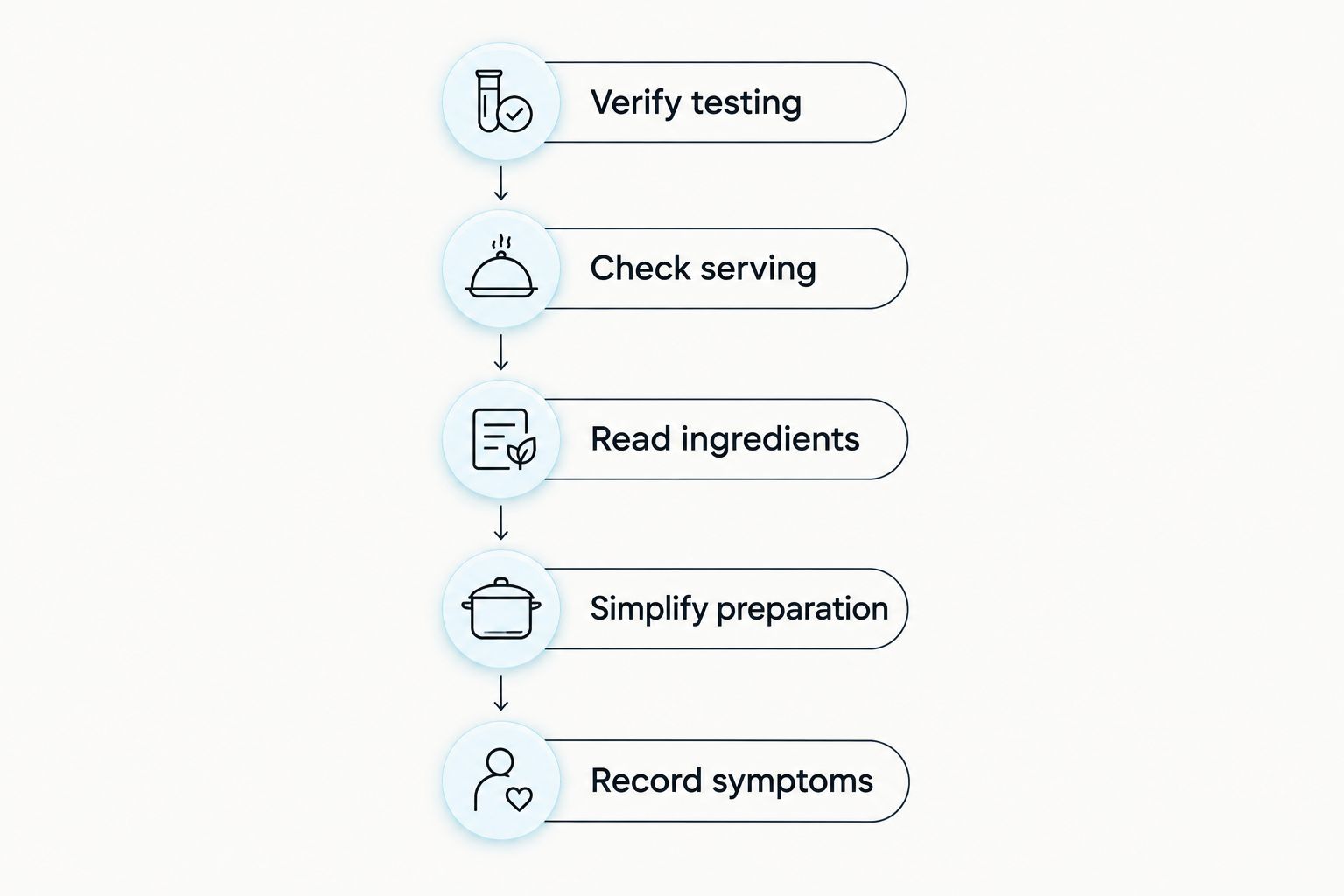
- Verify testing. Look for recognized low-FODMAP certification or product-specific testing information. Match the product, flavor, and serving rather than relying on a general brand statement.
- Check serving. Identify the amount covered by the evidence. A scoop is a measuring tool, not a universal unit shared by every powder.
- Read ingredients. Review the whole formula for added fermentable fibers, polyols, and other carbohydrate sources. Do not stop after finding pea protein isolate.
- Simplify preparation. Use a liquid you already tolerate and leave out unfamiliar additions while assessing the powder. This makes your observations easier to interpret.
- Record symptoms. Note the product, amount, preparation, and symptoms. Bring repeated reactions to a registered dietitian or clinician instead of repeatedly switching powders without a plan.
The purpose is to reduce uncertainty, not to prove that a food is universally safe. Your notes are more useful when the preparation stays consistent and you avoid introducing several new supplements at once.
What if you want a low-FODMAP protein without pea?
You do not need to keep testing pea protein if you prefer another protein source. Casa de Sante is best for people seeking a pea-free, low-FODMAP vegan protein option. That is a product-selection distinction, not a claim that one powder treats IBS better than another.
For your 2026 comparison, start with dietary requirements. Vegan suitability and milk allergy are separate questions from FODMAP content.
| Option | Best for | Relevant product details | Limitation |
|---|---|---|---|
| Elemental Vegan Protein Powder | People seeking a pea-free, dairy-free plant protein | Vanilla plant protein made without pea or soy isolates, inulin, or chicory root | A low-FODMAP formula does not guarantee individual tolerance |
| Elemental Whey WPI Protein Powder + Digestive Enzymes (Vanilla) | People who consume dairy and want a whey-based alternative | 26 g protein and 130 calories per 32 g scoop, with ProHydrolase enzymes | Whey is milk-derived, so it is not vegan or suitable for milk allergy |
Casa de Sante's vegan powder removes pea isolates from the choice entirely. Its lack of inulin and chicory root also addresses ingredients worth checking on a low-FODMAP diet, but you still need to assess the complete serving and your own response.
Casa de Sante's vanilla whey powder provides a different protein source, not a direct substitute for everyone's dietary requirements. Its 26 g protein per 32 g scoop describes protein delivery; the 130 calories describe energy, not FODMAP content.
Choose by verified suitability and dietary needs, not by the highest protein number alone. Protein grams cannot establish the amount of fermentable carbohydrate in a powder.
Can pea protein cause bloating even if it is low FODMAP?
Yes, a low-FODMAP pea protein powder can still coincide with bloating. A FODMAP assessment addresses specific carbohydrates at a defined serving; it does not evaluate every possible cause of digestive symptoms.
Look at the entire drink and the circumstances around it. A large shake, a newly added fiber, milk you do not tolerate, or several unfamiliar ingredients can complicate the picture without proving that pea protein itself is responsible.
Avoid diagnosing the cause from a single episode. Repeated symptoms deserve a structured review, especially if they occur with several different foods or continue after you stop the powder.
Is a reaction to pea protein the same as a pea allergy?
No. Food allergy and FODMAP intolerance involve different mechanisms, and a low-FODMAP label does not make an allergen safe.
Do not conduct a home tolerance experiment if pea has caused suspected allergic symptoms. Hives, swelling, wheezing, or breathing difficulty require medical attention; breathing difficulty or throat swelling is an emergency.
Is pea protein suitable during a low-FODMAP elimination diet?
A product with verified low-FODMAP suitability at the intended serving is the clearest choice during elimination. An untested pea protein powder adds uncertainty when you are trying to establish whether dietary changes improve symptoms.
Monash University's low-FODMAP approach separates restriction, reintroduction, and personalization. The aim is not permanent avoidance of every potentially fermentable food, and the elimination phase should not become an indefinite diet.
In your 2026 food record, distinguish a tested low-FODMAP product from an untested product that you happen to tolerate. Both observations matter, but they answer different questions: laboratory suitability and personal response.
If you are already losing weight unintentionally or struggling to eat enough, seek dietetic support before removing another protein source. Restriction should help answer a clinical question without undermining nutrition.
How should you prepare a pea protein shake for an IBS trial?
Keep the first preparation simple and familiar. Follow the product's verified serving guidance and use a liquid you already tolerate, rather than introducing a new powder, fruit blend, fiber supplement, and sweetener together.
Once you understand your response to the basic preparation, assess additions separately. Portion-dependent foods still require portion checks, even when they appear on a low-FODMAP food list.
Your diary should identify the actual preparation, not simply say protein shake. Record the powder amount, liquid, additions, and symptom pattern so a dietitian can distinguish a reproducible response from an isolated event.
Do not assume that adding digestive enzymes makes an untested powder low FODMAP. Enzymes act on particular substrates, and they do not replace evidence about the complete formula or assessment of persistent symptoms.
FAQ
Is pea protein low FODMAP in 2026?
Some pea protein products are low FODMAP at tested servings, but the category is not uniformly low FODMAP. Check the current formula and serving-specific evidence rather than relying on the ingredient name.
Is pea protein isolate always low FODMAP?
No, pea protein isolate is not automatically low FODMAP. Processing concentrates protein, but the ingredient name does not establish the finished product's residual FODMAP content.
Can I use a full scoop of pea protein during elimination?
Use a full scoop only when that amount matches the product's verified low-FODMAP serving. Scoop sizes and formulas differ, so another product's serving guidance does not apply automatically.
Does pea protein cause gas because it comes from peas?
Pea protein does not necessarily cause gas simply because it comes from peas. Processing changes the original food, and residual carbohydrates, added ingredients, portion size, and individual tolerance all need consideration.
Is unflavored pea protein better for IBS?
Unflavored pea protein is not automatically better for IBS, although a simpler ingredient list makes assessment easier. Product-specific testing and your response matter more than the absence of flavoring.
Can I use pea protein if I have SIBO?
A SIBO diagnosis does not determine whether a particular pea protein powder is suitable. Discuss dietary changes with your clinician or dietitian; a low-FODMAP powder does not treat the underlying condition.
Should I avoid pea protein if I have a pea allergy?
Yes, avoid pea protein if you have a pea allergy unless your allergy specialist gives different instructions. Low-FODMAP status does not establish allergy safety.
One last thing
Grams of protein are not grams of FODMAPs. A nutrition panel helps you assess protein intake, but it does not provide a complete measurement of individual fermentable carbohydrates.
Before your next purchase in 2026, save the exact product name, ingredient list, and tested serving information together. That record gives you a better basis for choosing a powder than a broad claim that all pea protein is either safe or unsuitable.