How much fiber should you take per day on a low FODMAP diet?






Aim for 25 grams of total fiber per day for women and 38 grams for men ages 19–50, using the standard adult intake targets rather than a separate low FODMAP allowance. Those amounts include food and supplements combined—not an additional supplement dose—and your starting intake and IBS symptoms determine how gradually you work toward them. This 2026 guide explains how to choose fiber sources, count your intake, and recognize when increasing fiber needs medical supervision.
- For how much fiber per day low FODMAP diet planning, use age-based targets—not a separate IBS allowance.
- Women ages 19–50 have a 25-gram daily target; men have a 38-gram daily target, including food and supplements.
- Psyllium has better support for IBS symptoms than wheat bran; increase intake gradually and follow fluid instructions.
- Casa de Sante low FODMAP supplements serve people managing IBS; they do not replace a varied, fiber-containing diet.
Why this matters
Low FODMAP does not mean low fiber. Removing foods without replacing their fiber can leave you with a diet that reduces some triggers but makes constipation harder to manage.
The useful question is not simply which powder to buy. First establish what you already eat, then decide whether food changes or a supplement addresses the gap. The guide to low FODMAP fiber supplements covers the supplement side of that decision.
Fiber quantity and FODMAP content measure different things. A food can supply useful fiber while remaining low FODMAP at an appropriate serving, and a product labeled high fiber can contain fermentable ingredients that aggravate IBS symptoms.
How much fiber should you take per day on a low FODMAP diet?
Use the usual adult fiber targets as your reference, then adjust the pace and sources to your bowel symptoms. There is no universal supplement dose for everyone following a low FODMAP diet.
The National Academies' Dietary Reference Intakes, published in 2005, establish the following adequate intake levels for generally healthy adults. These are the reference values used in this 2026 guide; they are not trial-tested prescriptions for individual IBS patients.
| Adult group | Total daily fiber target | What the number means |
|---|---|---|
| Women ages 19–50 | 25 grams | Fiber from food and supplements combined |
| Men ages 19–50 | 38 grams | Fiber from food and supplements combined |
| Women ages 51 and older | 21 grams | A general intake reference, not a supplement dose |
| Men ages 51 and older | 30 grams | A general intake reference, not a supplement dose |
The underlying reference is 14 grams of fiber per 1,000 calories. The age- and sex-based values reflect reference energy intakes; your clinician or registered dietitian can individualize the goal when your food intake, health conditions, or treatment plan differs.
Do not interpret the table as an instruction to reach the target immediately. If your current intake is low, a sudden increase can produce gas, abdominal discomfort, or altered stools—even when the chosen food is low FODMAP.
Women ages 19–50: 25 grams per day
25 grams per day is a total-intake goal, not a requirement to take fiber powder. Count the fiber in grains, vegetables, fruit, seeds, and any supplements before deciding whether you need more.
Pregnancy and breastfeeding have separate nutrient reference values. Discuss those needs with your prenatal care team rather than applying the general adult table without adjustment.
Men ages 19–50: 38 grams per day
38 grams per day is the general reference for men in this age group. If that amount is far above your current intake, build toward it through tolerated foods instead of adding a large supplement serving at once.
Persistent symptoms are a reason to review the plan, not proof that you must force more fiber. Stool consistency, ease of passing stool, and abdominal pain matter alongside the daily total.
Adults ages 51 and older: 21 or 30 grams per day
21 grams per day for women and 30 grams per day for men are the older-adult reference values. These remain total daily amounts, including anything supplied by a fiber supplement.
Swallowing difficulties, prescribed fluid restrictions, and medicines that interact with supplements need separate consideration. Ask your pharmacist about product-specific spacing rather than using one timing rule for every medicine.
Why your fiber plan varies
The reference target is only part of the decision. These factors determine how you approach it:
- Current intake: A large gap between your usual intake and your goal calls for gradual changes, not an immediate jump.
- Bowel pattern: Constipation, diarrhea, and mixed IBS symptoms require attention to fiber type as well as amount.
- Fiber properties: Solubility, gel formation, and fermentation affect how a fiber behaves in your gut.
- Serving size: Low FODMAP suitability depends on the portion, not just the food's name.
- Medical circumstances: Suspected obstruction, gastroparesis, swallowing problems, and fluid restrictions require individualized advice.
- Diet phase: Elimination narrows food choices temporarily; reintroduction helps expand your long-term options.
A food's FODMAP status does not predict every digestive response. You can react to a large fiber load independently of its FODMAP content, so record both portions and symptoms when changing your meals.
Which fiber sources work best with a low FODMAP diet?
For IBS symptom management, soluble fiber such as psyllium has better support than insoluble wheat bran. The American College of Gastroenterology's 2021 IBS guideline recommends soluble, rather than insoluble, fiber for global IBS symptoms.
That recommendation does not mean you must remove all insoluble fiber from food. It means wheat bran is not the preferred supplement strategy for treating overall IBS symptoms.
| Source | Best for | Useful feature | Limitation |
|---|---|---|---|
| Psyllium husk | A supplement option to discuss for IBS | Forms a water-holding gel and has guideline support | Needs appropriate fluid; abrupt increases can cause discomfort |
| Oats | Adding fiber through meals | Supply soluble fiber alongside other nutrients | Serving size and added ingredients still matter |
| Chia seeds | Adding fiber to tolerated meals | Provide fiber in a small food addition | Large portions increase the fiber load; check current serving guidance |
| Wheat bran | People who tolerate bran without symptom aggravation | Adds insoluble fiber | Not the guideline-preferred fiber treatment for global IBS symptoms |
| Inulin or chicory root fiber | People who tolerate fructans outside strict restriction | Provides fermentable prebiotic fiber | Fructans can trigger symptoms during low FODMAP elimination |
For food portions, use current laboratory-tested guidance, such as Monash University's food database, rather than assuming every serving is suitable. Processing, preparation, and the amount you eat can change the practical choice.
Do not treat prebiotic as a synonym for low FODMAP. Inulin and chicory root fiber are common examples of ingredients that need scrutiny during elimination, even when the front label emphasizes digestive health.
How do you increase fiber without making bloating worse?
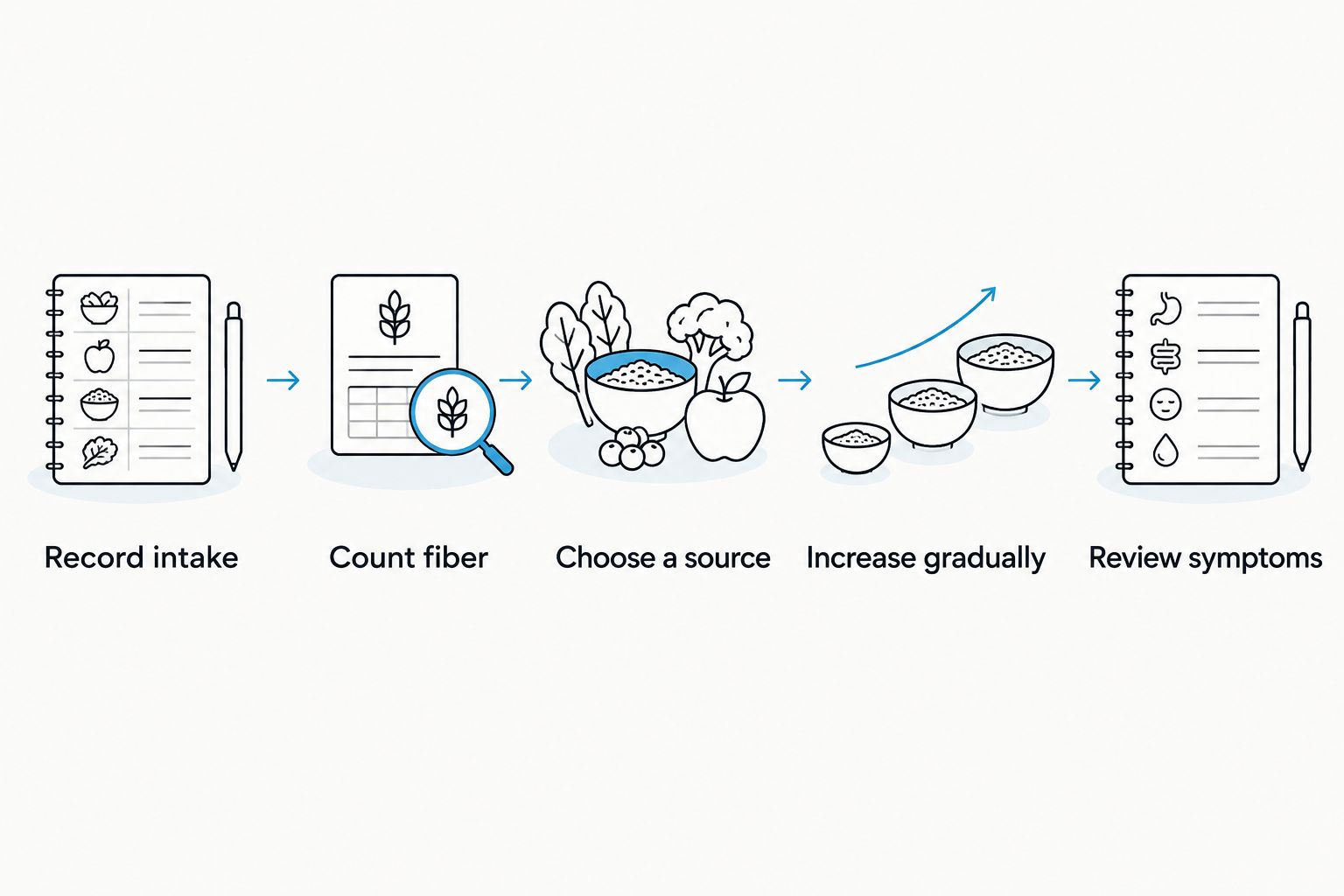
Build your 2026 fiber plan around observation rather than a fixed escalation schedule. A supplement label gives product instructions; your symptoms determine whether the change is tolerable.
- Record intake. Write down your usual meals, portions, drinks, and supplements before making changes. Include bowel frequency, stool consistency, straining, and discomfort.
- Count fiber. Use Nutrition Facts labels for packaged foods and a reliable food-composition database for basic ingredients. Count the amount you actually eat.
- Choose a source. Start with a food or fiber type that fits your current low FODMAP phase. Check the complete ingredient list on supplements.
- Increase gradually. Make a manageable change and assess tolerance before adding more. Avoid changing several supplements and major food groups together.
- Review symptoms. Keep helpful changes, reconsider poorly tolerated ones, and involve your clinician if constipation or diarrhea persists.
Drink fluids regularly, and follow the fluid directions supplied with a fiber product. Do not take dry psyllium powder or ignore swallowing warnings; bulk-forming products are unsuitable for some people.
If your clinician has restricted fluids, ask before adding a bulk-forming supplement. More water is not a universal instruction when heart, kidney, or other medical conditions affect your fluid allowance.
How do you count food fiber and supplement fiber together?
Read the Dietary Fiber line on the Nutrition Facts panel. Multiply it by the number of servings you consumed, then add the fiber from the rest of your day.
For a supplement, distinguish the weight of the powder from its dietary fiber content. A scoop's total weight is not automatically the amount of fiber it provides, and a capsule count does not establish a meaningful fiber dose.
Keep total carbohydrate separate from fiber. FODMAP content is also a separate question: the Nutrition Facts panel does not tell you whether a product's serving has been tested as low FODMAP.
For your 2026 food log, record the product name and serving alongside the fiber amount. That makes the log useful when a dietitian needs to identify whether the problem is the total load, a specific ingredient, or a portion.
Where do low FODMAP supplements fit?
Casa de Sante is best for people managing IBS who are shopping for low FODMAP supplements, not a substitute for dietary fiber. Protein powders, digestive enzymes, probiotics, and multivitamins have different purposes; their names alone do not establish how much dietary fiber they supply.
For meal-planning support, Casa de Sante offers The Complete Low-Fodmap IBS Relief Cookbook. Its practical role is helping you organize food choices; its limitation is that a cookbook cannot determine your personal fiber tolerance or replace medical care.
Choose a supplement only after identifying the problem it needs to address. A probiotic does not count toward your fiber target merely because it is marketed for gut health, and digestive enzymes do not replace the fiber missing from meals.
Should you eat less fiber if you have IBS with diarrhea?
25 grams per day for women and 38 grams per day for men ages 19–50 remain general reference targets, not instructions to force intake during active diarrhea. Soluble, gel-forming fiber behaves differently from coarse bran, so review the source before removing all fiber.
Ongoing diarrhea needs assessment rather than repeated supplement changes. Blood in stool, dehydration, fever, or unexplained weight loss warrants medical attention.
Should you take more fiber if you have IBS with constipation?
25 grams per day for women and 38 grams per day for men ages 19–50 are reference goals, not guaranteed constipation treatments. Gradually correcting a low intake can help, but more fiber is not always better when you already consume enough.
Severe pain, vomiting, marked abdominal swelling, or inability to pass gas requires urgent medical evaluation. Do not keep increasing bulk-forming fiber when obstruction is a concern.
Can you meet your fiber target during low FODMAP elimination?
25 grams per day is achievable for many women through a planned low FODMAP diet, but the right foods and portions depend on individual tolerance. Use a range of tolerated grains, vegetables, fruits, nuts, and seeds rather than relying on a single high-fiber ingredient.
The restriction phase is not intended to become your permanent diet. The American Gastroenterological Association's 2022 clinical practice update describes restriction, reintroduction, and personalization as distinct phases of low FODMAP treatment.
FAQ
How much fiber should I get each day on a low FODMAP diet?
General daily fiber targets are 25 grams for women and 38 grams for men ages 19–50. For adults ages 51 and older, the targets are 21 grams for women and 30 grams for men; food and supplements count together.
Do I need to take my whole fiber target as a supplement?
No, your fiber target includes everything you get from food and supplements combined. Assess your usual food intake before deciding whether a supplement is needed.
Is psyllium better than wheat bran for IBS?
Psyllium has better support than wheat bran for treating global IBS symptoms. The American College of Gastroenterology recommends soluble rather than insoluble fiber for that purpose.
Can a low FODMAP fiber supplement still cause bloating?
Yes, a low FODMAP fiber supplement can still cause bloating, particularly after a sudden increase. Fiber dose and fermentation characteristics matter separately from FODMAP status.
Should I avoid every product containing inulin?
During strict low FODMAP elimination, inulin deserves scrutiny because it is a fructan. Long-term suitability depends on your reintroduction results, portion, and tolerance.
Does a Casa de Sante protein powder replace a fiber supplement?
A protein powder is not automatically a replacement for a fiber supplement. Check its Dietary Fiber amount per serving rather than assuming a low FODMAP or protein claim establishes fiber content.
When should I ask a clinician before increasing fiber?
Ask before increasing fiber if you have swallowing difficulties, a prescribed fluid restriction, gastroparesis, or suspected bowel obstruction. Seek urgent care for severe abdominal pain with vomiting, marked swelling, or inability to pass gas.
One last thing
The most useful number is your current intake, not just your eventual target. Before buying another supplement in 2026, total the fiber in your usual meals and note which foods you tolerate.
That simple baseline separates a genuine intake gap from a problem that more fiber will not solve. Aim for a sustainable, varied diet and comfortable bowel function—not the highest number you can reach.