How much magnesium is safe to take daily for constipation?






There is no single magnesium dose that is safe for everyone to take daily for constipation in 2026: the right amount depends on the formulation, kidney function, other medicines, and how long you need treatment. The adult upper limit of 350 mg daily from supplements and medications is not a recommended constipation dose; clinician-directed laxative treatment is a separate decision. If you need magnesium repeatedly, have kidney disease, or develop significant abdominal pain, get medical advice rather than increasing the amount yourself.
- How much magnesium is safe daily for constipation depends on kidney function, formulation, other medicines, and treatment duration.
- The NIH adult supplemental limit is 350 mg daily; it is not a constipation treatment target.
- Magnesium oxide has guideline support for chronic constipation, but impaired kidney function increases toxicity risk.
- Casa de Sante Low FODMAP supplements address nutrition needs; they do not establish a safe magnesium laxative dose.
Why this matters
A magnesium supplement and a magnesium laxative do not necessarily use the same dosing instructions. Confusing the weight of a magnesium compound with its elemental magnesium content adds another risk: the numbers describe different things.
For a 2026 treatment decision, separate occasional constipation from symptoms that keep returning. The guide to gut health supplements for constipation provides related context, but persistent symptoms need an assessment of their cause—not simply another supplement.
A bowel movement does not prove that a magnesium dose is safe for continued daily use. Excess magnesium can cause diarrhea, and impaired kidney clearance can allow magnesium to accumulate in the blood.
How much magnesium is safe to take daily for constipation?
There is no universal daily magnesium laxative dose. The National Institutes of Health Office of Dietary Supplements sets an adult tolerable upper intake level of 350 mg per day from supplements and medications, excluding magnesium naturally present in food. This limit is based primarily on gastrointestinal adverse effects, including diarrhea; it is not a threshold below which every person is protected from harm.
The joint American Gastroenterological Association and American College of Gastroenterology guideline conditionally supports magnesium oxide for adults with chronic idiopathic constipation. That recommendation does not make every magnesium product interchangeable, and it specifically cautions against use in renal insufficiency because of hypermagnesemia risk.
| Number or instruction | What it means | What it does not mean |
|---|---|---|
| 350 mg daily | Adult upper limit for magnesium from supplements and medications without clinician-directed treatment | A recommended laxative dose or a guarantee of safety |
| 310–320 mg daily | Recommended total magnesium intake for most nonpregnant adult women, depending on age | The amount to take as a constipation supplement |
| 400–420 mg daily | Recommended total magnesium intake for adult men, depending on age | A daily magnesium laxative prescription |
| Product-specific directions | Instructions for that formulation, concentration, and intended use | Permission to substitute another magnesium salt at the same amount |
The intake figures above come from the NIH Office of Dietary Supplements magnesium reference for healthy adults. Total dietary requirements include food; the supplemental upper limit does not. Do not subtract your food intake from a dietary requirement and treat the remainder as a constipation dose.
Magnesium oxide: a clinician-guided chronic constipation option
Best for: adults with chronic idiopathic constipation whose clinician considers magnesium oxide appropriate and has reviewed kidney function.
Magnesium oxide acts as an osmotic laxative: it helps retain water in the intestine. Its guideline recommendation is conditional, meaning the evidence and treatment trade-offs require individual judgment rather than a blanket recommendation.
The advantage is its recognized role in constipation treatment. The limitations include loose stools, cramping, and magnesium accumulation in people with impaired kidney function. A clinician should determine the formulation, amount, and follow-up plan; a general nutritional supplement limit cannot replace that decision.
Other magnesium forms are not interchangeable
Magnesium citrate, hydroxide, and glycinate appear in different products with different intended uses. Check whether the container is a dietary supplement, an occasional-constipation medicine, or a bowel-preparation product before comparing amounts.
This 2026 comparison separates clinical purpose from marketing descriptions. A form promoted as gentle or well absorbed is not automatically the right laxative.
| Magnesium form | Best-fit role | Advantage | Limitation |
|---|---|---|---|
| Oxide | Clinician-guided chronic idiopathic constipation treatment | Included in the joint gastroenterology guideline | Conditional evidence; avoid in renal insufficiency |
| Hydroxide | Occasional constipation when appropriate under the medicine label | Established osmotic laxative use | Not a self-directed indefinite daily treatment |
| Citrate | Product-specific occasional laxative use or prescribed bowel preparation | Established laxative effect | Concentrations and intended uses differ; diarrhea and fluid loss are concerns |
| Glycinate | Nutritional supplementation when appropriate | An option for magnesium replacement rather than deliberate laxation | Not an established guideline treatment for chronic constipation |
Do not convert a dose between magnesium forms yourself. Matching capsule counts, spoonfuls, or compound weights does not establish an equivalent amount of elemental magnesium or an equivalent laxative effect.
How do I read the magnesium amount on the label?
On a US Supplement Facts panel, the magnesium amount refers to elemental magnesium per listed serving, not the total weight of magnesium oxide, citrate, or another compound. The serving size matters just as much as the number beside magnesium.
An OTC laxative uses a Drug Facts panel and can list the active magnesium compound and its concentration differently. If the label is unclear, ask a pharmacist to interpret it instead of attempting a conversion.
- Check the panel. Identify Supplement Facts versus Drug Facts and confirm the intended use.
- Read the serving. Establish whether the amount applies to a capsule, several capsules, or a measured liquid serving.
- Count all sources. Include multivitamins, antacids, electrolyte products, and other magnesium-containing medicines.
- Review the risks. Check kidney disease, dehydration, pregnancy, and possible medication interactions.
- Confirm the plan. Follow the specific product directions or the clinician's instructions, including when to stop.
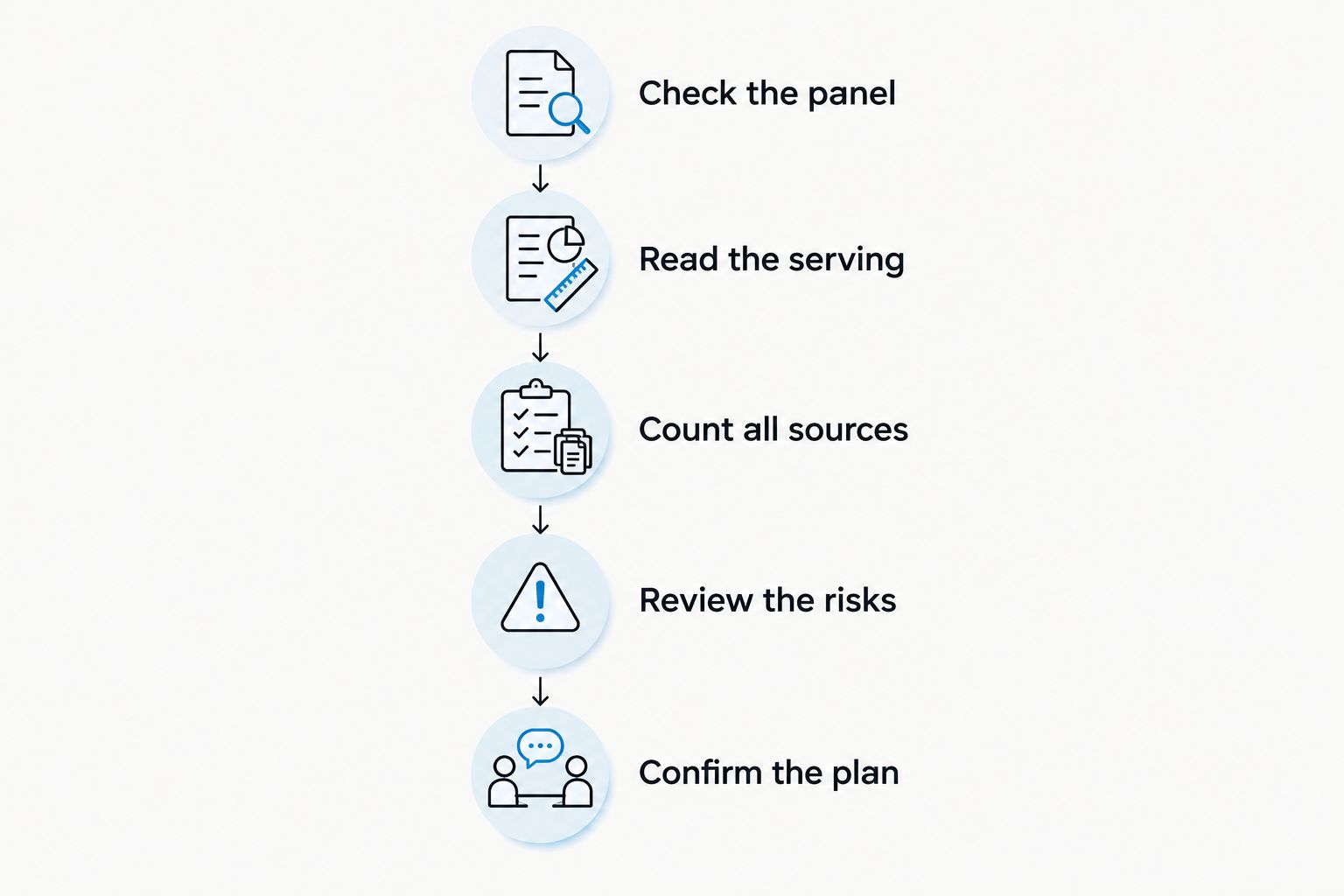
Keep the actual containers available when you speak with a pharmacist. A product name alone does not reveal its concentration, serving size, or combined magnesium exposure.
Why a safe magnesium amount varies
These factors change the safety assessment. They are reasons to individualize treatment, not instructions to increase your dose.
- Kidney function: Your kidneys remove excess absorbed magnesium. Impaired clearance increases the risk of dangerously high blood magnesium.
- Formulation: Different salts and liquid concentrations have different instructions. Elemental magnesium and compound weight are not interchangeable.
- Other magnesium sources: Supplements, antacids, and laxatives can overlap. Review the complete daily total rather than one bottle in isolation.
- Medication interactions: Magnesium can reduce absorption of certain medicines, including some antibiotics and osteoporosis treatments. A pharmacist should confirm product-specific spacing.
- Duration and response: Repeated need, worsening constipation, watery diarrhea, or continued incomplete emptying calls for reassessment instead of automatic escalation.
- Age and pregnancy: Adult supplement limits do not establish pediatric doses. Pregnancy and breastfeeding also require a separate medication review.
Can I take 350 mg of magnesium every day?
350 mg daily is an adult supplemental upper limit, not a promise of safety or constipation relief. Kidney disease, interacting medicines, and additional magnesium-containing products can change whether even a lower amount is appropriate.
For ongoing use in 2026, ask your clinician whether magnesium is treating a documented nutritional need or serving as a laxative. Those are different goals, with different monitoring and alternatives.
Does magnesium from food count toward the 350 mg limit?
350 mg daily applies to supplements and medications, not magnesium naturally present in food. Foods such as nuts, seeds, legumes, and leafy greens contribute to total nutritional intake without being counted against that supplemental limit.
If you follow a low FODMAP diet, choose foods and portions compatible with your individual tolerance. Do not remove tolerated magnesium-containing foods simply because you also use a supplement.
Is 400–420 mg a safe constipation dose for men?
400–420 mg daily is the recommended total nutritional intake for adult men, not a constipation treatment dose. It includes magnesium from food and does not justify taking that amount as a daily laxative supplement.
The same distinction applies to the 310–320 mg daily nutritional recommendation for most nonpregnant adult women. Nutritional requirements answer how much magnesium your body needs—not how much medicine your constipation requires.
What if constipation started with a GLP-1 medicine?
If constipation began after starting or increasing a GLP-1 medicine, tell the prescriber before building a daily laxative routine. Reduced food intake, changes in fluid intake, and medication effects on digestion all belong in the assessment.
For a 2026 medication review, bring the injection name, recent dose changes, bowel pattern, and every supplement you take. Do not assume a Low FODMAP label means a supplement treats medication-related constipation.
Nutrition support remains a separate decision. Casa de Sante Low FODMAP supplements are best suited to people seeking nutrition support compatible with a low FODMAP diet, not a substitute for constipation assessment. Casa de Sante's Vitamin & Mineral Gummies are a nutrition product; this guide does not recommend them as a magnesium laxative or constipation treatment.
When should I stop self-treatment and get help?
Seek urgent medical care for severe or persistent abdominal pain, vomiting, a swollen abdomen with inability to pass gas, bloody stools, or black, tarry stools. Do not take another laxative while trying to manage possible bowel obstruction at home.
Marked weakness, unusual drowsiness, fainting, breathing difficulty, or an abnormal heartbeat after magnesium use also needs urgent assessment. Bring the product and explain how much you took.
Arrange a nonemergency appointment when constipation keeps returning, requires repeated laxative use, or represents an unexplained change in your usual bowel habits. Your clinician can review medications, nutrition, and causes such as pelvic floor dysfunction rather than treating every episode as a magnesium shortage.
If the product says not to use it beyond a specified period without medical advice, follow that instruction. Continuing longer because the medicine still produces a bowel movement does not resolve the underlying safety question.
FAQ
What's the maximum magnesium I can take daily for constipation?
There is no universal safe daily magnesium laxative maximum. The NIH adult upper limit of 350 mg daily from supplements and medications is a general safety reference, not a constipation prescription; clinician-directed treatment requires a separate assessment.
Is magnesium safe if I have kidney disease?
Do not self-treat constipation with magnesium if you have kidney disease. Reduced kidney clearance can cause magnesium to accumulate, and the joint gastroenterology guideline advises avoiding magnesium oxide in renal insufficiency.
Is magnesium citrate better than magnesium glycinate for constipation?
Magnesium citrate has established laxative uses, while magnesium glycinate is not an established guideline treatment for chronic constipation. That difference does not make every citrate product appropriate for daily use; check its intended purpose and directions.
Can I take magnesium with my regular medicines?
Magnesium interacts with some medicines by reducing their absorption. Ask a pharmacist to check your complete medication list and give medicine-specific spacing instructions rather than using one timing rule for everything.
Should I take more magnesium if I still haven't had a bowel movement?
Do not exceed the product directions or your prescribed amount because the first dose did not work. Persistent constipation, pain, vomiting, or inability to pass gas requires assessment rather than repeated dosing.
Can Casa de Sante Low FODMAP supplements replace a constipation medicine?
Casa de Sante Low FODMAP supplements are not a substitute for an individualized constipation treatment plan. A nutrition product's Low FODMAP positioning does not establish a laxative effect or a safe magnesium dose.
Can children use the adult 350 mg magnesium limit?
Do not use the adult 350 mg supplemental limit to choose a child's constipation dose. Pediatric limits and treatment instructions depend on age, formulation, and medical circumstances; ask the child's clinician.
One last thing
The most useful number on a magnesium bottle is not always the largest number on the front. The serving size, elemental magnesium amount, and product-specific directions determine what you are actually taking.
Before starting a daily routine in 2026, photograph the front label and the facts panel and show both to your pharmacist. Ask a precise question: is this product appropriate for my constipation, with my kidney function and current medicines?