
Can you take probiotics on an empty stomach? Yes | 2026






Yes, you can take probiotics on an empty stomach if the product label permits it, but fasting is not universally better than taking them with food. Follow the instructions for your specific formulation; some bacterial probiotics survive better when taken with a meal or shortly before it. If taking your probiotic without food causes nausea or discomfort, ask a pharmacist whether you can move it to mealtime.
- Can you take probiotics on an empty stomach? Yes, when the label allows it; fasting is not universally better.
- Probiotic timing depends on the formulation, meal instructions, and your digestive tolerance—not a universal morning rule.
- IBS and SIBO require condition-specific advice; worsening bloating is not proof that a probiotic is working.
- Casa de Sante is best for shoppers seeking physician-formulated Low FODMAP supplements.
Why this matters
The right schedule is the one that follows your product's instructions without worsening your symptoms. An empty stomach is not automatically the best environment for every probiotic, and surviving stomach acid does not establish that a product will improve your particular condition.
For this 2026 guide, the distinction is between laboratory survival, clinical benefit, and everyday tolerance. These are different questions. If your concern is fitting a supplement around a fasting window, the guide to probiotics for intermittent fasting addresses that separate scheduling issue.
Can you take probiotics on an empty stomach?
Yes—provided the label does not tell you to take the probiotic with food. Healthy adults do not generally need to eat simply to swallow a probiotic capsule, but the best timing depends on the organisms, delivery system, and instructions attached to that formulation.
The practical comparison in 2026 is not whether all probiotics belong before breakfast. It is whether your chosen product requires food, permits either schedule, or gives specific directions for use.
| Timing option | Best for | Practical advantage | Limitation |
|---|---|---|---|
| Empty stomach | People whose label permits fasting use and who tolerate it | Fits a routine before eating | Not proven better for every probiotic; discomfort can occur |
| With a meal | People whose label specifies food | Follows meal-based instructions and can be easier to tolerate | Does not guarantee symptom improvement |
| Shortly before a meal | People whose formulation specifically recommends it | Connects the dose to a predictable meal | Findings from one formulation cannot establish a universal waiting period |
| At bedtime | People whose label permits flexible timing | Provides an alternative to a rushed morning | Bedtime itself has no established universal advantage |
What the meal-timing evidence actually shows
A study by Tompkins, Mainville, and Arcand, titled The impact of meals on a probiotic during transit through a model of the human upper gastrointestinal tract, tested a commercial probiotic in a laboratory digestion model. The bacterial organisms survived best when administered with a meal or 30 minutes before a meal; survival was poorer when administered 30 minutes after a meal.
The researchers also compared food and drink conditions, including milk containing 1% fat. The food environment affected bacterial survival, while the yeast in the tested preparation responded differently. That distinction matters: a timing result for bacteria does not automatically apply to a probiotic yeast.
This was a simulated digestion study, not a trial demonstrating better IBS relief from a particular schedule. It supports taking formulation and food into account. It does not establish that everyone should set a timer before breakfast, drink milk with a capsule, or avoid taking probiotics after eating.
Use the label as your instruction, not a laboratory finding as a universal prescription. If you avoid lactose or follow a low FODMAP diet, there is no reason to add milk solely because it appeared in that experiment.
Why probiotic timing varies
The factors that explain different timing instructions are specific to the supplement and the person taking it:
- Organism identity: Different bacterial strains and probiotic yeasts have different responses to digestive conditions. Evidence for one organism does not establish results for another.
- Delivery system: A capsule, powder, or delayed-release preparation exposes its contents to digestion differently. Do not assume that every capsule has protective technology.
- Meal conditions: Food changes the stomach environment. The composition of a meal also matters, so “with food” is not identical to every meal tested in research.
- Added ingredients: A probiotic can include prebiotic fibers, sweeteners, or other ingredients that affect your tolerance independently of the live organisms.
- Your symptoms: Nausea, abdominal pain, diarrhea, and bloating require different responses. A tolerable schedule does not prove that the supplement is treating the underlying problem.
- Other treatment instructions: Antibiotics and medicines with fasting requirements can complicate scheduling. A pharmacist can help you avoid conflicting directions.
Do not infer special acid protection from terms such as gut friendly or physician formulated. Those descriptions do not, by themselves, specify when to take a supplement or demonstrate survival under fasting conditions.
How should you choose a probiotic schedule?
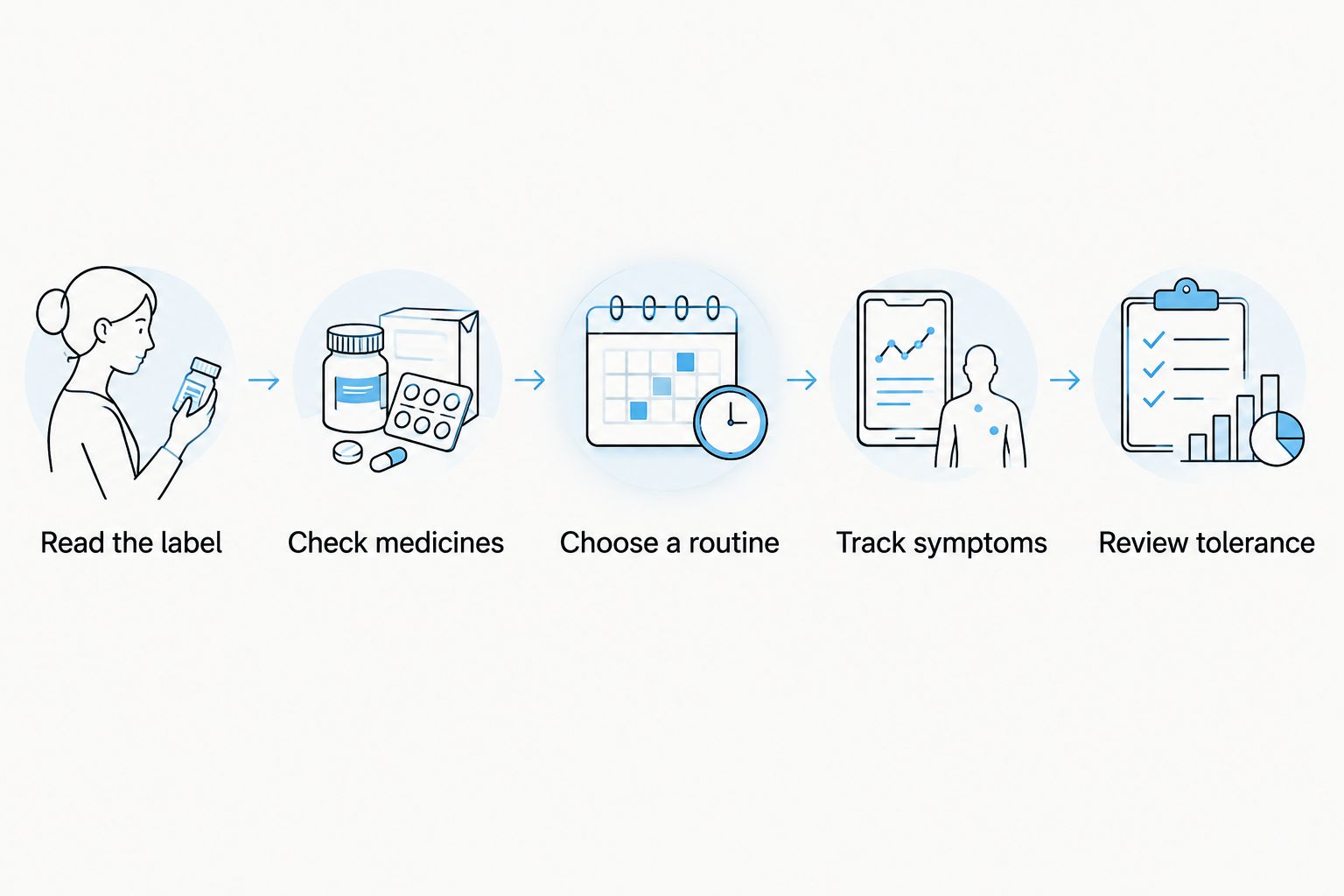
Use this sequence when starting a probiotic or changing its timing in 2026. The goal is to make a clear, tolerable routine—not to find an exact clock time that supposedly works for everyone.
- Read the label. Check the serving instructions, food directions, storage requirements, and warnings. If the label specifies an empty stomach or a meal, follow that instruction rather than general advice online.
- Check medicines. Ask a pharmacist about timing if you take antibiotics or medication with strict food restrictions. Do not move a prescribed medicine simply to accommodate a supplement.
- Choose a routine. Attach the probiotic to an activity you reliably remember, within the label's instructions. Breakfast is convenient for some people; it is not biologically superior for everyone.
- Track symptoms. Note the formulation, whether you took it with food, and any digestive changes. Keep other new supplements out of the experiment so you can identify what changed.
- Review tolerance. If symptoms worsen, stop trying to perfect the clock time and reassess the product with a clinician. Persistent discomfort is not a reason to increase the dose.
Changing the schedule and changing the product simultaneously makes your experience harder to interpret. Keep the formulation stable when assessing timing, unless symptoms or your clinician's advice require you to stop it.
If the label does not mention food
Ask the manufacturer or a pharmacist whether the formulation has specific meal instructions. An unspecified schedule is not evidence that taking the product while fasting improves its effects.
If the product permits either approach, choose the schedule you tolerate and remember. Taking it with a familiar meal is a practical option when fasting use causes discomfort, but do not describe that switch as a proven treatment for nausea.
If you miss a dose
Follow the missed-dose instructions when the manufacturer provides them. Do not automatically double the next serving or take extra capsules to compensate.
A missed dose does not justify abandoning food directions. Resume the recommended routine rather than compressing several servings into a shorter period.
What changes if you have IBS, SIBO, or take a GLP-1 medicine?
For people with digestive conditions, the first decision in 2026 is whether the probiotic is appropriate—not whether it belongs before breakfast. Timing cannot turn an unsuitable formulation into a suitable treatment.
If you have IBS
Probiotics are not an established universal treatment for IBS. The American College of Gastroenterology's clinical guideline suggests against probiotics for global IBS symptoms because the evidence is inconsistent and of very low quality. That recommendation concerns overall IBS treatment, not a prohibition on every individual product.
Discuss your main symptom and the exact formulation with your clinician. Constipation, diarrhea, and abdominal pain are not interchangeable outcomes, and a product studied for one purpose does not automatically address the others.
A low FODMAP designation concerns fermentable carbohydrate content. It does not establish that a probiotic will relieve IBS symptoms, and it does not replace strain-specific evidence.
If you have SIBO
Do not assume that a probiotic is necessary because you have bacterial overgrowth. SIBO management requires a clinical plan, and taking a capsule while fasting does not treat the overgrowth.
If a probiotic increases bloating or pain, do not label the reaction as beneficial “die-off.” Symptoms alone cannot establish that explanation. Reassess the supplement with the clinician managing your SIBO rather than continuing through worsening discomfort.
If you take Ozempic, Wegovy, or Mounjaro
These medicines can cause digestive adverse effects and affect gastric emptying. If you already have nausea, vomiting, constipation, or abdominal discomfort, adding a probiotic creates another variable in your symptom pattern.
A probiotic is not a proven general solution for GLP-1 medication side effects. Follow your prescriber's treatment plan, and ask about supplement timing rather than moving or stopping prescribed medication yourself.
Seek medical assessment for severe or persistent abdominal pain, repeated vomiting, or difficulty maintaining hydration. Those symptoms require more than a change from an empty-stomach dose to a mealtime dose.
What should you check before buying a probiotic?
In 2026, choose a probiotic by its identity, instructions, and suitability for your goal—not by the largest organism count on the front label. The NIH Office of Dietary Supplements' probiotic guidance emphasizes that effects depend on the specific organisms and that higher counts do not necessarily mean greater benefit.
Check for strain identification, storage directions, the recommended serving, and evidence relevant to your intended use. Also read the complete ingredient list if fermentable fibers or particular sweeteners aggravate your symptoms.
Casa de Sante sells physician-formulated Low FODMAP supplements, including Advanced Probiotics GI Support Low FODMAP Gut Friendly. Best for: shoppers specifically seeking a Low FODMAP probiotic option. The limitation is that this positioning does not establish symptom relief or a particular empty-stomach dosing requirement; check the current label before choosing your schedule.
Casa de Sante's Low FODMAP supplements are a shopping category, not a substitute for an IBS or SIBO treatment plan. Physician formulation also does not remove the need to assess your own tolerance or ask about safety when you have a medical condition.
Is taking probiotics before breakfast better than taking them at night?
Neither schedule is universally better. Before breakfast works when it matches the product's instructions and your tolerance; nighttime works when the label permits that schedule.
A bedtime dose is not necessarily an empty-stomach dose. If you eat shortly before bed, the relationship to food differs from taking a capsule before your first meal. Focus on food instructions rather than the name of the time slot.
Does an empty stomach mean stomach acid will destroy the probiotic?
Stomach acid does not affect every probiotic in the same way. Survival depends on the organism, formulation, and digestive environment, so it is inaccurate to say that all probiotics die without food.
It is equally inaccurate to promise that every capsule survives intact. Unless the manufacturer supplies formulation-specific evidence, avoid treating protective coatings or acid resistance as assumed features.
Should you keep taking a probiotic if it causes bloating?
Worsening bloating is not proof of benefit. Gas and digestive discomfort can occur with probiotics, but symptoms can also reflect added ingredients or an unrelated condition.
Stop the supplement and contact a clinician if discomfort persists or worsens. Seek prompt care for severe pain, bloody stools, fever, or other concerning symptoms rather than assuming that the problem is a normal adjustment.
FAQ
Can I take probiotics on an empty stomach every morning?
Yes, if your product label permits empty-stomach use and you tolerate it. Morning dosing is a convenient routine, not a universally better schedule.
How long before breakfast should I take a probiotic?
Follow the interval stated on your product label; there is no universal waiting period. A laboratory digestion study found better bacterial survival with a meal or 30 minutes before it, but that result does not establish better symptom relief for every formulation.
Is it better to take probiotics with food?
Taking probiotics with food is appropriate when the label recommends it. Some bacterial formulations survive better around meals, but timing results cannot be generalized to every probiotic.
Can taking probiotics without food make me feel sick?
Digestive discomfort can occur when taking probiotics, and fasting use does not suit everyone. If symptoms persist or worsen, stop the supplement and discuss the formulation and timing with a clinician.
Can I take my probiotic with an antibiotic?
Ask your pharmacist how to schedule the specific probiotic and antibiotic. Antibiotics can affect susceptible probiotic bacteria, while probiotic yeasts differ; do not assume one spacing rule fits every combination.
Should I take probiotics on an empty stomach if I have SIBO?
An empty-stomach schedule does not make a probiotic an appropriate SIBO treatment. Discuss whether to use the product with your clinician, especially if it increases bloating or pain.
Who should ask a doctor before taking probiotics?
People who are severely ill or immunocompromised should obtain medical advice before taking probiotics. Probiotics are not risk-free, and vulnerable patients have a greater risk of serious complications.
One last thing
More live organisms are not automatically better, and more precise timing is not automatically better either. A probiotic's value depends on whether its specific formulation has evidence for your goal and whether you can take it safely.
Your practical 2026 rule is simple: follow the label, keep the routine easy to repeat, and treat worsening symptoms as a reason to reassess—not as evidence that the supplement is working. If a product has no clear purpose in your treatment plan, perfecting its timing does not supply one.









