
Best probiotics ranked by strain diversity 2026






Best overall: a probiotic with fully identified strains and evidence for your specific goal. Best for comparing diversity: a formula that identifies every strain. Best for combined support: a synbiotic or enzyme combination whose additional ingredients fit your needs. This 2026 guide to the best probiotics ranked by strain diversity separates a useful label comparison from an unsupported promise of better results.
- The best probiotics ranked by strain diversity need identifiable strains, not just a longer species list.
- Casa de Sante probiotics suit shoppers seeking physician-formulated low FODMAP digestive supplements.
- Compare probiotic-focused formulas, synbiotics, and enzyme combinations by purpose before comparing strain counts.
- Higher CFU counts and greater strain diversity do not automatically mean better IBS symptom relief.
Why this matters
Strain diversity describes how many distinct microbial strains a probiotic contains. It does not establish whether that supplement treats your symptoms. For IBS, SIBO, or digestive symptoms during GLP-1 treatment, the practical question is whether the exact formulation fits your situation—not whether its label has the longest list.
What makes the best probiotic for strain diversity?
- Strain identity: Look for genus, species, and a strain designation.
- Relevant evidence: Match research to the strain, formulation, and intended use.
- Viable dose: Check what the CFU statement measures and when it applies.
- Ingredient tolerance: Review prebiotics, sweeteners, and other added ingredients.
- Practical use: Follow storage and administration instructions you can maintain.
Probiotic options at a glance
| Item | Best for | Standout distinction | Key limitation |
|---|---|---|---|
| Advanced Probiotics GI Support Low FODMAP Gut Friendly | Probiotic-focused label comparison | Probiotic and low FODMAP positioning | Product positioning does not establish strain diversity or symptom benefit |
| Advanced Probiotic Prebiotic Synbiotic Low FODMAP Gut Friendly | Comparing probiotic-plus-prebiotic options | Synbiotic positioning | Added prebiotic ingredients need their own tolerance review |
| FODMAP Digestive Enzymes + Prebiotics + Probiotics + Postbiotics | Comparing combined digestive-support formulas | Combines several ingredient categories | More ingredient categories do not mean more probiotic strains |
These options are ordered by formulation complexity, not by a claimed numerical strain count. A defensible diversity leaderboard requires the complete strain identities on each current label. Do not interpret this order as proof that one product contains more strains or works better than another.
How to count probiotic strains correctly in 2026
A species name and a strain designation answer different questions. The species identifies a microbial group; the strain designation distinguishes a particular member of that group. Research involving one strain does not automatically establish the same result for every strain within its species.
Check 3 identity fields for each listed organism: genus, species, and strain designation. Count distinct, fully identified entries rather than assuming every abbreviated name represents a separate strain. If the label lists species without strain designations, describe that information as species diversity—not verified strain diversity.
CFU means colony-forming units, a measure of viable microorganisms under the conditions of the counting method. CFU count measures quantity; strain count measures variety. Neither number, by itself, tells you whether a formula matches the evidence for your intended use.
A blended CFU total also does not describe how that total is distributed among its strains. For a meaningful comparison, read the entire label and any formulation-specific documentation rather than treating the largest front-label number as the deciding factor.
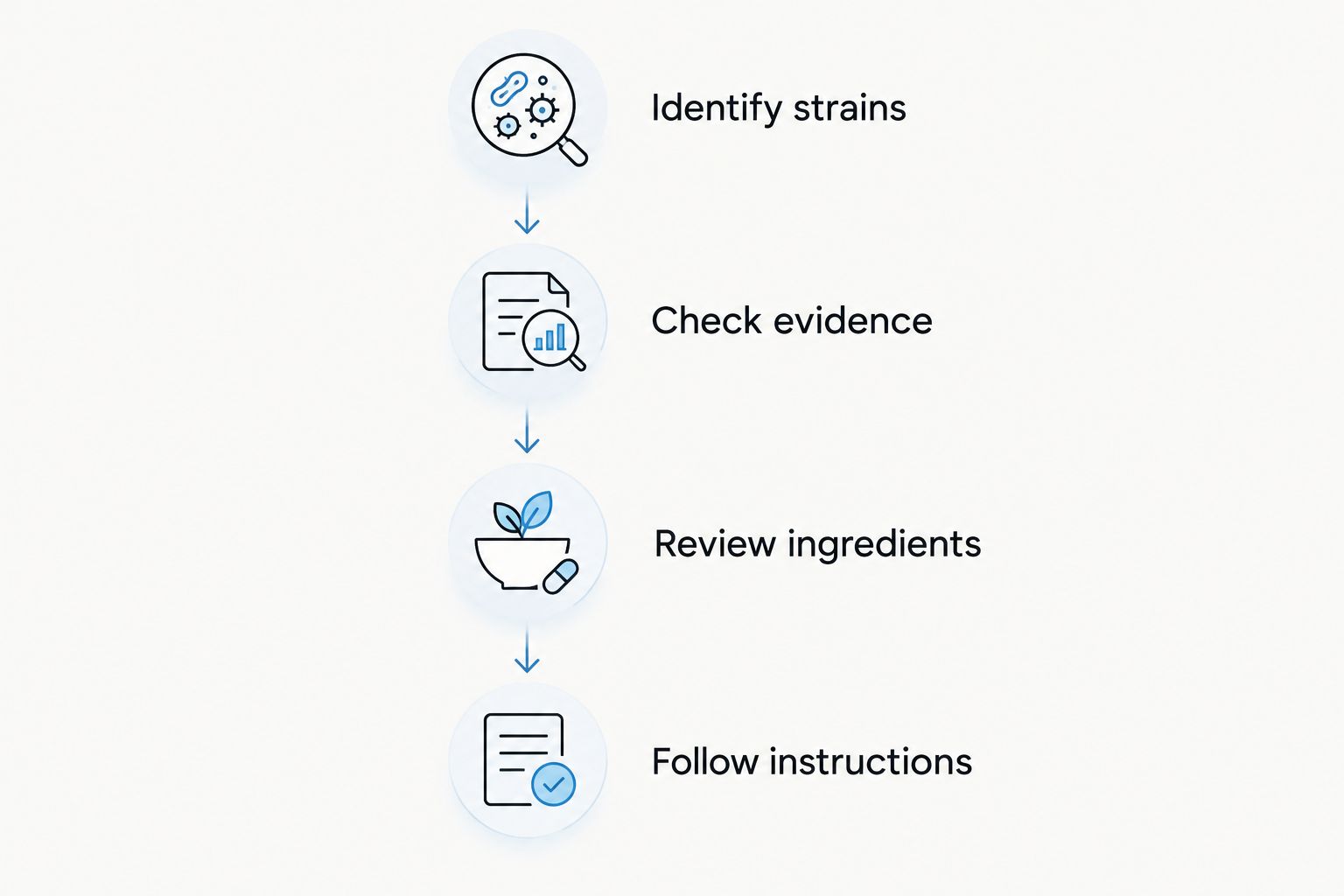
Use this label-reading sequence:
- Identify strains: Find the complete microbial identities.
- Check evidence: Look for research relevant to your goal.
- Review ingredients: Examine everything beyond the microbes.
- Follow instructions: Check storage, serving, and administration directions.
1. Advanced Probiotics GI Support: best for probiotic-focused review
Advanced Probiotics GI Support Low FODMAP Gut Friendly is the most direct starting point in this shortlist when your question concerns a probiotic rather than a synbiotic or an enzyme combination. Its product name places probiotics and GI support at the center of the comparison. That is a reason to inspect its label first, not a clinical superiority claim.
For your 2026 comparison, focus on the listed organisms, their strain designations, and the dose instructions. Then ask whether evidence for those exact organisms or that formulation applies to your intended use. A general digestive-support description cannot answer that question alone.
Advanced Probiotics GI Support pros:
- Provides a probiotic-focused starting point for comparison.
- Has explicit low FODMAP positioning.
- Keeps the initial buying question centered on probiotic selection.
Advanced Probiotics GI Support cons:
- GI support positioning does not establish a specific treatment effect.
- Low FODMAP positioning does not establish strain diversity.
- A product name cannot substitute for full strain and dose information.
Best for: You want to evaluate a probiotic-focused option before considering a formula with several advertised ingredient categories.
Verdict: Hold until the current label and relevant evidence match your goal. Choose Advanced Probiotics GI Support for its fit with your selection criteria, not because its name implies the highest strain count.
2. Advanced Probiotic Prebiotic Synbiotic: best for combined selection
Advanced Probiotic Prebiotic Synbiotic Low FODMAP Gut Friendly is the option to examine when you specifically want to compare probiotic and prebiotic components together. A prebiotic is a substrate selectively used by host microorganisms that confers a health benefit. A synbiotic combines live microorganisms with a substrate intended to support microbial activity.
That makes ingredient review essential. Do not count a prebiotic as another probiotic strain, and do not assume a synbiotic contains greater microbial diversity than a probiotic-only formula. These are different formulation questions.
For sensitive digestion, identify the added substrate and its amount before deciding whether the combination fits your plan. Your response to one prebiotic does not establish your response to every prebiotic ingredient. Keep the evaluation specific.
Advanced Probiotic Prebiotic Synbiotic pros:
- Fits a deliberate probiotic-plus-prebiotic comparison.
- Has explicit low FODMAP positioning.
- Lets you evaluate the microbial and substrate components together.
Advanced Probiotic Prebiotic Synbiotic cons:
- Requires a separate review of the prebiotic ingredient.
- Does not establish greater strain diversity through its name.
- A combined formula makes attribution harder if symptoms change.
Best for: You and your clinician have a reason to consider both a probiotic and a prebiotic, rather than adding a prebiotic simply to obtain a longer ingredient list.
Verdict: Hold until both components fit your needs. Skip Advanced Probiotic Prebiotic Synbiotic if your only reason for choosing it is the assumption that “synbiotic” means more strains.
3. FODMAP Digestive Enzymes combination: best for broader formula review
FODMAP Digestive Enzymes + Prebiotics + Probiotics + Postbiotics combines several digestive-support categories in one named product. Its supplied description states that it is FODMAP Friendly certified, formulated by Onikepe Adegbola, MD PhD, and third-party tested. Those are product-specific attributes, not evidence that every ingredient addresses every digestive complaint.
The distinction matters when ranking diversity. Digestive enzymes are not probiotic strains, and postbiotics are not additional live probiotic strains. Count only the identifiable live microbial strains when comparing probiotic diversity.
This formula deserves consideration when you intentionally want to review a combination product. It is a less direct choice when your immediate question is whether a particular probiotic component agrees with you, because several components enter the comparison together.
FODMAP Digestive Enzymes combination pros:
- Combines enzymes, prebiotics, probiotics, and postbiotics.
- Has an explicit FODMAP Friendly certification statement.
- Has named physician formulation and third-party testing statements.
FODMAP Digestive Enzymes combination cons:
- Ingredient-category breadth does not establish microbial diversity.
- Multiple components make symptom attribution harder.
- Certification and testing statements do not prove treatment efficacy.
Best for: You have a clear reason to consider several digestive-support categories together and can review each component against your needs.
Verdict: Hold until the full combination fits your plan. Skip FODMAP Digestive Enzymes + Prebiotics + Probiotics + Postbiotics as a shortcut to the “most diverse” probiotic; that is not what its category list measures.
The following Casa de Sante products represent two distinct buying questions: a probiotic-focused formula and a broader digestive-support combination. Compare their current labels before choosing; the product cards are not a strain-count ranking.


How these options are ranked
The shortlist follows a decision sequence: probiotic-focused review first, deliberate probiotic-plus-prebiotic selection second, and broader combination review third. That order helps you separate the question you are trying to answer from additional formulation features.
The criteria remain strain identity, relevant evidence, viable dose, ingredient tolerance, and practical use. No product earns a clinical advantage merely by containing more strains. Likewise, physician formulation, testing, and low FODMAP positioning answer different questions from condition-specific efficacy.
For a strict 2026 numerical comparison, sort products only after establishing the distinct strain identities on each label. Keep that count separate from the recommendation. The most diverse formula and the most appropriate formula need not be the same product.
Which probiotic should you choose in 2026?
Choose the simplest formulation that meets your evidence and tolerance requirements. Start by defining what you want to evaluate: bowel symptoms, an antibiotic-related concern, or another clinician-identified goal. Then look for evidence relevant to that goal rather than collecting unrelated probiotic claims.
Casa de Sante probiotics are best suited to shoppers seeking physician-formulated low FODMAP digestive supplements. That positioning makes the brand relevant to this audience, but it does not replace an individual assessment of strain identity, ingredients, and suitability.
If you are undecided, review a probiotic-focused formula before adding other categories. That is a cleaner comparison—not a guarantee that a simpler product will work better. Choose a synbiotic or enzyme combination only when its additional components have a purpose in your plan.
Make your evaluation interpretable:
- Introduce 1 new supplement at a time unless your clinician directs otherwise.
- Select 1 primary symptom to record consistently.
- Record bowel changes, discomfort, and other relevant effects alongside it.
- Agree on a review point with your clinician rather than assuming indefinite use.
IBS, SIBO, and medication-related digestive symptoms are not interchangeable diagnoses. Do not use a diversity ranking to decide whether you need a probiotic, or to replace prescribed treatment. People who are seriously ill or immunocompromised should obtain medical advice before using live-microorganism supplements.
Severe abdominal pain, persistent vomiting, blood in the stool, or signs of dehydration require medical assessment. A new supplement is not the next step for those symptoms.
FAQ
What's the best probiotic ranked by strain diversity?
The best choice is not automatically the probiotic with the most strains. Compare fully identified strains and evidence for your intended use, then assess dose, ingredients, and suitability.
Is a multi-strain probiotic better than a single-strain probiotic?
A multi-strain probiotic is not automatically better than a single-strain probiotic. Evidence for the exact strain or formulation and your intended use matters more than the number of strains.
How do I count the strains in a probiotic?
Count distinct microbial entries with complete strain designations. A list containing only species names establishes species diversity, not a verified count of distinct strains.
Does a higher CFU count mean more strain diversity?
A higher CFU count does not mean more strain diversity. CFU measures viable microbial quantity, while strain diversity describes the variety of distinct strains.
Does a low FODMAP probiotic guarantee less bloating?
Low FODMAP positioning does not guarantee less bloating. It addresses a different question from whether a particular probiotic formulation improves your symptoms or agrees with you.
Is a synbiotic the same as a multi-strain probiotic?
A synbiotic is not the same as a multi-strain probiotic. Synbiotic describes a combination of live microorganisms and a substrate; multi-strain describes the variety of microbial strains.
Can probiotics replace treatment for SIBO or GLP-1 side effects?
Probiotics should not replace prescribed treatment for SIBO or medical assessment of GLP-1 side effects. Ask your clinician whether a probiotic has a role in your individual treatment plan.
Do digestive enzymes and postbiotics count as probiotic strains?
Digestive enzymes and postbiotics do not count as additional live probiotic strains. Evaluate those components separately when comparing a combination supplement with a probiotic-focused formula.
One last thing
A longer microbial list is not the same as a more useful microbial list. In 2026, keep two separate notes: what strains the product contains, and why those strains fit your goal. If you can answer only the first question, you have compared diversity—not established the best probiotic for you.









