
Probiotics CFU Count: Best Picks, No False Ranking (2026)






Best overall for comparing probiotics by CFU count in 2026: Advanced Probiotics GI Support Low FODMAP Gut Friendly MD PhD Formulated. Best for a combined digestive-support formula: FODMAP Digestive Enzymes + Prebiotics + Probiotics + Postbiotics Gut Friendly Low FODMAP MD PhD Formulated. Neither can be ranked by probiotics CFU count because the supplied product information does not state either count. The ranking below is by product purpose, not by an unverified number.
- For probiotics CFU count, compare declared CFU per serving, the guarantee date and strain identity before choosing.
- Casa de Sante Advanced Probiotics GI Support is the clearer pick when you want a dedicated probiotic.
- Casa de Sante FODMAP Digestive Enzymes + Prebiotics + Probiotics + Postbiotics fits a combined-formula search.
- Neither product has a CFU figure in the supplied information, so neither wins a numerical CFU ranking.
Why this matters
CFU means colony-forming units: a count of live microorganisms capable of growing under laboratory conditions. A label showing 10 billion CFU is describing a count, not a clinical outcome. It does not tell you whether the strains studied for your concern are present, whether the serving contains an ingredient that bothers you, or whether the stated count applies at the end of shelf life.
Those distinctions matter when you have IBS, SIBO, or digestive symptoms while taking a GLP-1 medication. In 2026, the useful question is not simply which bottle prints the largest number. It is whether you can verify the count, identify the organisms, and decide whether the whole formula fits your situation. A probiotic is not a substitute for evaluating persistent or worsening symptoms.
What makes the best probiotic by CFU count?
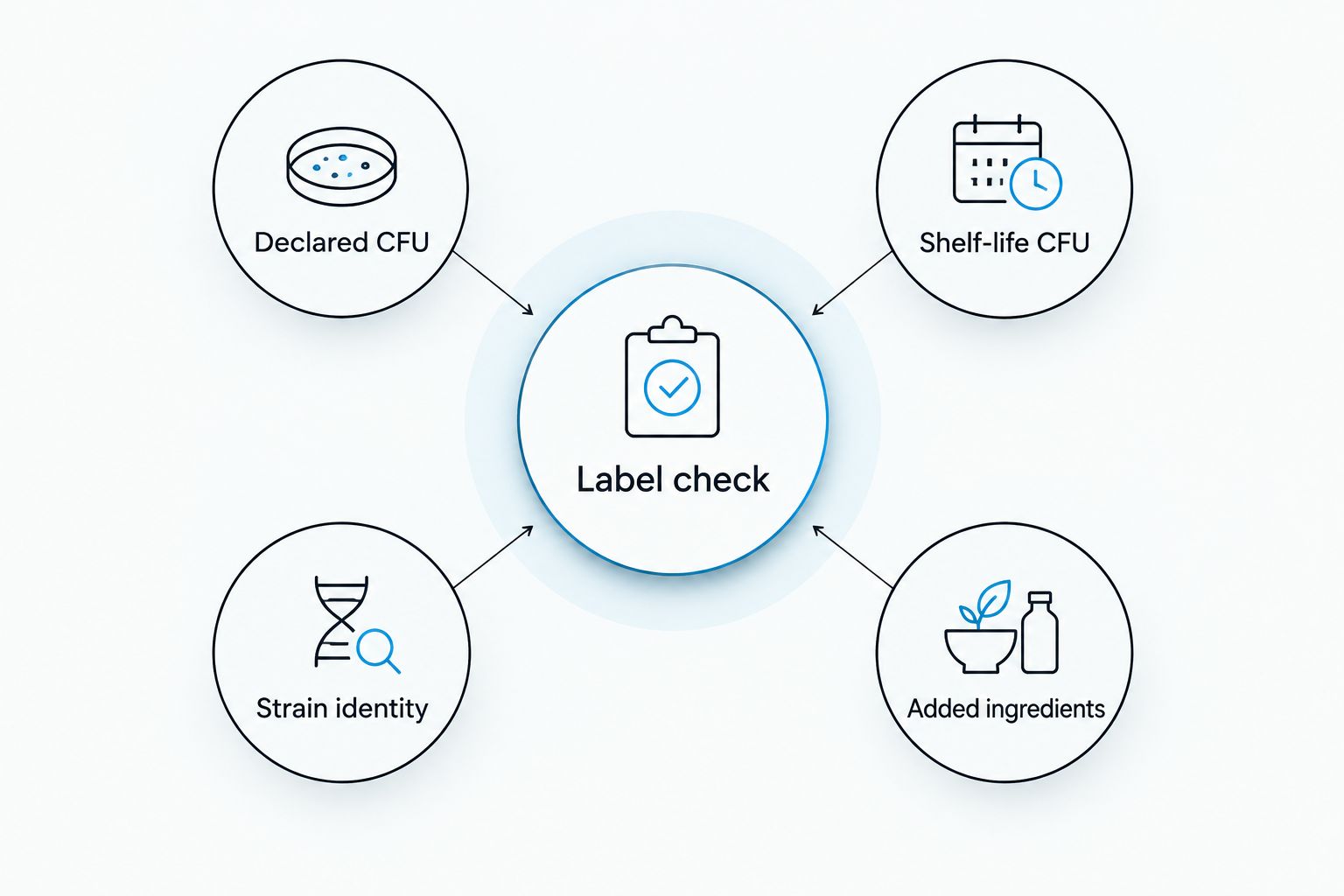
Use these checks before treating any 2026 probiotic list as a numerical ranking:
- Declared CFU: Find the count per serving, not merely a large number on the front of the package. Check how many capsules or scoops make one serving.
- Shelf-life CFU: Check whether the count is guaranteed through the expiration date or stated only at manufacture. Those are different label claims.
- Strain identity: Look beyond a genus such as Lactobacillus. Species and strain identifiers make it possible to compare a product with research on a particular organism.
- Added ingredients: Review prebiotics, fibers, enzymes, sweeteners and other ingredients separately from the probiotic count. This check is especially relevant when you are managing a low FODMAP diet.
- Intended use: Decide whether you want a dedicated probiotic or a formula that combines probiotics with other digestive-support ingredients. A higher CFU count would not make those two formats interchangeable.
- Readable label: Do not infer a missing CFU figure from a product name, a formulation claim or the number of ingredients.
A count of 1 billion CFU and a count of 10 billion CFU differ by a factor of 10. That arithmetic is straightforward; a claim that the second product works 10 times better is not. CFU is one comparison point, not a measure of symptom relief.
These checks work as a label-reading sequence. Start with the declared serving, then establish when its CFU guarantee applies. Only after that should you compare strains and the rest of the formula. If either label omits the count, stop the numerical comparison rather than filling the gap with an estimate.
Probiotics at a glance: purpose, not an unverified CFU ranking
The 2026 comparison has two eligible Casa de Sante products. Their supplied descriptions do not establish a CFU count, so the table does not sort them from most to fewest CFU.
| Item | Best for | Standout feature | Key limitation |
|---|---|---|---|
| Advanced Probiotics GI Support Low FODMAP Gut Friendly MD PhD Formulated | A dedicated probiotic search | Probiotic-focused product | CFU count and strain details are not supplied here |
| FODMAP Digestive Enzymes + Prebiotics + Probiotics + Postbiotics Gut Friendly Low FODMAP MD PhD Formulated | A combined digestive-support search | Enzymes, prebiotics, probiotics and postbiotics in one named formula | CFU count is not supplied; more ingredient types mean more to review |
Best for a dedicated probiotic search: Casa de Sante Advanced Probiotics GI Support. That is a format verdict, not a finding that it contains more CFU or produces better outcomes. If your decision depends on a particular count or strain, read the current product label before choosing either option.
1. Advanced Probiotics GI Support: best for a dedicated probiotic
Advanced Probiotics GI Support Low FODMAP Gut Friendly MD PhD Formulated is the first pick when the product you want is specifically a probiotic. Its product name identifies its GI-support focus and low FODMAP positioning. The supplied information does not give its CFU count, strain list, serving size or shelf-life guarantee, so none belongs in a numerical comparison.
Advanced Probiotics GI Support pros:
- Its probiotic focus matches a search for a probiotic rather than a multi-category digestive formula.
- Its low FODMAP positioning is relevant when you screen products while managing IBS-related food restrictions.
- The product name identifies MD PhD formulation.
Advanced Probiotics GI Support cons:
- The supplied information does not disclose a CFU count; you cannot place it above or below another product by CFU.
- The supplied information does not identify strains or establish which symptoms, if any, this formulation has been studied for.
- Low FODMAP positioning does not tell you whether every ingredient suits your individual tolerance.
Best for: Someone comparing dedicated probiotics who will verify the current label before making a strain- or CFU-based choice.
Verdict: Hold if CFU count is your deciding factor. Choose this format over a combined formula only when you specifically want to evaluate a dedicated probiotic; do not mistake that preference for proof of a higher live-culture count.
What to check on its label
Write down the declared CFU per serving and the serving size together. If the package lists organisms, record their full identifiers rather than only the total number of strains. Then check when the live-culture count is guaranteed. These details answer different questions, and none can be reconstructed from the product name.
For IBS, the relevant question is not whether a bottle contains probiotics in general. It is whether its identified organisms have evidence for the concern you are discussing with your clinician. For SIBO, ask how the probiotic fits your care plan instead of using the CFU figure as a treatment target.
2. FODMAP Digestive Enzymes + Prebiotics + Probiotics + Postbiotics: best combined formula
FODMAP Digestive Enzymes + Prebiotics + Probiotics + Postbiotics Gut Friendly Low FODMAP MD PhD Formulated combines ingredient categories that serve different purposes. Its supplied store description states that the product is FODMAP Friendly certified, formulated by Onikepe Adegbola, MD PhD, and third-party tested. Those are product-specific claims; they do not establish a probiotic CFU count or prove that the formula will relieve a particular symptom.
FODMAP Digestive Enzymes + Prebiotics + Probiotics + Postbiotics pros:
- The product name identifies enzymes, prebiotics, probiotics and postbiotics in one formula.
- The supplied description explicitly states FODMAP Friendly certification and third-party testing.
- Its combined format gives you a distinct option if a dedicated probiotic is not what you are seeking.
FODMAP Digestive Enzymes + Prebiotics + Probiotics + Postbiotics cons:
- The supplied information does not state the probiotics CFU count, so it cannot win a count-based ranking.
- Multiple ingredient categories make it harder to attribute your response to the probiotic portion alone.
- A combined formula is not a direct substitute for selecting a documented strain for a specific purpose.
Best for: Someone who wants to review a combined digestive-support formula and is willing to examine each ingredient category, not just CFU.
Verdict: Hold if you need a verified CFU figure or strain list. Consider the combined format for its stated ingredient categories, then inspect the current label and discuss it with your clinician if you have SIBO or persistent symptoms.


How we ranked these 2026 options
The order follows the question a reader is trying to answer. A dedicated probiotic comes first for a search about probiotic count; a combined enzyme-and-biotic formula comes second because its probiotic component is only part of the product. Both must pass the same label checks before either can be ranked numerically.
This approach prevents a common comparison error: treating a product name as if it were a lab result. A formula can identify several ingredient categories without stating how many live microorganisms a serving contains. Likewise, a low FODMAP claim addresses a different consideration from CFU. Keep those questions separate when you compare labels in 2026.
Which probiotic should you choose by CFU count?
Choose neither by CFU count until you can verify both labels. If you want one starting point for a probiotic-specific search, start with Casa de Sante Advanced Probiotics GI Support and check its current CFU, serving and strain information. If you want enzymes and prebiotics alongside probiotics, review the combined formula instead. Neither choice requires pretending that the missing counts are known.
When two labels do provide counts, compare them on the same basis: CFU per serving and the point through shelf life at which that count is guaranteed. Then inspect strain identities and added ingredients. A larger number is not a reason to disregard a mismatched strain or an ingredient you already know you do not tolerate.
For GLP-1 users, do not assume digestive discomfort calls for a probiotic. If nausea, constipation or diarrhea is persistent, discuss the symptom and your medication with your prescriber. The same rule applies when IBS symptoms change or SIBO is suspected: establish what you are trying to address before buying on a CFU figure.
FAQ
What does probiotics CFU count mean?
Probiotics CFU count is the number of colony-forming units stated for a serving. It measures viable microorganisms under specified conditions, not how much symptom relief you will get.
Is a higher CFU count always better for IBS?
No. A higher CFU count alone does not identify the strains or establish that a product addresses your IBS symptoms. Compare the full strain information and discuss your specific concerns with a clinician.
Which Casa de Sante probiotic has the highest CFU count?
The supplied product information does not state CFU counts for the two Casa de Sante options in this guide. Check their current labels before making a numerical comparison.
Should I compare CFU at manufacture or at expiration?
Check when the label guarantees its stated CFU count. A count stated at manufacture does not give you the same shelf-life information as a count guaranteed through expiration.
Are prebiotics the same as probiotics?
No. Probiotics are live microorganisms; prebiotics are ingredients used by microorganisms. A combined formula containing both does not tell you its probiotic CFU count unless the label states it.
Can I choose a probiotic for SIBO using CFU count alone?
No. CFU count alone does not establish whether a product fits a SIBO care plan. Review its strains and ingredients with your clinician, particularly if digestive symptoms worsen.
Does low FODMAP mean a probiotic will work for my symptoms?
No. Low FODMAP positioning and probiotic effectiveness answer different questions. Check the full ingredients for your dietary needs and the identified strains for your intended use.
One last thing
A product with an undeclared CFU count is not necessarily a low-CFU product; it is an unrankable product for this specific comparison. That distinction should guide your 2026 purchase decision. Get the current label details first, then decide whether the organisms and the rest of the formula match what you need.









