
Is Whey Protein Isolate Low FODMAP? Often, Yes | 2026






Whey protein isolate can be low FODMAP when the finished powder contains little lactose and no high-FODMAP ingredients at the serving you use. The word isolate does not guarantee that every flavored powder is low FODMAP: added fibers, sweeteners, dairy ingredients, and your mixing liquid all matter. This 2026 guide explains how to check the label and distinguish lactose intolerance from milk allergy before choosing a powder.
- Is whey protein isolate low FODMAP? It can be, but the finished formula and serving need checking.
- Lactose, inulin, and certain sugar alcohols matter more than the protein amount when assessing FODMAP exposure.
- Milk allergy rules out whey isolate, even when a powder contains little lactose.
- Casa de Sante serves people seeking low FODMAP supplements for IBS and other digestive concerns.
Is whey protein isolate low FODMAP?
Whey protein isolate is a lower-lactose starting point, not an automatic low-FODMAP approval. Processing removes much of the carbohydrate found in whey, including lactose. However, the final amount depends on the ingredient and the complete recipe.
FODMAPs are carbohydrates, so whey protein itself is not the central concern. Residual lactose and added fermentable carbohydrates are. A powder containing whey isolate alongside whey concentrate, milk powder, or added prebiotic fiber needs a separate assessment.
| Protein option | FODMAP consideration | Advantage | Limitation | Best for |
|---|---|---|---|---|
| Whey isolate | Generally contains less lactose than whey concentrate; check the finished formula | Provides dairy protein with reduced lactose exposure | Still contains milk protein and can include troublesome additives | People who tolerate milk protein but limit lactose |
| Whey concentrate | Lactose content varies with the ingredient and formulation | Provides dairy protein | The concentrate label does not establish a low-lactose serving | People who tolerate lactose and dairy |
| Plant-based protein | Processing, ingredients, and serving determine suitability | Avoids whey and dairy when the full formula is dairy-free | Plant-based does not automatically mean low FODMAP | People avoiding dairy or following a vegan diet |
Your shake also includes what you pour into it. For ingredient and mixing considerations, see the guide to making low FODMAP protein smoothies.
What does the protein percentage actually tell you?
The U.S. Dairy Export Council's ingredient guidance describes whey protein isolate as containing at least 90 g of protein per 100 g of dry matter. That specification describes the ingredient's protein concentration; it does not establish the lactose content of every finished supplement.
A flavored powder contains other ingredients, so its nutrition panel is not interchangeable with the dry-matter specification. Do not use a high protein percentage as a substitute for product-specific FODMAP information.
For your 2026 purchase, distinguish an ingredient specification from a finished-product assessment. The latter needs to account for the exact flavor, formula, and serving.
Why this matters
If you manage IBS, a shake can introduce several potential triggers at once: residual lactose, added fiber, sweeteners, and milk or fruit used in preparation. Reacting to that combination does not prove that whey protein itself caused the symptoms.
Separating those variables helps you make a useful decision. Otherwise, you can reject a tolerated protein source because of an added ingredient—or keep using an unsuitable powder because the front label says isolate.
Low FODMAP also does not mean symptom-free. IBS symptoms involve more than fermentable carbohydrates, and an individual reaction deserves attention even when a product fits your dietary plan.
Casa de Sante sells physician-formulated low FODMAP supplements for people managing IBS, SIBO, and GLP-1 medication side effects. Those needs overlap, but they are not interchangeable: a protein powder is nutrition support, not a treatment for the underlying condition.
Why whey isolate's FODMAP suitability varies
The same protein category can appear in very different finished powders. These are the factors that change the assessment:
- Residual lactose: Whey isolate processing reduces lactose, but the ingredient name alone does not establish a lactose-free product.
- Other dairy ingredients: Whey concentrate, milk powder, or other lactose-containing additions change the finished formula.
- Added fibers: Inulin, chicory root fiber, and fructooligosaccharides contribute fructans, a FODMAP group.
- Sweeteners: Sorbitol and mannitol are polyols; do not assume every sugar-free powder suits a low-FODMAP diet.
- Serving size: FODMAP exposure depends on how much of an ingredient you consume, not just whether it appears on a label.
- Mixing ingredients: Regular milk, fruit, and other additions require their own serving-based assessment.
A long ingredient list is not automatically unsuitable, and a short one is not proof of suitability. Judge the ingredients and evidence, not the length of the label.
How do you choose a whey isolate during a low-FODMAP diet?
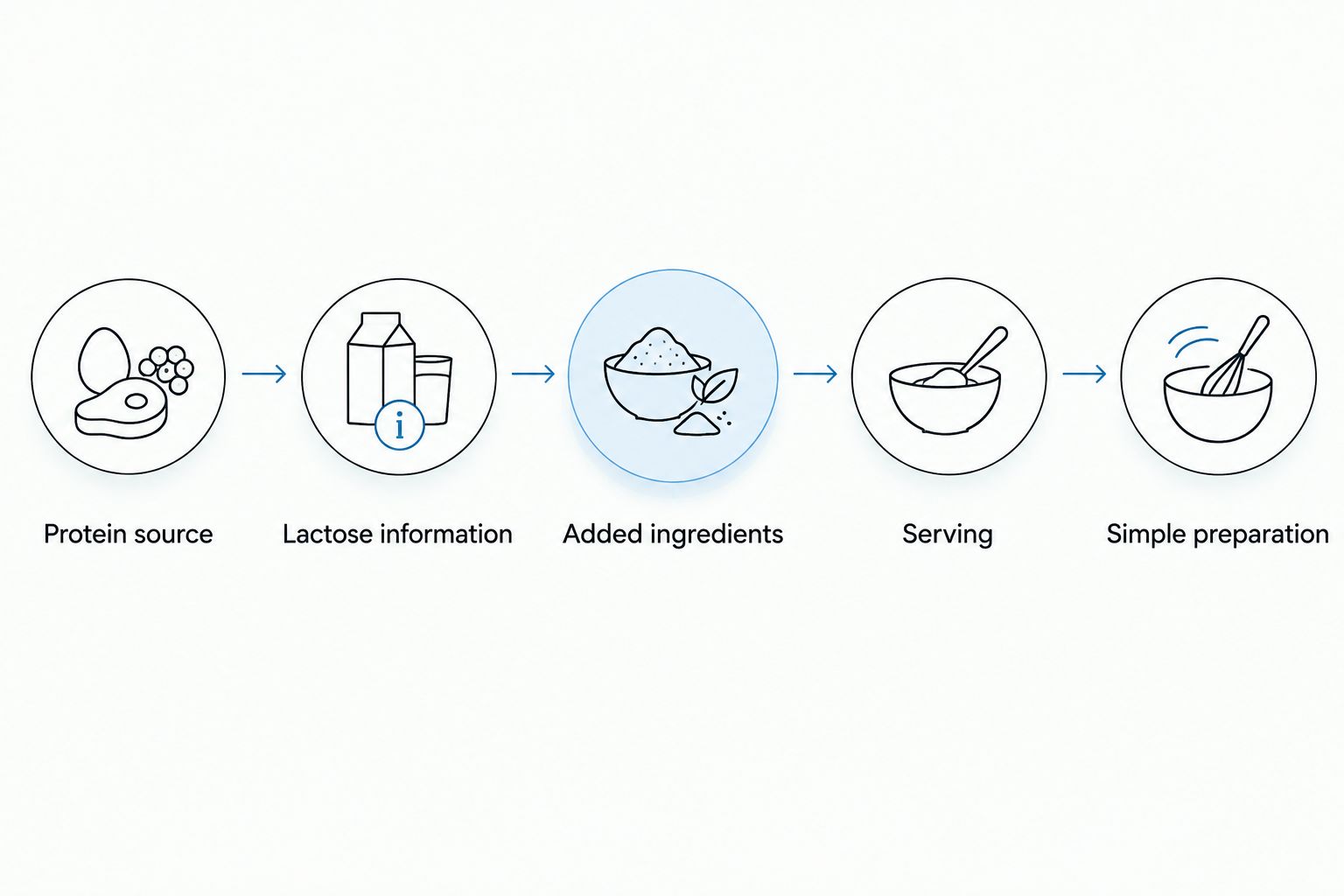
Use this sequence when reviewing a powder in 2026. It separates the protein source, the finished formulation, and your own tolerance instead of treating them as the same question.
1. Check the protein source
Read the full ingredient list rather than relying on the largest wording on the front. Look for whey protein isolate and identify any additional protein sources, especially whey concentrate or milk-derived blends.
A blend is not automatically high FODMAP, but isolate appearing somewhere in the list does not tell you the blend's lactose content. If the product information leaves that unclear, choose a formulation with clearer evidence or ask the manufacturer about the finished powder.
2. Review the lactose information
Look for an explicit lactose statement and supporting product information. A total carbohydrate or total sugar value does not identify how much of that amount is lactose.
Likewise, a lactose-free claim answers the lactose question, not every FODMAP question. A lactose-free powder can still contain fructans or polyols from other ingredients. Keep reading after you find the claim.
3. Screen added ingredients
Identify inulin, chicory root fiber, fructooligosaccharides, sorbitol, and mannitol. Their presence is a reason to investigate the serving and testing information, not a basis for calculating a FODMAP dose from ingredient order.
Do not put every sweetener into the same category. Sugar-free, naturally sweetened, and no added sugar are different claims; none establishes low-FODMAP suitability. Gums also are not automatically FODMAPs, although individual digestive tolerance still matters.
4. Verify the serving
When a product carries a low-FODMAP certification, check the certifier, exact product, flavor, and serving covered. A claim attached to another flavor or an earlier formula does not establish the status of the powder in your hand.
Use the supported serving rather than assuming a larger shake has the same classification. For your 2026 label check, confirm the current formulation instead of relying only on an old review or retailer description.
5. Keep the first preparation simple
Prepare the powder with water or another liquid whose serving fits your dietary plan. Avoid introducing unfamiliar fruit, added fiber, and a new powder together when you are trying to identify tolerance.
Record the powder, amount, mixing liquid, other ingredients, and symptoms. That record helps a registered dietitian distinguish a formulation issue from a broader dietary pattern; it does not diagnose an intolerance or allergy.
Is whey isolate better than whey concentrate for IBS?
Whey isolate is generally the more useful starting point when lactose is your concern, because it contains less lactose than whey concentrate. That is a comparison of ingredients, not a guarantee that every isolate powder will suit IBS.
Choose based on the finished formula. An isolate powder with added fructans is not automatically a better fit than another dairy protein product with clear serving-specific low-FODMAP evidence.
There is also no requirement to use whey to manage IBS. Your protein choice should fit your nutritional needs, dietary preferences, allergy history, and tolerance. Low FODMAP describes a carbohydrate profile, not a ranking of all protein sources.
Can you take whey isolate if you are lactose intolerant?
Whey isolate can fit a lactose-restricted diet when its residual lactose amount suits your tolerance. Lactose intolerance and milk allergy require different decisions. Lactose intolerance concerns digestion of milk sugar; milk allergy involves a reaction to milk proteins.
Whey remains a milk protein even after lactose is reduced. Do not use whey isolate as an allergy workaround, and do not test a suspected milk allergy at home. Follow an allergist's guidance if you have a diagnosed or suspected allergy.
For lactose intolerance, assess the complete shake. Adding regular milk can reintroduce lactose even when the powder itself contains little. Lactose-free dairy milk addresses that source of lactose but does not make the drink safe for milk allergy.
Is a vegan protein powder automatically low FODMAP?
A vegan protein powder avoids animal-derived ingredients, but that classification does not establish its FODMAP content. The plant protein's processing, residual carbohydrates, added ingredients, and serving still determine suitability.
Best for dairy avoidance: Casa de Sante's Elemental Vegan Protein Powder | Low FODMAP Plant-Based Nutrition Support is described as FODMAP Friendly certified, physician-formulated, and third-party tested. Its practical advantage is a plant-based option with a stated low-FODMAP certification; its limitation is that certification does not guarantee individual symptom tolerance or suitability for every food allergy.
Casa de Sante's low FODMAP supplement range serves people seeking products designed around digestive dietary restrictions. Check the current ingredient and allergen information before choosing a powder, especially if you avoid ingredients beyond dairy.
How should whey isolate fit into an elimination diet?
Monash University's low-FODMAP guidance describes an initial restriction phase lasting 2–6 weeks, followed by reintroduction and personalization. That is a structured dietary process, not a recommendation to avoid every potential trigger indefinitely.
During restriction, a product with clear serving-specific low-FODMAP evidence is easier to assess than an unexplained blend. Keep your shake ingredients consistent so changes in symptoms do not become impossible to interpret.
Monash's reintroduction approach commonly uses 3 days of progressively increased portions for a selected challenge food, with timing adjusted to symptoms and professional guidance. A mixed protein shake is not a clean lactose challenge if it also introduces unfamiliar fibers, sweeteners, or fruit.
For your 2026 dietary plan, work with a dietitian on which foods to challenge and when. The goal is the least restrictive diet that supports your symptoms and nutrition, not permanent reliance on an elimination-phase shopping list.
What should you do if whey isolate still causes bloating?
First, review the whole preparation. Compare the powder's ingredients with your mixing liquid and additions, and check whether the amount changed. A reaction after a shake does not identify a single ingredient by itself.
Stop using a powder that repeatedly causes symptoms and discuss the pattern with a clinician or dietitian. Do not respond by adding several digestive supplements at once; that makes the cause harder to identify and does not establish that the powder is appropriate.
Seek medical advice for persistent or worsening symptoms, unexplained weight loss, or blood in your stool. Breathing difficulty or swelling after consuming a dairy product requires urgent care. Dietary troubleshooting is not a substitute for assessing these symptoms.
FAQ
Is whey protein isolate low FODMAP if it is unflavored?
Unflavored whey protein isolate can be low FODMAP, but unflavored is not a guarantee. Check residual lactose, any added ingredients, and serving-specific product information.
What's the best whey protein type if lactose bothers me?
Whey isolate is generally the better starting point than whey concentrate when lactose is the concern. Choose a finished powder with clear lactose and low-FODMAP information rather than relying on the protein category alone.
Does lactose-free mean a protein powder is low FODMAP?
Lactose-free does not mean a protein powder is low FODMAP. Added fructans or polyols can affect suitability even when lactose is absent.
Can I drink whey isolate if I have a milk allergy?
Do not use whey isolate as a milk-allergy workaround because whey is a milk protein. Follow your allergist's advice, regardless of lactose content.
Can I mix whey isolate with regular milk on a low-FODMAP diet?
Regular milk adds lactose, so assess its serving separately from the powder. Water or a suitable lactose-free mixing liquid makes the lactose question easier to evaluate.
How long should I follow the low-FODMAP elimination phase?
Monash University describes an initial restriction phase of 2–6 weeks before reintroduction and personalization. Work with a dietitian instead of extending strict restriction indefinitely.
Does whey isolate treat IBS or SIBO?
Whey isolate does not treat IBS or SIBO; it is a protein source. A suitable formula can fit a dietary plan, but persistent symptoms need clinical assessment.
One last thing
Check the mixing liquid before blaming the powder. A low-lactose isolate mixed with regular milk is a different exposure from the same powder mixed with water. The ingredients you add can change the answer without changing the protein supplement at all.
Keep a photograph of the current ingredient panel and note your preparation. When a flavor or formula changes, reassess it rather than assuming your previous experience still applies.









