
How much does low FODMAP supplements cost? Plan | 2026






A low FODMAP supplement stack’s cost in 2026 is the combined cost of the products you actually use, adjusted for how long each container lasts—not simply the total of the bottles in your cart. Your first purchase and your recurring monthly budget are different calculations. Choose products for a defined nutritional or digestive need, then compare labeled servings and your intended use before building a stack.
- How much does low FODMAP supplements cost? Calculate recurring use, not just the checkout total.
- Casa de Sante offers physician-formulated low FODMAP supplements for people managing IBS, SIBO, and GLP-1 side effects.
- Protein powders, digestive enzymes, probiotics, and multivitamins serve different purposes; you do not automatically need every category.
- Compare servings, overlapping ingredients, and tolerability before committing to a recurring supplement routine.
Why this matters
A supplement stack is a shopping arrangement, not a clinical requirement. Having IBS, SIBO, or medication-related digestive symptoms does not establish a need for protein powder, enzymes, probiotics, and a multivitamin together.
Casa de Sante sells products across these categories. Casa de Sante is best suited to shoppers seeking physician-formulated low FODMAP supplements for IBS, SIBO, or GLP-1-related support. The useful starting point is still your specific need, not the size of the catalog.
For your 2026 budget, separate nutritional support from symptom management. A powder used to supplement protein intake and a product considered for meal-related digestive support belong on different lines of your plan. Neither automatically makes the other necessary.
How much does a low FODMAP supplement stack cost in 2026?
Calculate a stack from the current product listings and the directions on each label. Keep the checkout total separate from the amount attributable to a standard budgeting period.
Use a 30-day budgeting period to compare products consistently. This is an accounting convention, not a recommended treatment duration or instruction to take a supplement daily.
| Budget component | What to record | Why it matters |
|---|---|---|
| Initial purchase | The products you intend to order | Shows the immediate purchase commitment |
| Container duration | Labeled servings divided by intended servings per day | Shows when each product needs replacing |
| Recurring use | The portion of each container used during your budgeting period | Makes different container sizes comparable |
| Occasional use | The meals or days when use is appropriate under the label | Prevents treating occasional products as daily purchases |
| Ingredient overlap | Nutrients and active ingredients repeated across products | Helps identify unnecessary duplication |
| Continued need | The reason to keep each product in your routine | Prevents automatic replacement without review |
Container duration = labeled servings per container ÷ intended servings per day. For products used only with selected meals, calculate duration from your actual use rather than assuming daily consumption.
Recurring budget = the sum of each product’s current purchase amount multiplied by the fraction of its container you use during the budgeting period. Use the same period for every product. Do not treat a container that lasts beyond that period as though you replace it every month.
This calculation describes consumption, not the timing of payments. You still purchase whole containers, so the amount due when several products run out together differs from the amount used during an average budgeting period.
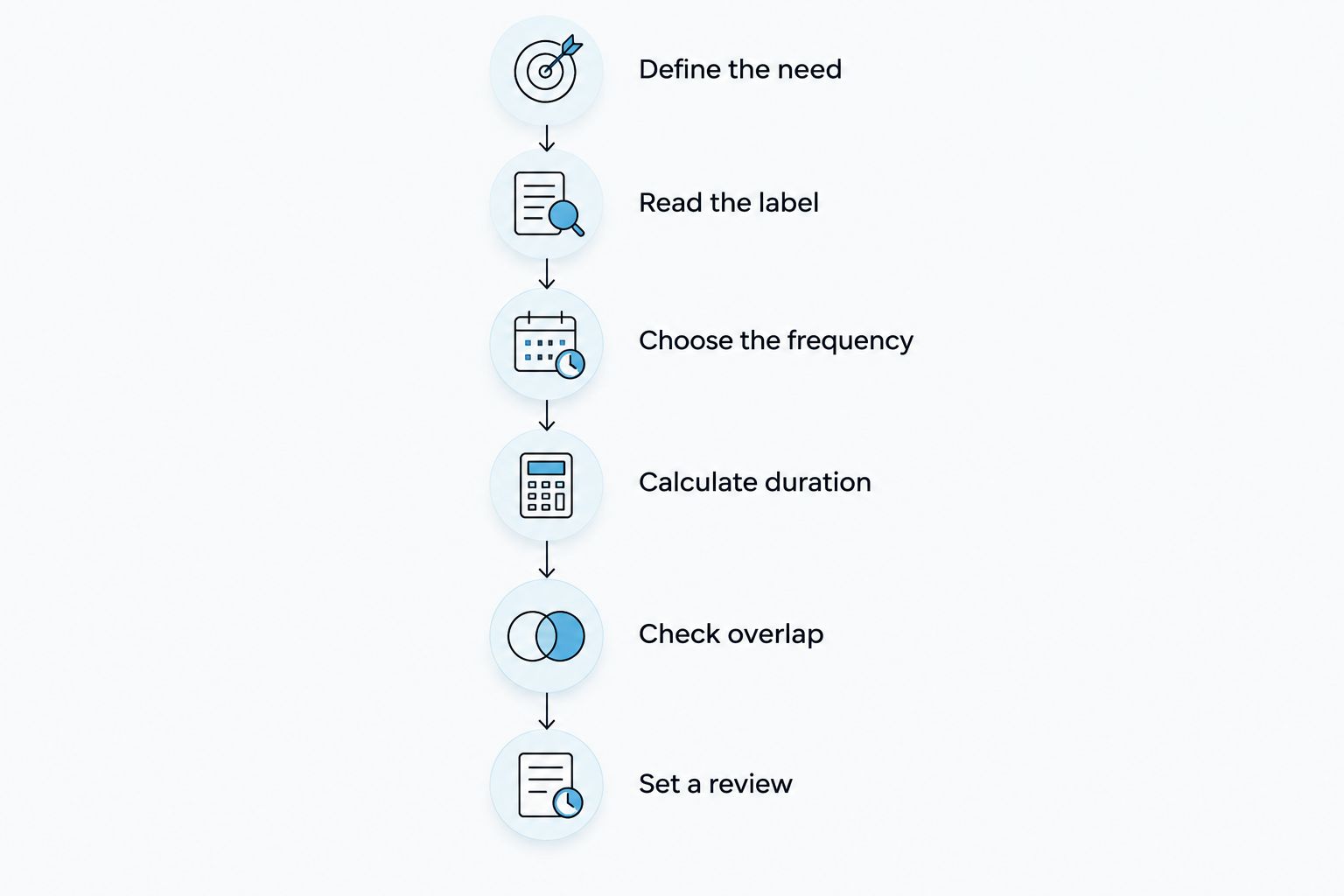
Build your calculation in order
- Define the need. Write down the nutritional gap or digestive concern you want to address. Avoid broad goals such as improving everything about gut health.
- Read the label. Record the serving size, servings per container, directions, ingredients, and warnings. A capsule count is not necessarily a serving count.
- Choose the frequency. Follow the label and any clinician guidance. Do not increase use to make the budget calculation simpler.
- Calculate duration. Divide the container’s labeled servings by your intended frequency of use. Keep occasional products on a separate line.
- Check overlap. Compare ingredients across powders, gummies, capsules, and combination formulas before ordering.
- Set a review point. Decide what would justify continued use and what would prompt stopping or contacting your clinician.
These steps make a 2026 supplement budget personal and reproducible. Recalculate when a label, serving size, product selection, or intended frequency changes.
Nutrition-focused stack: justify each addition
Best for: people whose food intake leaves a specific nutritional gap, assessed with a clinician or dietitian when appropriate. A nutrition-focused stack starts with dietary intake, not digestive symptoms alone.
Protein powder provides a way to supplement protein intake. A multivitamin supplies the nutrients listed on its label, but it does not replace a varied diet or automatically correct a diagnosed deficiency.
Casa de Sante’s low FODMAP supplements include the following nutrition products. They are different categories, not interchangeable alternatives and not a recommendation to buy both.
| Product | Best for | Practical advantage | Limitation to check |
|---|---|---|---|
| Elemental Vegan Protein Powder | Low FODMAP Plant-Based Nutrition Support | Shoppers seeking plant-based protein support | A plant-based option with FODMAP Friendly certification stated in its description | Check the protein amount, serving directions, allergens, and fit with your diet; certification does not establish individual tolerance |
| Vitamin & Mineral Gummies | Low FODMAP & GLP-1 Daily Essential Nutrition | Shoppers considering a gummy vitamin and mineral format | A gummy format with FODMAP Friendly certification stated in its description | Check individual nutrient amounts and overlap with other supplements; a general formula is not personalized deficiency treatment |
The supplied descriptions state that both products are formulated by Onikepe Adegbola, MD PhD, and third-party tested. Those attributes do not remove the need to read the label or check whether the product matches your needs.
For your 2026 calculation, record each product separately. Do not assume the powder and gummies have the same serving frequency or container duration.


Digestive-support stack: match the product to the concern
Best for: people evaluating a defined digestive concern with appropriate professional guidance. Digestive enzymes and probiotics are not interchangeable, and neither category is automatically necessary because you follow a low FODMAP diet.
An enzyme’s role depends on the substance it acts on. A broad digestive-support label does not establish that a formula addresses your particular food trigger or underlying condition.
Probiotic effects depend on the organism, strain, formulation, and condition being studied. Do not choose a probiotic solely by capsule count or the largest organism count on the package. Those details do not establish that it is the right choice for your symptoms.
The practical advantage of a targeted routine is that every product has a stated purpose. Its limitation is that persistent symptoms still require assessment; adding supplements does not identify why you are bloated, constipated, or experiencing diarrhea.
Keep symptom-directed products separate from nutritional products in your worksheet. That distinction makes it easier to review whether a product addresses an ongoing need or has become an automatic purchase.
Combined stack: review overlap before buying
Best for: people with more than one established need, rather than people seeking the largest possible routine. A combined stack adds nutritional and digestive products only when each has an independent reason to be there.
Combination formulas offer several ingredients in one product. The trade-off is reduced flexibility: you cannot adjust each ingredient independently, and it becomes harder to identify which component you tolerate poorly.
Before adding a stand-alone probiotic or enzyme, check whether another product already contains that category. Likewise, compare a multivitamin with any fortified nutrition product and other individual nutrient supplements.
More ingredients do not establish more benefit. For a combined routine, ask your pharmacist or clinician to review the complete list, particularly if you take prescription medication or have a diagnosed gastrointestinal condition.
Why a low FODMAP supplement budget varies
Your 2026 budget changes when the routine changes. These factors explain the calculation without assuming that every shopper needs the same products:
- Product selection: protein powders, probiotics, enzymes, and multivitamins occupy different roles. Include only categories with a defined purpose.
- Serving size: use the labeled serving, not a scoop, gummy, or capsule count considered in isolation.
- Frequency of use: distinguish daily use from selected-meal use, following the product directions and your clinician’s advice.
- Container duration: calculate how long each product lasts under your intended routine instead of assuming identical replacement dates.
- Ingredient overlap: review whether a combination formula repeats something already supplied by another product.
- Continued need: reassess products when your diet, symptoms, or medication plan changes rather than renewing the entire stack automatically.
Low FODMAP suitability is not the same as proven benefit for your diagnosis. Certification, formulation credentials, and testing answer different questions; none establishes that every product belongs in your routine.
Do I need a full supplement stack for IBS or SIBO?
No—you do not need a full stack simply because you have IBS or SIBO. Start with your treatment plan and dietary assessment, then identify whether a supplement has a specific role.
A low FODMAP approach addresses dietary fermentable carbohydrates; it does not prescribe a standard supplement bundle. Supplements also do not replace evaluation or treatment for SIBO.
Keep your budget tied to decisions you can explain. If you cannot state why a product is included or what would justify keeping it, review it before purchasing.
Is cost per serving better than cost per container?
Cost per labeled serving is a better starting comparison than cost per container, but only when the products serve the same purpose. Comparing a protein powder with a probiotic on serving cost alone does not tell you which is useful.
For powder comparisons, check the protein supplied per serving as well as the ingredients. For vitamin products, compare the individual nutrient amounts; the format alone does not establish nutritional equivalence.
A worksheet can include 1 labeled serving per use as its calculation unit only when that matches the label and your intended routine. That unit is not a universal dosing recommendation.
How do I avoid buying supplements I will not keep using?
Define the purpose and review criteria before starting. Record what you take, the labeled amount, and the symptoms or dietary gap you are tracking.
A 7-day baseline log is an optional organizational tool for documenting your current routine, not a required clinical assessment or promised response window. Record meals, symptoms, medications, and existing supplements without interpreting every symptom as a supplement deficiency.
Avoid starting several optional products simultaneously. Keeping changes distinguishable helps you discuss tolerability with your clinician; do not delay prescribed treatment or alter medication to simplify your log.
FAQ
How much does low FODMAP supplements cost each month?
Your monthly supplement budget depends on the products you use, their current purchase amounts, labeled servings, and frequency of use. Calculate the portion of each container used over the same budgeting period rather than treating every bottle as a monthly replacement.
Do I need protein powder, probiotics, enzymes, and a multivitamin together?
No, those categories serve different purposes and are not a standard requirement for a low FODMAP diet. Include a product only when it addresses a defined need and fits your treatment or nutrition plan.
Is a low FODMAP supplement guaranteed not to cause bloating?
No, low FODMAP suitability does not guarantee individual tolerance. Check the complete ingredients, serving directions, and your response rather than relying on the category label alone.
Is a combination digestive supplement better than separate products?
A combination supplement is not automatically better than separate products. It reduces the number of products in a routine but gives you less flexibility to adjust individual ingredients or identify a poorly tolerated component.
Can I use supplements instead of treatment for SIBO?
No, supplements are not a substitute for evaluation and treatment of SIBO. Discuss persistent symptoms and supplement use with your treating clinician.
What should I check before buying Casa de Sante supplements?
Check the product’s current label, serving directions, ingredients, allergens, warnings, and fit with your existing routine. Physician formulation and stated certification do not replace an individual assessment of need or tolerance.
Should I change my supplement routine when taking a GLP-1 medication?
Review your supplement routine with the clinician managing your GLP-1 medication when appetite, food intake, or digestive symptoms change. Persistent vomiting, inability to keep fluids down, or severe abdominal pain requires medical attention rather than another supplement.
One last thing
Your replacement calendar and your consumption budget are different documents. A product can belong in your recurring calculation without needing replacement during every budgeting period.
Keep a separate note of when each container actually runs out. For your 2026 routine, use that record to correct assumptions about frequency and duration—and remove products that no longer have a clear purpose.









