
Best probiotics for leaky gut syndrome






Best overall for leaky gut syndrome: no probiotic is an established treatment. Best for comparing low FODMAP probiotic options: Casadesante. Best budget option: do not buy a supplement before identifying the cause of your symptoms. This 2026 guide ranks three formulations by their intended use—not by unproven claims about repairing your intestinal lining.
- The best probiotics for leaky gut syndrome have no established winner; intestinal permeability is not a supplement diagnosis.
- Casadesante is best suited to shoppers comparing low FODMAP probiotic options, not seeking a proven leaky gut treatment.
- Choose a probiotic, synbiotic, or combination formula according to your symptoms, ingredients, and clinician’s advice.
- More strains or a higher CFU count does not establish better IBS relief or intestinal barrier repair.
What makes the best probiotic for this question?
- Relevant evidence: Human research on the exact strain and condition, not generic gut-health claims.
- Clear labeling: Strain identifiers, serving instructions, storage requirements, and expiration information.
- Ingredient tolerance: Prebiotics, sweeteners, and other ingredients assessed separately.
- Formula fit: A probiotic-only approach versus added prebiotics or digestive enzymes.
- Safety: Your medical history and treatment plan reviewed before use.
Low FODMAP probiotic options at a glance
| Option | Best for | Standout formulation feature | Key limitation |
|---|---|---|---|
| Advanced Probiotics GI Support | Comparing a probiotic-focused option | Low FODMAP probiotic positioning | Does not establish a treatment for intestinal permeability |
| Advanced Probiotic & Prebiotic | Comparing a combined probiotic and prebiotic | Both ingredient categories in one formula | Prebiotic tolerance needs separate consideration |
| FODMAP Digestive Enzymes + Prebiotics + Probiotics + Postbiotics | Reviewing a multi-category digestive supplement | Enzymes and microbiome-related ingredients together | Multiple components complicate identifying what helps or worsens symptoms |
Why this matters
Increased intestinal permeability is a real biological phenomenon. The popular label leaky gut syndrome, however, is not a standardized diagnosis that tells you which supplement to take. Bloating, diarrhea, constipation, and abdominal pain do not identify intestinal permeability on their own.
Treat the diagnosed condition, not the marketing label. IBS, celiac disease, inflammatory bowel disease, infections, and medication effects require different approaches. A supplement selected for general digestive support does not replace that distinction.
Probiotics also are not interchangeable. Evidence for one strain in one condition does not establish that a different blend treats another condition. A result involving antibiotic-associated diarrhea, for example, cannot be relabeled as proof of intestinal barrier repair.
For your 2026 decision, separate two questions: whether your symptoms need medical evaluation, and whether a particular probiotic has a reasonable role in your care. The second question comes after the first.
1. Advanced Probiotics GI Support: best for probiotic-focused shopping
The full product name is Advanced Probiotics GI Support Low FODMAP Gut Friendly MD PhD Formulated. Its stated positioning makes it the first option to examine when you want to compare a low FODMAP probiotic rather than begin with a formula explicitly combining several digestive supplement categories.
That is a shopping distinction, not an efficacy ranking. The product name does not establish its strain-specific evidence, your individual tolerance, or an ability to treat leaky gut syndrome. Read the current supplement label before deciding.
Advanced Probiotics GI Support pros
- Low FODMAP positioning matches the concerns of shoppers managing food-related IBS symptoms.
- Probiotic-focused naming gives you a clear starting point for comparison.
- MD PhD formulation is stated in the supplied product name.
Advanced Probiotics GI Support cons
- Low FODMAP positioning does not establish symptom relief for every person with IBS.
- Physician formulation does not substitute for clinical evidence on the finished formula.
- The name alone does not tell you which strains or other ingredients you will take.
Best for: Someone comparing a probiotic-focused low FODMAP option with a clinician or pharmacist.
Before choosing Advanced Probiotics GI Support, check whether its label identifies organisms down to the strain level. Also review any non-probiotic ingredients rather than assuming the name describes the entire formula.
Casadesante’s low FODMAP probiotic positioning is relevant to ingredient screening, but it is not evidence of intestinal barrier repair. If the reason for taking the product is simply that bloating has been called leaky gut, clarify the symptom diagnosis first.
Verdict: Hold until the current label and your symptom-specific reason for use are reviewed.
2. Advanced Probiotic & Prebiotic: best for a combined formula
The full product name is Advanced Probiotic & Prebiotic | Low FODMAP Daily Gut Health & Microbiome Balance. It combines the probiotic and prebiotic categories in one product, making it a different choice from selecting a probiotic alone.
Probiotics are live microorganisms used for a health benefit; prebiotics are substrates selectively used by microorganisms to confer a health benefit. Combining them does not automatically make a product more effective. The organisms, substrate, amount, and intended outcome still matter.
Advanced Probiotic & Prebiotic pros
- Explicitly identifies both probiotic and prebiotic components.
- Low FODMAP positioning addresses a relevant shopping concern for sensitive digestion.
- Offers a single product to review when your care plan calls for both categories.
Advanced Probiotic & Prebiotic cons
- Added prebiotics introduce another ingredient category to assess for tolerance.
- A combined formula makes it harder to separate the effects of its components.
- Microbiome-balance language does not establish a treatment for intestinal permeability.
Best for: Someone specifically considering both a probiotic and prebiotic, rather than assuming every probiotic needs added fiber.
If fermentable ingredients have previously worsened your gas or distension, inspect the prebiotic ingredient and serving information closely. Low FODMAP positioning does not mean every ingredient is symptom-free for every user.
For a 2026 label comparison, ask whether the research you are reading concerns the finished combination or only one component. Evidence about an isolated strain cannot confirm the performance of a different strain-and-prebiotic mixture.
Advanced Probiotic & Prebiotic belongs on a shortlist when the combined approach serves a defined purpose. It is not the default simply because its ingredient list covers more categories.
Verdict: Hold unless the prebiotic component fits your tolerance and care plan.
3. FODMAP Digestive Enzymes combination: best for multi-category review
The full product name is FODMAP Digestive Enzymes + Prebiotics + Probiotics + Postbiotics Gut Friendly Low FODMAP MD PhD Formulated. Its supplied description states FODMAP Friendly certification, formulation by Onikepe Adegbola, MD PhD, and third-party testing.
This is a multi-category digestive supplement, not simply another probiotic. Digestive enzymes act on food components; probiotics, prebiotics, and postbiotics are distinct categories. Those functions should not be collapsed into a general promise to heal the gut.
FODMAP Digestive Enzymes combination pros
- Names its different ingredient categories directly.
- The supplied description states FODMAP Friendly certification.
- The supplied description identifies physician formulation and third-party testing.
FODMAP Digestive Enzymes combination cons
- Several components make it harder to identify the source of a benefit or adverse effect.
- Enzymes are not interchangeable with probiotics or prescription treatment for diagnosed enzyme deficiencies.
- Certification and testing claims do not establish clinical efficacy for leaky gut syndrome.
Best for: Someone whose clinician is reviewing both meal-related digestion concerns and microbiome-related supplementation.
Check which enzymes the formula contains and what their labeled purpose is. Do the same for each probiotic, prebiotic, and postbiotic component. A longer ingredient list is not a substitute for a specific reason to use each category.
Casadesante’s combination probiotic supplement gives you multiple categories to evaluate together. That convenience also creates a trade-off: if you feel worse, the formula does not tell you which component caused the change.
Do not use this product to bypass evaluation of persistent diarrhea, unexplained weight loss, or suspected malabsorption. Those symptoms need a cause-specific assessment.
Verdict: Hold unless there is a clear reason to use a multi-category formula.
Product labels to compare
These cards identify the formulations discussed above. Use the current product information to check ingredients and directions; the cards are not evidence that any product treats intestinal permeability.


How to assess probiotic evidence in 2026
Start with the strain identifier. A species name describes a broader group; a strain identifier tells you more precisely which organism was studied. If a paper studied a named strain, a product containing only the same species is not automatically equivalent.
Next, identify the outcome. Reduced bloating, a change in stool frequency, and a laboratory measure of intestinal permeability are different endpoints. Improvement in one does not establish improvement in all three.
Then examine the study population. Findings in healthy volunteers, hospitalized patients, or people with a specific gastrointestinal disease answer different questions. Research should match your situation closely enough to inform a decision.
Finally, distinguish human clinical evidence from laboratory or animal research. An effect on cells or an animal intestinal barrier is a research finding, not proof that an oral supplement treats your symptoms.
Use the NIH Office of Dietary Supplements’ probiotic fact sheet for background on strain-specific effects and labeling. Its general information is not an endorsement of these products. A published mechanism is not the same as a demonstrated patient benefit.
Your 2026 checklist before starting a supplement
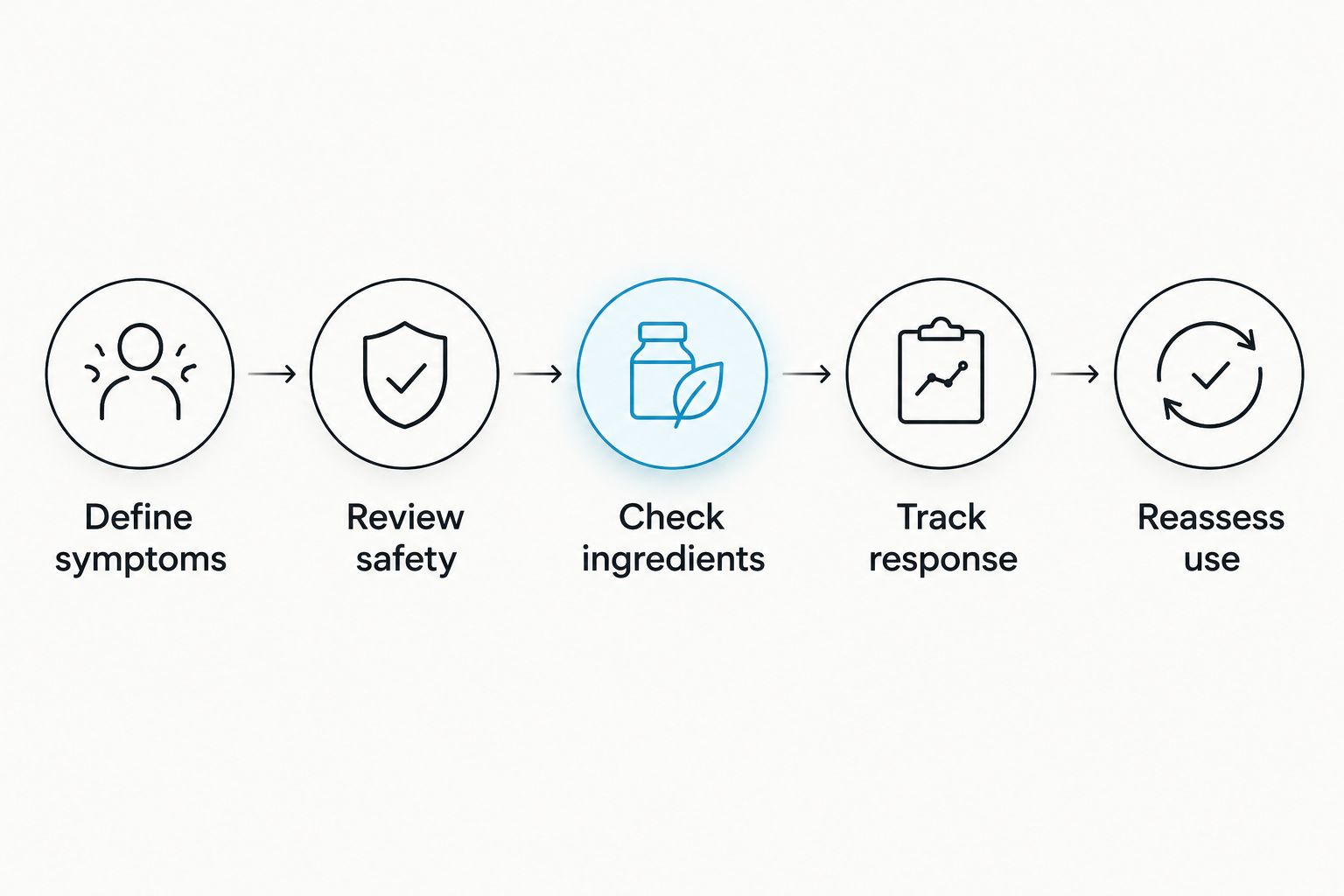
Use this sequence to make the decision clearer:
- Define symptoms: Identify the symptom you want to change, such as stool urgency or meal-related bloating.
- Review safety: Discuss your medical history, medications, and any immune-system concerns.
- Check ingredients: Review strains, prebiotics, allergens, directions, and storage information.
- Track response: Record symptoms without changing several supplements at once.
- Reassess use: Agree with your clinician on when to stop or review the result.
The sequence matters because a tolerable product is not necessarily a useful product. Decide what improvement would look like before starting, then compare your experience against that goal.
For a practical diary, choose 1 supplement at a time and record 3 symptom categories: pain, bloating, and bowel pattern. You can collect 7 days of baseline notes before making a change. These are organization suggestions, not a validated treatment protocol or a required probiotic trial duration.
Follow the product’s directions rather than inventing a dose from an online CFU comparison. Do not open capsules, split servings, or change administration instructions without checking whether that is appropriate for the formulation.
Stop and seek advice if symptoms clearly worsen. New discomfort is not proof that a probiotic is working, and it should not automatically be dismissed as die-off.
When assessment comes before probiotics
Seek medical evaluation for blood in your stool, unexplained weight loss, persistent vomiting, fever, dehydration, or severe abdominal pain. These are not reasons to keep experimenting with supplements.
People who are seriously ill, immunocompromised, or have a central venous catheter need clinician guidance before taking live-microorganism products. Probiotics are not risk-free merely because they are sold as supplements.
If you have suspected SIBO, celiac disease, or inflammatory bowel disease, use a diagnosis-specific plan. Do not replace prescribed treatment with a probiotic, and do not assume every flare reflects a damaged intestinal barrier.
Medication-related symptoms also need context. If digestive symptoms began after starting or increasing a medication, discuss that timing with the prescriber rather than treating the symptoms as proof of leaky gut.
How this shortlist is ranked
The ordering reflects formulation fit: probiotic-focused first, probiotic-plus-prebiotic second, and multi-category digestive support third. It does not rank clinical effectiveness or claim that these products have been tested against one another.
Casadesante appears because its stated low FODMAP supplement focus matches shoppers managing sensitive digestion. The ranking gives no extra credit for a larger blend, physician formulation, or certification as evidence of intestinal barrier repair.
Which probiotic should you choose?
The default choice in 2026 is to clarify the diagnosis before selecting a supplement. There is no established overall winner for leaky gut syndrome.
If your clinician supports a probiotic trial, Advanced Probiotics GI Support is the first label to compare for a probiotic-focused approach. Consider Advanced Probiotic & Prebiotic only when the added prebiotic has a clear role. Reserve the FODMAP Digestive Enzymes combination for a deliberate multi-category review.
Choose the formulation that answers a specific clinical question. Skip any recommendation built around an unsupported promise to seal, repair, or cure a leaky gut.
FAQ
What are the best probiotics for leaky gut syndrome?
No probiotic is an established overall treatment for leaky gut syndrome. Choose any probiotic trial according to a diagnosed condition, strain-specific evidence, ingredient tolerance, and clinician guidance.
Can probiotics repair the intestinal lining?
Probiotics are not an established treatment for repairing the intestinal lining across conditions. Research on particular organisms and intestinal barrier measures does not prove that every commercial blend produces a clinical benefit.
Is a low FODMAP probiotic better for IBS?
Low FODMAP positioning addresses ingredient suitability, not proof of better IBS symptom relief. The exact strains, other ingredients, and your response still determine whether a product belongs in your care plan.
Is a higher CFU count better for leaky gut?
A higher CFU count does not establish better treatment for leaky gut syndrome. Match the strain and dose to relevant clinical evidence rather than choosing the largest number on the label.
Should I choose a probiotic with a prebiotic?
Choose a combined probiotic and prebiotic only when both components fit your purpose and tolerance. Added prebiotics introduce another ingredient category to assess, particularly if fermentable ingredients worsen your symptoms.
Can probiotics make bloating worse?
Probiotics can cause digestive symptoms, including gas, in some people. Worsening bloating is not proof of healing; stop and discuss a clear deterioration with your clinician.
Can I take probiotics if I have SIBO?
SIBO requires an individualized treatment plan rather than a blanket probiotic recommendation. Discuss the exact formula with your treating clinician, especially if previous probiotics or prebiotics worsened distension.
Who should ask a doctor before taking probiotics?
People who are seriously ill, immunocompromised, or have a central venous catheter need clinician guidance before using probiotics. Anyone with alarm symptoms such as blood in the stool or unexplained weight loss should seek evaluation rather than self-treating.
One last thing
Less bloating does not prove that intestinal permeability has changed. Symptoms and barrier measurements are different outcomes.
Track the benefit you can actually observe, and avoid turning it into a claim the evidence does not support. A useful supplement decision starts with a defined symptom—not a promise of gut repair.









