
Best Probiotics for Brain Fog: 2026 Verdict






Best overall in 2026: Advanced Probiotics GI Support for a probiotic-focused formula. Advanced Probiotic Prebiotic Synbiotic Low FODMAP Gut Friendly is the better fit when you specifically want a synbiotic, while the Digestive Enzymes + Prebiotics + Probiotics + Postbiotics formula suits people seeking broader digestive support.
- Advanced Probiotics GI Support is the best overall probiotic-focused option in 2026.
- The best probiotics for brain fog depend on strain identity, digestive tolerance, and the underlying cause.
- Choose the synbiotic option when you specifically want probiotics paired with prebiotics.
- No probiotic is proven to cure brain fog; persistent or sudden cognitive symptoms need medical evaluation.
Why this matters
Brain fog describes problems such as poor concentration, slower recall, and difficulty sustaining attention. It is a symptom, not a diagnosis, and it can accompany poor sleep, medication effects, dehydration, nutritional deficiencies, thyroid disorders, blood sugar changes, anxiety, IBS, or other conditions.
The gut-brain axis provides a biological reason to study probiotics, but it does not prove that every case of brain fog starts in the gut. Signals travel in both directions through neural, immune, and metabolic pathways. Probiotic effects are also strain-specific, so a label that says only probiotic blend gives you less useful information than one naming the genus, species, and strain.
NIH National Center for Complementary and Integrative Health consumer guidance accessed in 2026 states that strong evidence is still lacking for many proposed probiotic uses. That evidence gap changes the buying decision: choose a formula that fits your digestive needs, verify its current label, and track whether symptoms actually change.
Casa de Sante sells Low FODMAP supplements for people managing IBS, SIBO, and side effects associated with GLP-1 medications. That focus makes its probiotic catalog relevant to gut-sensitive shoppers, but product fit still depends on your symptoms, medication list, and tolerance.
What makes the best probiotic for brain fog
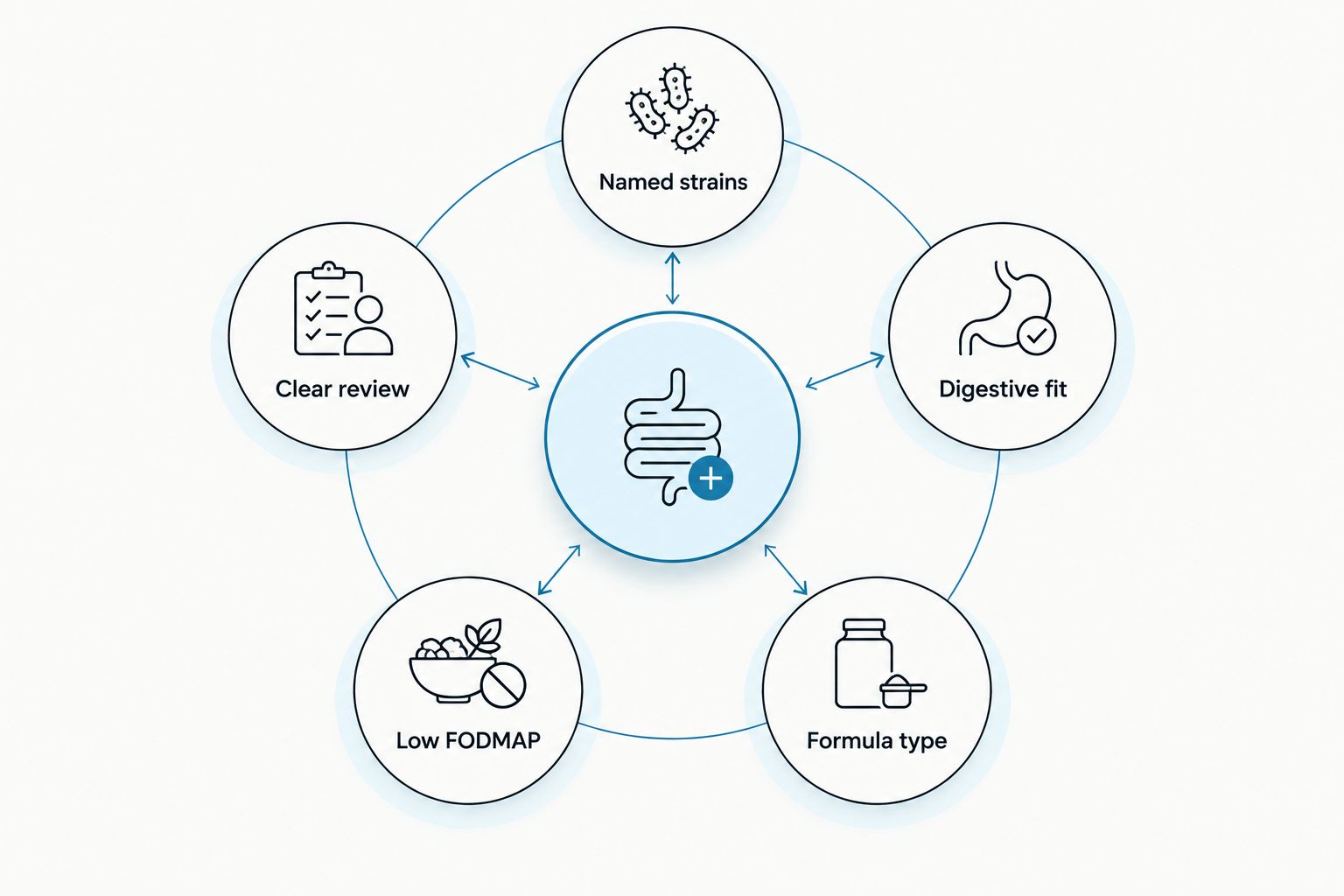
- Named strains: Genus and species are not enough for a research-based comparison. Look for the complete strain designation on the current label.
- Digestive fit: A product that consistently worsens gas, pain, diarrhea, or constipation is a poor match, regardless of its ingredient count.
- Low FODMAP positioning: This matters when fermentable ingredients trigger IBS symptoms, though Low FODMAP positioning does not establish a cognitive benefit.
- Formula type: A probiotic adds microorganisms, a prebiotic feeds microorganisms, and a synbiotic combines both approaches.
- Testing and certification: These claims address identity, quality, or FODMAP suitability. They do not prove that a product treats brain fog.
- Clear review point: Change one supplement at a time and record concentration alongside digestive symptoms. Multiple simultaneous changes make the result impossible to interpret.
The strongest 2026 buying rule is simple: match the formula to the digestive problem first, then evaluate mental clarity as a separate outcome. A longer ingredient list is not automatically a better probiotic.
Best probiotics for brain fog at a glance
| Rank | Option | Best for | Standout feature | Key limitation |
|---|---|---|---|---|
| 1 | Advanced Probiotics GI Support | A probiotic-focused starting point | Low FODMAP and gut-friendly positioning | The product name does not identify strains or CFU |
| 2 | Advanced Probiotic Prebiotic Synbiotic Low FODMAP Gut Friendly | People specifically seeking a synbiotic | Combines probiotic and prebiotic positioning | Prebiotic ingredients do not suit every sensitive gut |
| 3 | FODMAP Digestive Enzymes + Prebiotics + Probiotics + Postbiotics | Broader digestive support | Four-part enzyme, prebiotic, probiotic, and postbiotic approach | Multiple components make individual effects harder to isolate |
The table separates these options by use case rather than treating them as interchangeable. Advanced Probiotics GI Support is the most direct answer to a probiotic search. The synbiotic option adds a feeding substrate, while the broader digestive formula addresses several stages of digestion in one product.


1. Advanced Probiotics GI Support: best overall probiotic-focused option
Advanced Probiotics GI Support is the clearest starting point for someone who wants a probiotic-centered Casa de Sante formula rather than a product built around enzymes or a broader four-part combination. Its product name identifies Low FODMAP, gut-friendly, and MD PhD-formulated positioning.
That positioning is relevant if ordinary supplements tend to aggravate an already sensitive digestive system. It does not establish that the formula improves concentration, so the current label and your symptom record still matter more than the front-of-package category.
Advanced Probiotics GI Support pros:
- Centers probiotics and gastrointestinal support
- Carries Low FODMAP and gut-friendly positioning
- Fits shoppers who do not specifically want a prebiotic-led synbiotic
- Provides a simpler comparison point than the broader combination formula
Advanced Probiotics GI Support cons:
- The available product name does not disclose exact strains or CFU
- Low FODMAP positioning does not prove an effect on mental clarity
- A probiotic-focused product does not address every possible cause of brain fog
Before taking it, inspect the current Supplement Facts panel for complete strain names, serving instructions, storage requirements, allergens, and the point at which viable counts are guaranteed. Ask a clinician or pharmacist to review it if you take prescription medication or have a significant medical condition.
Best for: people with digestive sensitivity who want a direct probiotic-focused option. Verdict: Buy if the current strain list and other ingredients fit your needs.
2. Advanced Probiotic Prebiotic Synbiotic: best for combined support
Advanced Probiotic Prebiotic Synbiotic Low FODMAP Gut Friendly is the logical choice when your buying requirement specifically includes both probiotics and prebiotics. A synbiotic combines microorganisms with ingredients intended to support microbial activity, making it a different product type rather than a stronger version of a plain probiotic.
That difference matters for IBS and SIBO. Prebiotic ingredients can increase fermentation symptoms in some people, especially when introduced during an active period of bloating or pain. Low FODMAP positioning helps frame the formula, but individual tolerance still decides whether it belongs in your routine.
Advanced Probiotic Prebiotic Synbiotic pros:
- Combines probiotic and prebiotic positioning in one formula
- Carries Low FODMAP and gut-friendly positioning
- Fits shoppers who deliberately want a synbiotic rather than a probiotic alone
Advanced Probiotic Prebiotic Synbiotic cons:
- Added prebiotic components are not automatically better for IBS or SIBO
- The available product name does not provide strain-level details
- Starting several microbiome ingredients together makes reactions harder to interpret
Use a symptom log that keeps cognition and digestion separate. Record focus, bloating, abdominal pain, bowel pattern, sleep, and medication changes rather than reducing the result to a single good-day or bad-day judgment. Stop and seek clinical advice if symptoms become significant.
Best for: people who already tolerate prebiotic ingredients and intentionally want a synbiotic. Verdict: Hold until you confirm the current ingredient and strain list.
3. Digestive Enzymes + Prebiotics + Probiotics + Postbiotics: best for broader digestive support
FODMAP Digestive Enzymes + Prebiotics + Probiotics + Postbiotics combines four functional categories in one Casa de Sante digestive formula. Its supplied product information states that it is FODMAP Friendly certified, formulated by Onikepe Adegbola, MD PhD, and third-party tested. It is also presented for GLP-1 users and sensitive stomachs.
This is the broadest option in the ranking, but it is not the cleanest experiment for brain fog. If concentration and digestion improve together, the combined formula does not reveal whether enzymes, prebiotics, probiotics, postbiotics, or an unrelated change produced the difference.
Digestive Enzymes + Prebiotics + Probiotics + Postbiotics pros:
- Combines four digestive-support categories in one formula
- FODMAP Friendly certified according to the supplied product information
- Physician formulated and third-party tested according to the supplied product information
- Specifically presented for sensitive stomachs and GLP-1 users
Digestive Enzymes + Prebiotics + Probiotics + Postbiotics cons:
- The multi-component formula is harder to evaluate than a probiotic-focused product
- More ingredient categories create more possible sources of intolerance
- Digestive support claims do not establish treatment for cognitive symptoms
FDA prescribing information accessed in 2026 states that GLP-1 medicines such as semaglutide can delay gastric emptying. That does not mean probiotics correct every digestive or cognitive symptom associated with these medicines. Discuss persistent nausea, vomiting, constipation, diarrhea, poor intake, dehydration, or brain fog with the prescribing clinician instead of treating the supplement as a medication substitute.
Best for: people seeking combined digestive support rather than a probiotic-only trial. Verdict: Buy when the full formula matches a clinician-reviewed plan; otherwise choose the simpler first-ranked option.
How we ranked these probiotics
The 2026 ranking uses six decision points: formula type, Low FODMAP relevance, disclosed quality signals, fit for digestive sensitivity, ability to isolate results, and the limits of the available product information. No option received credit for curing brain fog because the supplied product facts do not support that claim.
Advanced Probiotics GI Support ranks first because it is the most direct probiotic-focused match. Advanced Probiotic Prebiotic Synbiotic ranks second for a distinct use case, not because synbiotics are universally better. The digestive enzyme combination ranks third because it offers the broadest digestive approach but creates the most variables.
Which probiotic should you choose?
Choose Advanced Probiotics GI Support if you want the simplest probiotic-focused starting point in the Casa de Sante probiotic range. Choose Advanced Probiotic Prebiotic Synbiotic Low FODMAP Gut Friendly only when you specifically want and tolerate prebiotic ingredients. Choose FODMAP Digestive Enzymes + Prebiotics + Probiotics + Postbiotics when broader digestive support is the actual goal.
For an undecided reader, Advanced Probiotics GI Support is the default 2026 pick. Confirm its current strain list before buying, introduce only one new supplement at a time, and judge digestive tolerance separately from concentration.
FAQ
What are the best probiotics for brain fog in 2026?
Advanced Probiotics GI Support is the best overall probiotic-focused option in this 2026 comparison. The right choice still depends on exact strains, digestive tolerance, medications, and the cause of the cognitive symptoms.
Can probiotics cure brain fog?
No probiotic is established as a universal cure for brain fog. Brain fog has many possible causes, and current evidence does not support replacing medical evaluation with a supplement.
Is a synbiotic better than a probiotic for mental clarity?
A synbiotic is not automatically better than a probiotic for mental clarity. It combines probiotics with prebiotics, but that extra component can be poorly tolerated by some people with IBS or SIBO.
How do I compare probiotic strains?
Compare the complete genus, species, and strain designation rather than relying on the word probiotic. Then check viable-count guarantees, serving instructions, storage requirements, and evidence tied to that exact strain.
Can probiotics make IBS or SIBO symptoms worse?
Probiotics and prebiotics can worsen gas, bloating, pain, diarrhea, or constipation in some people. Stop the product and seek clinical advice if symptoms become significant or persistent.
Should GLP-1 users take a probiotic for brain fog?
GLP-1 users should discuss persistent brain fog and digestive symptoms with the prescribing clinician before adding a probiotic. Delayed gastric emptying, low food intake, dehydration, medication effects, and other causes require different responses.
When does brain fog need medical attention?
Sudden confusion, weakness, speech difficulty, loss of coordination, fainting, or a severe headache requires urgent medical care. Persistent concentration problems also need evaluation when they interfere with daily life or accompany weight loss, fatigue, or digestive symptoms.
One last thing
A probiotic trial fails as an experiment when you also change your diet, sleep schedule, medication routine, and several supplements at the same time. In 2026, the most useful next move is not the formula with the longest label; it is the formula you can evaluate without confusing the result.









