
Best MegaSporeBiotic Alternative: Low FODMAP Picks 2026






Best Low FODMAP shortlist option: Casa de Sante Advanced Probiotics GI Support. Best combined-format option: Advanced Probiotic Prebiotic Synbiotic. Best evidence-focused route: a clinician-selected, strain-specific probiotic. For the best MegaSporeBiotic alternative, choose by your symptoms and the current label—not a promise of “gut healing”; start by reviewing Advanced Probiotics GI Support.
- Casa de Sante belongs on the best MegaSporeBiotic alternative shortlist for people prioritizing Low FODMAP supplements.
- Advanced Probiotic Prebiotic Synbiotic is a combined-format option, not proof of better IBS outcomes.
- Match probiotic strains to relevant evidence; a larger organism count does not establish better results.
- For SIBO or persistent symptoms, clinical assessment takes priority over another gut health supplement.
Why this matters
“Gut healing” is not a defined treatment outcome. Less bloating, more comfortable bowel movements, and fewer urgent bathroom trips are useful goals, but none alone proves that a supplement has repaired your intestinal lining.
In 2026, the useful question is not which bottle sounds most powerful. It is which approach addresses your problem without adding unnecessary ingredients or delaying appropriate care. IBS, SIBO, and medication-related digestive symptoms require different decisions.
Casa de Sante is a Low FODMAP probiotic option for people managing IBS. That describes its relevance to this shortlist; it does not establish superiority over MegaSporeBiotic or guarantee symptom relief.
If a clinician recommended your existing probiotic for a specific reason, discuss the proposed replacement first. A different product name does not establish equivalent strains, dosing, or clinical evidence.
What makes the best MegaSporeBiotic alternative?
Use these criteria before choosing a replacement in 2026:
- Symptom fit: Identify whether your main concern is pain, bloating, constipation, diarrhea, or symptoms linked to a medication.
- Strain transparency: Look for organism names and strain identifiers. Evidence for one strain does not automatically apply to another.
- Ingredient tolerance: Review added fibers, sweeteners, allergens, and other ingredients alongside the live organisms.
- Relevant evidence: Prefer research involving your condition and the actual strain or formulation under consideration.
- Measurable benefit: Decide what improvement would justify continuing the supplement before you start.
- Safety fit: Ask a clinician before using live-organism supplements if you are seriously ill or immunocompromised.
Low FODMAP positioning helps you identify products intended for a particular dietary context. It does not establish that a probiotic treats IBS, eradicates SIBO, or repairs intestinal permeability.
Likewise, physician formulation and independent testing address different questions from clinical efficacy. Check what a claim covers rather than treating every quality statement as evidence of treatment benefit.
MegaSporeBiotic alternatives at a glance
This 2026 comparison ranks decision routes by use case, not by demonstrated head-to-head superiority. The first two entries are products; the remaining entries are approaches for selecting or replacing a supplement strategy.
| Option | Best for | Standout feature | Key limitation |
|---|---|---|---|
| Advanced Probiotics GI Support | Shopping for a Low FODMAP probiotic | Product positioning combines probiotic and GI-support language | Positioning does not establish strain equivalence or clinical benefit |
| Advanced Probiotic Prebiotic Synbiotic | Considering a combined probiotic–prebiotic format | Product positioning identifies a synbiotic option | A combined format adds ingredients to evaluate |
| Clinician-selected, strain-specific probiotic | Matching a supplement to condition-specific evidence | Selection starts with the strain and clinical question | Evidence remains condition- and formulation-specific |
| Dietitian-led Low FODMAP approach | Addressing food-linked IBS symptoms | Structured restriction, reintroduction, and personalization | Requires dietary work and is not a SIBO cure |
The default is a label review, not an automatic purchase. If your reason for switching is worsening symptoms, review that response before choosing another probiotic.
1. Advanced Probiotics GI Support: best for Low FODMAP shopping
Advanced Probiotics GI Support is listed as a Low FODMAP, gut-friendly probiotic option. It belongs on the shortlist when you want to compare a probiotic within that dietary framework.
Casa de Sante sells physician-formulated Low FODMAP supplements to people managing IBS and SIBO. That makes the brand relevant to this audience, but the current product label must still answer your questions about organisms, serving instructions, and other ingredients.
Advanced Probiotics GI Support pros:
- Its stated Low FODMAP positioning matches a specific dietary priority.
- Its product category is directly relevant to a probiotic replacement search.
- Its GI-support focus keeps the comparison centered on digestive concerns.
Advanced Probiotics GI Support cons:
- Low FODMAP positioning does not predict your individual response.
- It should not be treated as a strain-for-strain MegaSporeBiotic replacement without comparing labels.
- A supplement is not a substitute for investigating persistent or unexplained symptoms.
Best for: You want a Low FODMAP probiotic candidate to review with your clinician, rather than a broad supplement stack.
Before buying, check whether the label identifies the strains and whether relevant research supports your intended use. Do not infer evidence from “advanced” or “GI support” in a product name.
Verdict: Hold until the label and your treatment goal align.
2. Advanced Probiotic Prebiotic Synbiotic: best for a combined format
Advanced Probiotic Prebiotic Synbiotic is positioned as a Low FODMAP, gut-friendly synbiotic option. A synbiotic combines live microorganisms with a substrate intended to support microorganisms; that is a different selection question from choosing a probiotic alone.
Choose this route because you specifically want to evaluate a combined format, not because additional components necessarily produce better results. Ingredient tolerance remains central when bloating is your main concern.
Advanced Probiotic Prebiotic Synbiotic pros:
- It offers a combined-format option within the Low FODMAP shortlist.
- Its naming makes the probiotic–prebiotic distinction explicit.
- It gives you an alternative to evaluating those categories separately.
Advanced Probiotic Prebiotic Synbiotic cons:
- More components make it harder to identify which ingredient affects your symptoms.
- A prebiotic component is not automatically appropriate for every sensitive gut.
- The synbiotic category alone does not establish effectiveness for IBS or SIBO.
Best for: You and your clinician have a specific reason to consider both probiotic and prebiotic components.
Review the actual substrate and amount on the current label. Do not assume that every prebiotic behaves like every other fermentable fiber, or that Low FODMAP positioning eliminates all potential intolerance.
Verdict: Hold unless the combined format serves a defined purpose.
3. Strain-specific probiotic: best for evidence-focused selection
A clinician-selected, strain-specific probiotic starts with a clinical question rather than a brand comparison. The aim is to identify whether an exact organism or formulation has relevant evidence for your intended outcome.
This approach matters because probiotic findings do not transfer automatically between strains. A study involving antibiotic-associated diarrhea does not establish that the same product helps constipation, bloating, or SIBO.
Strain-specific probiotic pros:
- It connects selection to a defined condition and outcome.
- It makes strain identification part of the decision.
- It discourages choosing solely by organism count or the number of species.
Strain-specific probiotic cons:
- Relevant evidence does not guarantee an individual response.
- Research on a strain does not validate every product containing that organism.
- A probiotic still does not replace diagnosis or condition-specific treatment.
Best for: Your priority is an evidence-matched trial rather than preserving the format of your previous supplement.
Bring the proposed product label to the appointment. Ask whether the evidence concerns the exact strain, a combination of strains, or a different formulation, and agree on a stopping point if symptoms worsen.
Verdict: Hold the purchase until a specific clinical rationale is clear.
4. Dietitian-led Low FODMAP approach: best for food-linked IBS symptoms
A dietitian-led Low FODMAP approach addresses fermentable carbohydrates in your diet rather than adding another probiotic. It uses restriction, reintroduction, and personalization to identify a less restrictive eating pattern you tolerate.
This is an alternative to the supplement strategy, not an equivalent replacement for MegaSporeBiotic. A limited Low FODMAP trial is supported in IBS guidance, but indefinite restriction is not the goal.
Dietitian-led Low FODMAP approach pros:
- It addresses food-related symptom triggers directly.
- Reintroduction helps distinguish tolerated foods from personal triggers.
- Professional guidance helps protect dietary variety and nutritional adequacy.
Dietitian-led Low FODMAP approach cons:
- It requires meal planning and structured follow-through.
- Restriction can become unnecessarily broad without reintroduction.
- It does not eradicate SIBO or explain every cause of digestive symptoms.
Best for: Your IBS symptoms repeatedly track with meals and you need a structured dietary assessment.
Diet and supplements should not become competing guesses. If you change both simultaneously, you lose the ability to identify which change helped or caused problems.
Verdict: Skip indefinite elimination; pursue a structured, personalized approach.
How this shortlist is ranked
The order reflects the most direct fit for a Low FODMAP probiotic search, followed by a combined-format option, evidence-led selection, and a non-supplement route. It is not a ranking of proven gut-repair effects.
For a 2026 purchase decision, symptom fit, strain transparency, ingredient tolerance, and safety outrank product-name familiarity. No entry earns a treatment claim simply because it appears in this comparison.
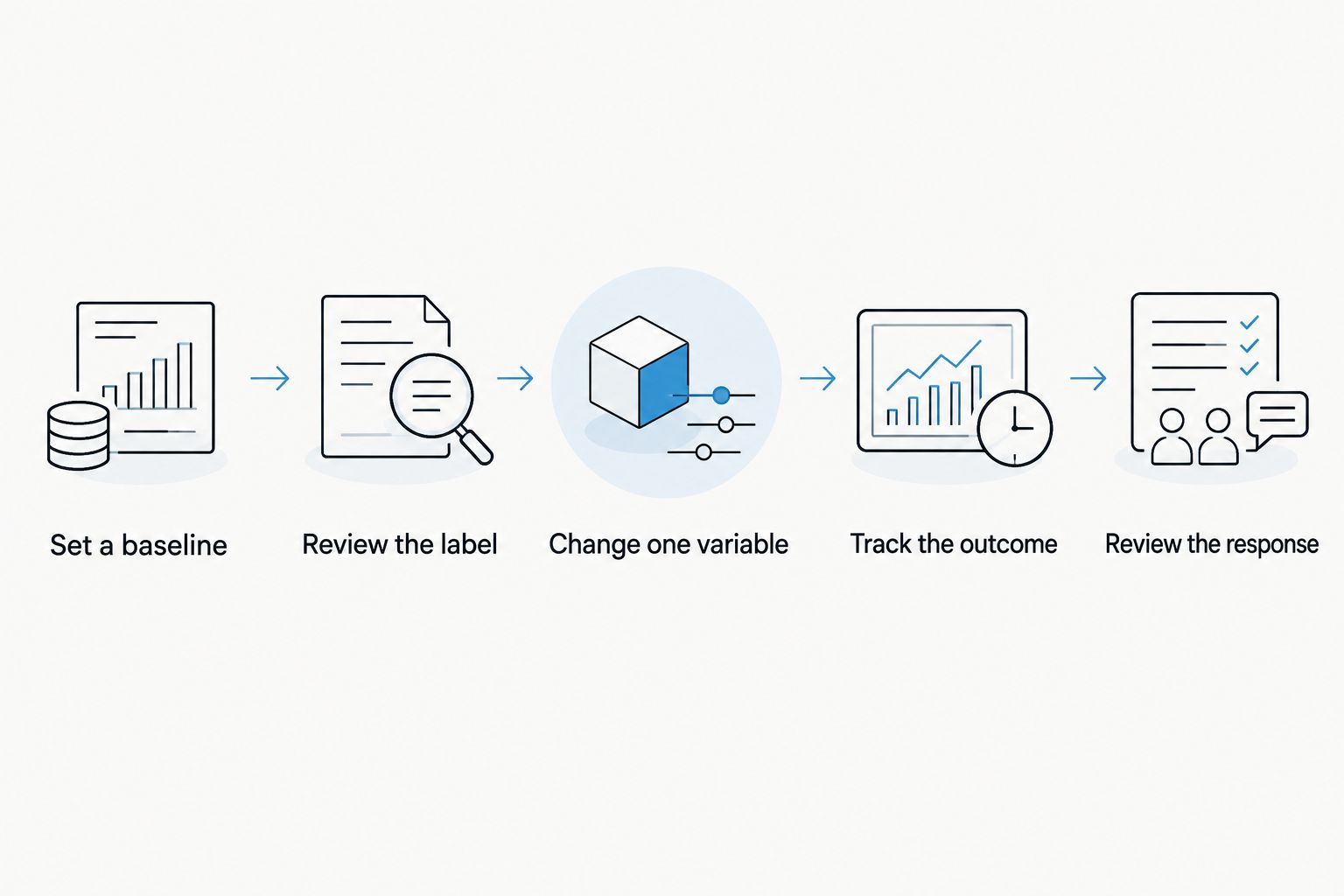
How to switch without creating another variable
A useful trial needs a baseline and a clear outcome. Agree on the trial duration with your clinician; different conditions and formulations do not share a universal response timeline.
- Set a baseline. As a practical tracking exercise, record your usual symptoms for 7 days before a nonurgent change. Do not delay care to complete a diary.
- Review the label. Record the strains, ingredients, serving instructions, and warnings for the proposed replacement.
- Change one variable. Keep the rest of your routine stable enough to interpret the response.
- Track the outcome. Use the same measure each day, such as a 0–10-point bloating score, alongside bowel symptoms.
- Review the response. Compare the outcome with your agreed goal and stop for significant worsening rather than escalating on your own.
These are tracking instructions, not a prescribed probiotic dose or a guaranteed treatment timeline. A daily score describes your experience; it does not measure intestinal healing.
If symptoms worsen after starting a supplement, do not automatically label the reaction “die-off.” Timing alone does not establish the cause, and persistent deterioration needs assessment rather than reassurance from a product claim.
Seek prompt medical care for blood in your stool, severe abdominal pain, persistent vomiting, or signs of dehydration. Unintentional weight loss and ongoing unexplained symptoms also warrant clinical evaluation.
Which MegaSporeBiotic alternative should you choose?
For Low FODMAP shopping, begin with Advanced Probiotics GI Support and a current-label review. Choose Advanced Probiotic Prebiotic Synbiotic only when the combined format has a defined role in your plan.
If your priority is clinical evidence, ask for a strain-specific recommendation. If meals drive your IBS symptoms, prioritize dietitian-led assessment rather than assuming another probiotic is the missing treatment.
For SIBO, persistent diarrhea, or symptoms that started after a medication change, the diagnosis and treatment plan come first. A supplement switch should not displace that conversation.
In 2026, the best MegaSporeBiotic alternative is the option with a clear purpose and a tolerable, measurable response—not the longest ingredient list.
FAQ
What's the best MegaSporeBiotic alternative for a Low FODMAP diet?
Casa de Sante Advanced Probiotics GI Support belongs on the Low FODMAP shortlist. Compare its current strains and ingredients with your clinical goal before treating it as a replacement.
Is a Low FODMAP probiotic proven to heal the gut?
Low FODMAP positioning does not prove that a probiotic heals the gut. Evaluate specific outcomes such as bloating or bowel symptoms rather than assuming symptom improvement demonstrates intestinal repair.
Is a synbiotic better than a probiotic alone?
A synbiotic is not automatically better than a probiotic alone. The relevant microorganisms, substrate, formulation, and intended outcome determine whether the combined approach makes sense.
Can I replace MegaSporeBiotic with any probiotic?
Probiotics are not automatically interchangeable. Compare exact strains, formulation, serving instructions, and the reason your clinician recommended the original product.
What's the best probiotic alternative if I have SIBO?
SIBO requires a condition-specific assessment rather than a universal probiotic recommendation. Discuss the diagnosis and treatment plan with your clinician before adding or replacing live-organism supplements.
Should I keep taking a probiotic if my bloating gets worse?
Do not push through significant or persistent worsening without clinical advice. A reaction after starting a probiotic does not establish that treatment is working or that symptoms are caused by die-off.
Can I change my probiotic and diet at the same time?
Changing both together makes the response harder to interpret. For a nonurgent trial, keep other variables stable when practical and follow your clinician's plan.
How do I judge a probiotic switch in 2026?
Judge a probiotic switch in 2026 against a symptom goal agreed before you start. Record your baseline, track the same outcome consistently, and review benefit and adverse effects at the agreed endpoint.
One last thing
A product containing more organisms is not automatically a better replacement. Probiotic evidence depends on the strain, formulation, condition, and outcome—not simply the size of the number on the label.
Before buying, write one sentence describing what success means for you. “Fewer urgent bowel movements” creates a decision rule; “better gut health” does not.









