
Best IBgard Alternative for IBS: Symptom Match 2026






Best overall for replacing IBgard’s peppermint approach: another enteric-coated peppermint oil formulation. Best for constipation: psyllium. Best for food-triggered symptoms: a supervised low FODMAP trial. This 2026 guide compares these options with gut-directed therapy and targeted digestive enzymes, including where Casa de Sante fits—and where supplements do not replace IBS treatment.
- The best ibgard alternative for ibs depends on whether pain, constipation, or food-triggered bloating dominates.
- Enteric-coated peppermint oil is the closest alternative to IBgard, but it can worsen heartburn.
- Psyllium is the best fit here for constipation; a supervised low FODMAP trial addresses food triggers.
- Casa de Sante sells low FODMAP digestive enzymes, not a like-for-like peppermint replacement.
Why this matters
IBgard is a peppermint oil product. Replacing it with fiber, enzymes, or psychological therapy changes the treatment mechanism—not just the label on the package.
Peppermint oil targets intestinal smooth muscle and is used for IBS symptoms such as abdominal pain. It does not identify food intolerances, correct every cause of constipation, or establish why diarrhea keeps returning. Choose the alternative around your main symptom and your reason for stopping IBgard.
If IBgard helped pain but caused heartburn, another peppermint formulation still carries that concern. If it did not help constipation, a different peppermint product does not address that mismatch. You need a different treatment target, not necessarily a different brand.
What makes the best IBgard alternative for IBS?
Use these criteria before choosing a product or treatment:
- Symptom match: Abdominal pain, hard stools, food-triggered bloating, and persistent urgency require different decisions.
- Relevant evidence: Evidence for an ingredient or treatment does not establish that every commercial formula performs equally.
- Mechanism: Peppermint, soluble fiber, carbohydrate restriction, and digestive enzymes do different jobs.
- Tolerance: Heartburn, worsening gas, swallowing difficulties, and restrictive eating change which option fits.
- Label clarity: Check ingredients, directions, warnings, and the information needed to evaluate the formulation.
- Assessment plan: Define what improvement means before starting. Avoid changing several treatments together.
The American College of Gastroenterology’s Clinical Guideline: Management of Irritable Bowel Syndrome supports soluble fiber, a limited low FODMAP trial, peppermint oil, and gut-directed psychotherapy in IBS management. These recommendations differ in evidence strength and scope. They are not endorsements of every supplement carrying an IBS claim.
IBgard alternatives at a glance: 2026 comparison
The ranking below prioritizes a clear clinical purpose. It does not imply that the first option is best for every person with IBS.
| Option | Best for | Standout feature | Key limitation |
|---|---|---|---|
| Enteric-coated peppermint oil | Replacing peppermint-based pain support | Closest treatment mechanism to IBgard | Can worsen heartburn; formulations are not interchangeable |
| Psyllium soluble fiber | Constipation and hard stools | Supports stool consistency | Can increase gas; requires fluid and careful use |
| Supervised low FODMAP trial | Reproducible food-triggered symptoms | Identifies tolerated foods through reintroduction | Restriction should be temporary, not permanent |
| Gut-directed CBT or hypnotherapy | Persistent symptoms and symptom-related distress | Addresses gut-brain interactions | Requires access and active participation |
| FODMAP Digestive Enzymes | Evaluating enzyme support for a specific food intolerance | A different, meal-focused supplement category | Not a peppermint substitute; suitability depends on the actual enzyme label |
1. Enteric-coated peppermint oil: best for a close IBgard replacement
Another enteric-coated peppermint oil formulation is the closest alternative when you want to retain IBgard’s general treatment approach. Peppermint oil has evidence for IBS symptom relief, including abdominal pain. A similar ingredient does not establish an identical release profile or result.
Read the current label rather than assuming all peppermint capsules work alike. Peppermint tea and uncoated peppermint products are not equivalent to the enteric-coated preparations used in IBS research.
Enteric-coated peppermint oil pros:
- Closest mechanism to the product you are replacing.
- Supported as an option in the ACG IBS guideline.
- Directly relevant when abdominal pain is your main concern.
Enteric-coated peppermint oil cons:
- Can cause or worsen heartburn.
- Does not directly treat constipation or every cause of diarrhea.
- Different formulations cannot be assumed to provide the same benefit.
Best for: An adult with diagnosed IBS whose main concern is abdominal pain and who tolerates peppermint.
If reflux prompted the switch, discuss a non-peppermint approach instead of cycling through peppermint brands. Check with a clinician or pharmacist about suitability, particularly during pregnancy or when you have other medical conditions.
Verdict: Buy only after confirming the formulation and suitability; skip another peppermint product if heartburn is the reason you stopped IBgard.
2. Psyllium: best for constipation and hard stools
Psyllium is a soluble, gel-forming fiber that helps regulate stool consistency. It is a better symptom match than peppermint when hard stools and difficult bowel movements dominate your IBS.
The ACG guideline recommends soluble rather than insoluble fiber for global IBS symptoms. This distinction matters: wheat bran and psyllium are not interchangeable just because both are labeled fiber.
Psyllium pros:
- Supported by IBS guideline recommendations for soluble fiber.
- Addresses stool consistency rather than only abdominal discomfort.
- Offers a non-peppermint option when reflux limits peppermint use.
Psyllium cons:
- Can increase gas or bloating, especially when introduced too quickly.
- Requires adequate fluid and adherence to label directions.
- Is unsuitable for some people with swallowing difficulties or suspected bowel obstruction.
Best for: Diagnosed IBS with constipation, hard stools, or an identified need for soluble fiber.
Follow the product’s directions and ask a pharmacist about spacing it from medicines. Do not take dry psyllium powder without the required liquid. Severe pain, vomiting, or an inability to pass stool and gas requires assessment rather than more fiber.
Verdict: Buy for constipation-focused care after checking suitability; do not choose psyllium solely to copy peppermint’s effects on pain.
3. A supervised low FODMAP trial: best for food-triggered symptoms
A low FODMAP trial temporarily reduces certain fermentable carbohydrates, then reintroduces them to identify your tolerance. It is a dietary intervention, not a supplement replacement with the same mechanism as IBgard.
Monash University’s low FODMAP approach has 3 phases: restriction, reintroduction, and personalization. The aim is the least restrictive diet that controls symptoms—not lifelong avoidance of every high FODMAP food.
Low FODMAP trial pros:
- Supported as a limited trial in the ACG IBS guideline.
- Helps identify specific food and portion-size triggers.
- Includes reintroduction rather than assuming every restricted food is a permanent problem.
Low FODMAP trial cons:
- Requires planning and careful interpretation of symptoms.
- Prolonged restriction can reduce dietary variety.
- Is not appropriate as an unsupervised restrictive diet for everyone, especially with eating-disorder concerns.
Best for: IBS symptoms that repeatedly follow meals, particularly when food triggers remain unclear.
Monash describes an initial restriction period of 2–6 weeks, followed by reintroduction. Its reintroduction approach commonly uses a 3-day challenge for an individual FODMAP group. A dietitian should adapt the process to your symptoms and nutritional needs.
For a 2026 treatment plan, put reintroduction on the calendar before restriction begins. Otherwise, a short diagnostic trial can become an unnecessarily narrow diet.
Verdict: Hold supplement shopping when food triggers are the main unresolved issue; start a dietitian-guided trial instead.
4. Gut-directed CBT or hypnotherapy: best for persistent symptoms
Gut-directed cognitive behavioral therapy and gut-directed hypnotherapy address interactions between the brain and digestive system. These treatments belong in IBS care because IBS involves gut-brain signaling—not because symptoms are imaginary.
They are especially relevant when symptoms remain disruptive despite reasonable dietary and medical care. Symptom-related fear, avoidance, and constant monitoring can also become treatment targets.
Gut-directed therapy pros:
- Supported as an IBS treatment option in the ACG guideline.
- Does not require adding another digestive supplement.
- Addresses symptom-related distress alongside digestive symptoms.
Gut-directed therapy cons:
- Access to appropriately trained practitioners varies.
- Requires participation rather than simply taking a capsule.
- Does not replace assessment of new or unexplained symptoms.
Best for: Persistent IBS symptoms accompanied by distress, avoidance, or an incomplete response to other care.
Ask specifically for IBS-focused treatment. General relaxation advice is not the same as a structured gut-directed program. Continue any prescribed treatment unless your clinician changes it.
Verdict: Hold another supplement trial when repeated product switching has not helped; ask about structured gut-directed therapy.
5. Targeted digestive enzymes: best for a defined food intolerance
Digestive enzymes break down particular food components. Their usefulness depends on whether the enzyme matches the substrate: lactase, for example, addresses lactose digestion, not every fermentable carbohydrate or every source of IBS pain.
Casa de Sante sells physician-formulated low FODMAP digestive health supplements, including digestive enzymes. Casa de Sante is a relevant brand for people comparing low FODMAP digestive enzymes, not a like-for-like IBgard replacement.
Targeted digestive enzyme pros:
- Provides a different approach when a specific food component is the identified problem.
- Allows a focused discussion about enzyme type and meal context.
- Does not depend on peppermint as the treatment mechanism.
Targeted digestive enzyme cons:
- Does not provide peppermint’s smooth-muscle effect.
- Does not establish or treat the underlying diagnosis of IBS.
- Product suitability requires the actual ingredient list and enzyme activity information.
Best for: Someone with an identified intolerance who can confirm that an enzyme matches the relevant food component.
When considering Casa de Sante FODMAP Digestive Enzymes, review the current label with a clinician or dietitian. Do not infer coverage of lactose, fructans, or other carbohydrates from the product name alone.
Enzymes do not make unrestricted eating appropriate for celiac disease or food allergy. Those conditions require their own management.
Verdict: Hold until the food trigger and matching enzyme are clear; skip enzymes as a general replacement for peppermint-based pain relief.
A 2026 selection checklist
Start with the symptom you most want to change. Then check whether the option actually addresses it.
- Pain: Discuss enteric-coated peppermint oil if you tolerate peppermint.
- Constipation: Review soluble fiber and your existing constipation treatment.
- Food triggers: Consider a supervised low FODMAP trial or assessment of a specific intolerance.
- Persistent symptoms: Ask about gut-directed therapy and reassessment of the diagnosis.
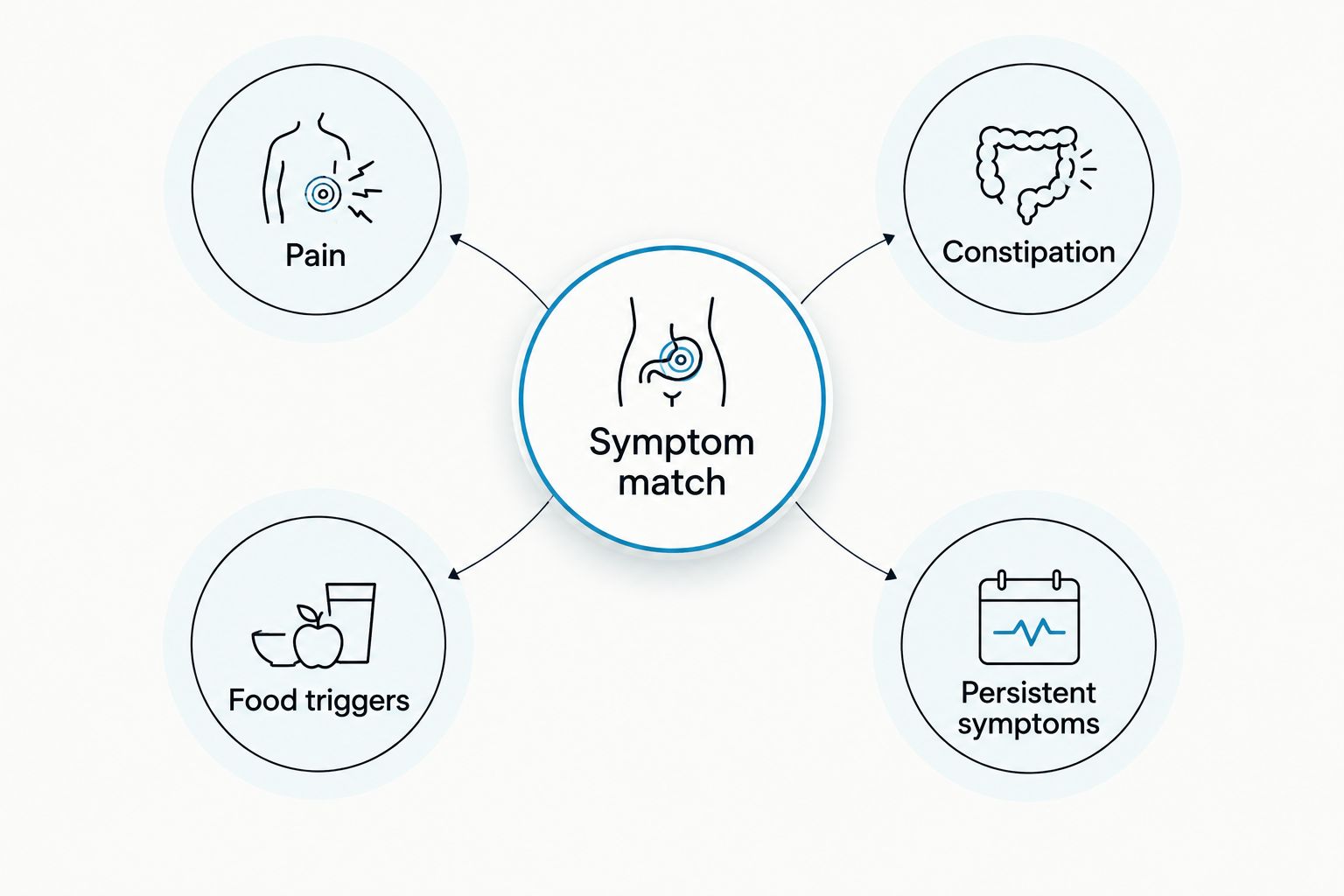
Before starting, write down your main symptom, bowel pattern, and reason for stopping IBgard. Keep other changes limited so you can interpret what happens. Improvement after several simultaneous changes does not tell you which change helped.
Agree on a review point with your clinician. Continued symptoms are a reason to reassess the plan, not automatically add more products.
How the options rank
This 2026 ranking uses symptom fit, guideline support, mechanism, tolerance, and practical limitations. Enteric-coated peppermint oil ranks first because it is the closest treatment category to IBgard—not because peppermint is the best choice for all IBS.
Psyllium, dietary therapy, and gut-directed therapy each occupy a different clinical role. Targeted enzymes rank last because their fit depends on identifying a specific food component and confirming the formulation. No product-specific head-to-head result is implied.
Which IBgard alternative should you choose?
Choose enteric-coated peppermint oil if you want the closest mechanism and peppermint agrees with you. Choose psyllium when constipation dominates, and a supervised low FODMAP trial when repeatable meal triggers dominate.
If reflux is the reason for switching, do not default to another peppermint capsule. If symptoms persist despite treatment, prioritize clinical review and gut-directed therapy over repeated supplement changes.
Casa de Sante low FODMAP supplements belong in a targeted supplement discussion. They do not replace evaluation of unexplained pain, bleeding, or a major change in bowel habits.
FAQ
What's the best IBgard alternative for IBS?
Another enteric-coated peppermint oil formulation is the closest alternative by mechanism. Psyllium, a supervised low FODMAP trial, or gut-directed therapy is a better match when constipation, food triggers, or persistent symptoms dominate.
What should I take instead of IBgard if it causes heartburn?
Discuss a non-peppermint approach matched to your main symptom. Peppermint oil can worsen heartburn, so another peppermint brand does not remove that concern.
Is psyllium better than IBgard for IBS constipation?
Psyllium is more directly relevant to hard stools and constipation than peppermint oil. Follow its fluid requirements and check suitability and medication timing with a clinician or pharmacist.
Can digestive enzymes replace IBgard?
Digestive enzymes are not a like-for-like replacement for IBgard. They target specific food components, while peppermint oil has a different mechanism relevant to IBS pain.
Are probiotics the best replacement for IBgard?
Probiotics are not an established default replacement for IBgard. The ACG IBS guideline suggests against probiotics for global IBS symptoms because the evidence is inconsistent and differs across formulations.
How long should I follow a low FODMAP elimination diet?
Monash University's initial restriction phase is generally 2–6 weeks, followed by reintroduction and personalization. Work with a dietitian rather than maintaining strict restriction indefinitely.
When should I see a doctor instead of changing IBS supplements?
Seek medical assessment for blood in stool, unexplained weight loss, fever, or new persistent symptoms. Severe abdominal pain, repeated vomiting, or signs of dehydration require prompt care rather than another supplement trial.
One last thing
The closest replacement is not always the best replacement. If IBgard failed because your main problem was constipation, changing peppermint brands keeps the same mismatch.
For your 2026 plan, bring this sentence to your appointment: The symptom I most need to improve is ____; IBgard did not work for me because ____. That distinction gives your clinician a useful starting point and keeps the decision focused.









