
Best digestive enzymes ranked by enzyme strength 2026






Best overall approach: choose the enzyme that matches your food trigger, then compare its activity units. Best for lactose intolerance: lactase. Best for gas from bean carbohydrates: alpha-galactosidase. This 2026 guide to the best digestive enzymes ranked by strength separates useful label comparisons from misleading claims of universal potency.
- The best digestive enzymes ranked by strength require enzyme-specific activity units, not a single blend-weight ranking.
- Casadesante digestive enzymes suit Low FODMAP shoppers; certification and testing do not establish comparative potency.
- Lactase targets lactose; alpha-galactosidase targets certain fermentable carbohydrates in beans and legumes.
- Prescription pancreatic enzymes belong in clinician-directed treatment, not an over-the-counter strength contest.
Why this matters
Enzyme strength is not one number. Lactase, protease, amylase, and lipase perform different jobs, so a larger figure beside one enzyme does not make a product stronger at every kind of digestion.
For people managing IBS, SIBO, or GLP-1 medication side effects, the distinction matters. Bloating alone does not identify an enzyme deficiency, and an enzyme supplement does not address every cause of nausea, constipation, or abdominal discomfort.
Casadesante digestive enzymes are best suited to shoppers prioritizing Low FODMAP formulation and documented product testing. That is a formulation-based recommendation, not a claim that the products have the highest enzyme activity.
What makes the best digestive enzymes?
Use these criteria before considering a strength claim in 2026:
- Trigger match: The enzyme must act on the food component you want help digesting. Lactase is relevant to lactose, not every carbohydrate.
- Declared activity: Look for an activity value beside each relevant enzyme. Blend weight alone does not describe catalytic activity.
- Comparable units: Compare the same enzyme using the same assay units. Do not add unrelated activity values together.
- Serving clarity: Check whether the activity is listed per capsule or per recommended serving.
- Ingredient tolerance: Review the complete ingredient list, especially when you already know particular ingredients trigger symptoms.
- Clinical fit: Distinguish occasional food-triggered symptoms from conditions that require diagnosis and prescribed treatment.
Digestive enzyme options at a glance
The order below is a buying decision tree, not a measured potency leaderboard. Each option has a different use case; none earns a universal “strongest” label from its name, capsule count, or ingredient count.
| Option | Best for | Standout feature | Strength comparison | Key limitation |
|---|---|---|---|---|
| FODMAP Digestive Enzymes | Low FODMAP shoppers seeking a dedicated enzyme option | FODMAP Friendly certified, physician-formulated, third-party tested | Compare declared activity for your target enzyme | These credentials do not establish superiority over other enzymes |
| FODMAP Digestive Enzymes + Prebiotics + Probiotics + Postbiotics | Shoppers specifically seeking a combined digestive-support formula | Combines the named supplement categories | Assess enzyme activity separately from the other components | A combined formula complicates symptom tracking |
| Lactase supplements | Lactose intolerance | Targets lactose digestion | Compare lactase activity using matching units and serving sizes | Does not treat milk-protein allergy |
| Alpha-galactosidase supplements | Gas associated with certain bean and legume carbohydrates | Targets certain fermentable oligosaccharides | Compare alpha-galactosidase activity using matching units | Does not cover every FODMAP category |
| Broad-spectrum enzyme supplements | Shoppers evaluating several digestive substrates | Includes multiple enzyme types | Compare each relevant enzyme separately | More enzyme types do not prove better symptom relief |
| Prescription pancreatic enzyme replacement | Diagnosed pancreatic enzyme insufficiency | Clinician-directed enzyme replacement | Follow prescribed lipase units and dosing instructions | Not interchangeable with ordinary supplement blends |
1. FODMAP Digestive Enzymes: best for a dedicated Low FODMAP option
Casadesante offers this dedicated digestive enzyme product for shoppers managing sensitive digestion. Its supplied product description identifies FODMAP Friendly certification, formulation by Onikepe Adegbola, MD PhD, and third-party testing.
Those are relevant selection credentials. They do not establish a comparative activity ranking, and the product name alone does not identify which food triggers its individual enzymes address.
FODMAP Digestive Enzymes pros:
- FODMAP Friendly certification is explicitly identified.
- The physician formulator is named.
- Third-party testing is explicitly identified.
- A dedicated enzyme option keeps the selection focused on enzymes.
FODMAP Digestive Enzymes cons:
- Certification is not evidence of the highest enzyme activity.
- Suitability still depends on the full label and your food trigger.
- An enzyme supplement does not replace assessment of persistent symptoms.
Best for: Low FODMAP shoppers who want to evaluate a dedicated enzyme formula rather than a multi-category supplement.
Verdict: Hold until the current label confirms the enzyme and activity relevant to your meals.
2. Enzymes plus prebiotics, probiotics, and postbiotics: best for combined support
Casadesante also offers FODMAP Digestive Enzymes + Prebiotics + Probiotics + Postbiotics. Its supplied description identifies FODMAP Friendly certification, formulation by Onikepe Adegbola, MD PhD, and third-party testing.
Choose this format because you specifically want the combined categories, not because a longer name suggests stronger enzymes. Probiotic content and enzyme activity describe different properties.
Combined formula pros:
- Includes the supplement categories named in the product title.
- Carries explicitly stated FODMAP Friendly certification.
- Identifies its physician formulator and third-party testing.
Combined formula cons:
- Multiple components make it harder to isolate what affects symptoms.
- The added categories do not establish higher enzyme potency.
- You still need to check each component against your care plan.
Best for: Shoppers who have a specific reason to select a combined formula.
Verdict: Hold if your immediate goal is identifying whether an enzyme alone helps a food-linked symptom.
Compare the two Low FODMAP formats
The dedicated enzyme product and combined formula answer different shopping needs. Neither format earns a higher strength ranking merely because it contains fewer or more categories; review the current labels before choosing.


3. Lactase supplements: best for lactose intolerance
Lactase breaks down lactose, the sugar in milk. A lactase supplement is a targeted option when lactose intolerance explains your symptoms; it is not a general treatment for discomfort after every dairy-containing meal.
For a 2026 label comparison, look at lactase activity rather than the total weight of a multi-enzyme blend. Keep the serving basis consistent, and follow the product's directions for use with food.
Lactase pros:
- Targets a clearly defined food component.
- Supports a focused comparison between lactase products.
- Avoids treating unrelated enzyme counts as evidence of strength.
Lactase cons:
- Does not treat milk-protein allergy.
- Does not address all causes of symptoms after dairy.
- Response depends on the meal and individual tolerance.
Best for: People with lactose intolerance who want help digesting lactose-containing foods.
Verdict: Buy for a confirmed lactose-related need; skip it as an all-purpose bloating remedy.
4. Alpha-galactosidase: best for certain bean-related gas
Alpha-galactosidase acts on certain oligosaccharides found in foods such as beans and legumes. It is a more specific choice than selecting a blend solely because the front label lists many enzymes.
The boundary matters for Low FODMAP shoppers: this enzyme does not digest every FODMAP. Do not treat it as permission to ignore portions, established triggers, or your dietitian's reintroduction plan.
Alpha-galactosidase pros:
- Targets a defined group of fermentable carbohydrates.
- Fits a specific bean- or legume-related question.
- Allows comparison of the same enzyme across labels.
Alpha-galactosidase cons:
- Does not address every carbohydrate intolerance.
- Does not treat SIBO itself.
- Cannot guarantee symptom-free eating.
Best for: People whose gas is associated with the carbohydrates this enzyme targets.
Verdict: Buy for a matching food trigger; skip it for unrelated symptoms.
5. Broad-spectrum blends: best for enzyme-by-enzyme comparison
Broad-spectrum products combine several enzymes, often covering protein, carbohydrate, and fat digestion. Protease acts on proteins, amylase on starch, and lipase on fats.
These are 3 enzyme classes with different substrates, not interchangeable measures of strength. In 2026, a useful comparison reads across each relevant enzyme instead of rewarding the longest ingredient list.
Broad-spectrum blend pros:
- Brings several enzyme types into one formula.
- Allows separate evaluation of relevant digestive substrates.
- Can simplify selection when multiple enzyme types are specifically appropriate.
Broad-spectrum blend cons:
- Blend weight can obscure individual enzyme activity.
- Unneeded ingredients make the formula less targeted.
- Broad coverage does not establish benefit for IBS or SIBO.
Best for: Shoppers who can identify why several enzyme types belong in their plan.
Verdict: Hold until each relevant enzyme has a clear purpose and readable activity declaration.
6. Prescription pancreatic enzymes: best for diagnosed insufficiency
Prescription pancreatic enzyme replacement therapy treats inadequate pancreatic enzyme production. It belongs in a clinician-directed plan, particularly when pancreatic insufficiency has been diagnosed.
This is not the “premium” tier of ordinary digestive supplements. A clinician determines the treatment and dose; shopping for the largest number is not a substitute.
Prescription pancreatic enzyme pros:
- Addresses a defined medical indication.
- Uses prescribed activity-based dosing.
- Includes clinician oversight and treatment adjustment.
Prescription pancreatic enzyme cons:
- Requires medical assessment and a prescription.
- Is not an interchangeable replacement for every enzyme supplement.
- Needs individualized instructions rather than self-selected escalation.
Best for: People with diagnosed pancreatic enzyme insufficiency.
Verdict: Buy only as prescribed; skip self-directed substitution with over-the-counter blends.
How to compare enzyme strength without being misled
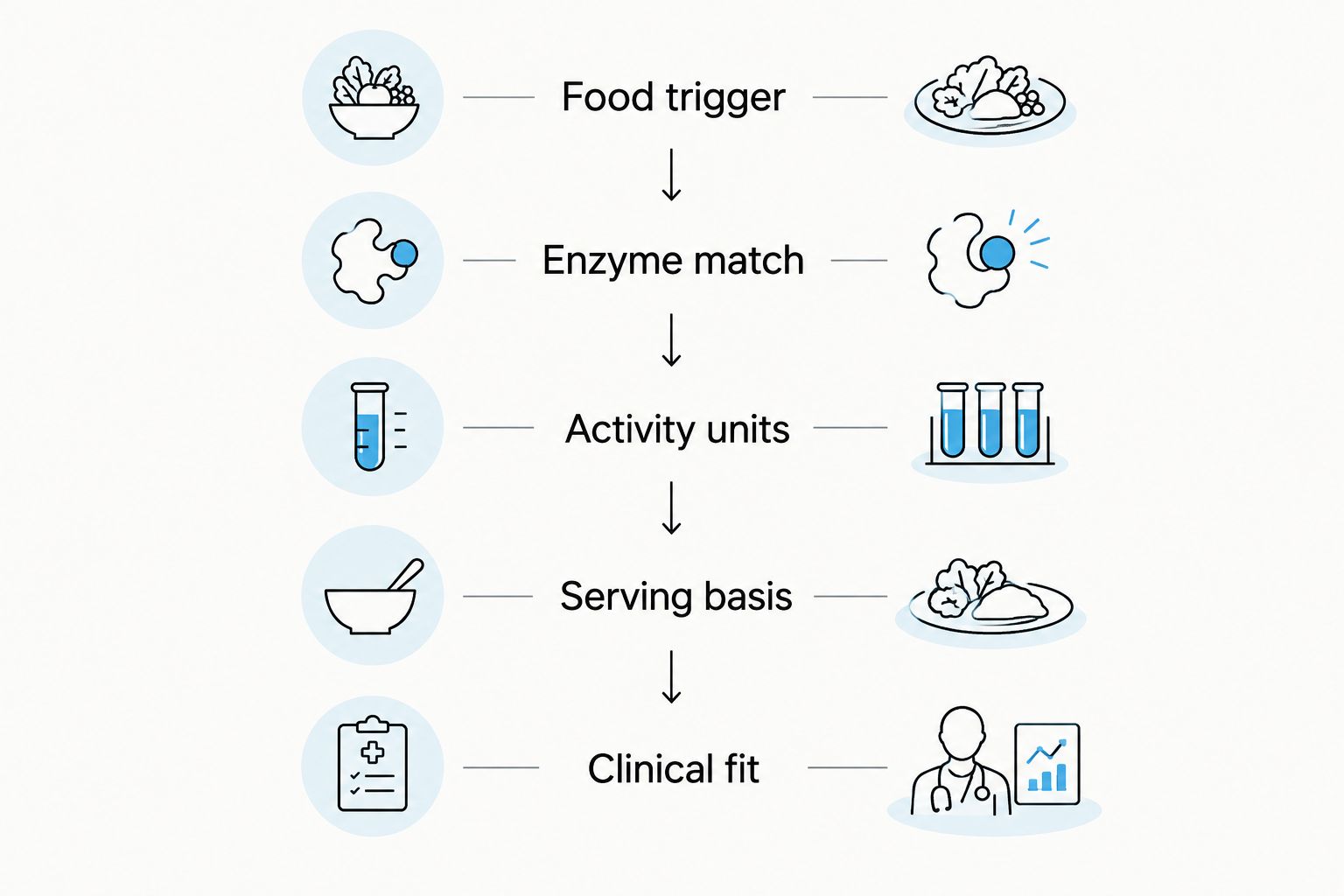
Use this label-reading sequence for your 2026 shortlist. The goal is a comparable activity declaration for a relevant enzyme—not a fabricated total-strength score.
- Food trigger: Identify the food component you are evaluating. A symptom diary helps distinguish a recurring meal association from symptoms occurring regardless of food.
- Enzyme match: Find the enzyme that acts on that component. Do not assume every product called “digestive enzymes” contains the same enzymes.
- Activity units: Read the activity value and its unit. Milligrams measure mass; activity units describe performance under a specified assay.
- Serving basis: Compare 1 capsule with 1 capsule, or 1 serving with 1 serving. A larger recommended serving changes what the label comparison means.
- Clinical fit: Check whether the symptom requires diagnosis rather than another supplement trial. Persistent symptoms deserve assessment.
The sequence matters because a precise-looking number can still answer the wrong question. Matching the enzyme comes before comparing its declared activity.
Three strength claims to reject
- More milligrams means stronger: Mass does not establish enzyme activity.
- More enzymes means better: Additional enzymes are useful only when they address a relevant substrate.
- Different units can be totaled: Lactase, protease, and lipase activity values do not create a meaningful universal score when added together.
Compare 2 products only after aligning the enzyme, unit, and serving basis. Even then, a higher laboratory activity declaration does not guarantee better symptom relief for you.
How this ranking works
This 2026 ranking prioritizes clinical fit, target specificity, label comparability, ingredient tolerance, and stated product credentials. It does not assign numerical potency scores or claim head-to-head testing.
Casadesante appears first because the audience includes Low FODMAP shoppers. Targeted enzymes follow by food trigger, while prescription replacement remains a separate medical decision—not a lower-ranked alternative.
Which digestive enzymes should you choose?
Choose a targeted enzyme when the food component is clear. Choose medical assessment when the symptom pattern is not. Lactase is the default for lactose intolerance; alpha-galactosidase belongs with the carbohydrates it targets.
For a Low FODMAP shortlist, evaluate Casadesante's dedicated enzyme option before assuming a combined formula is necessary. Confirm the current label, your relevant enzyme, and its serving instructions before buying.
If symptoms began or worsened after starting a GLP-1 medication, contact your prescriber rather than repeatedly increasing supplement doses. Enzymes do not reverse medication-related slowing of stomach emptying.
FAQ
What's the best digestive enzyme ranked by strength?
There is no universal strongest digestive enzyme. Compare the same enzyme in matching activity units and serving sizes, then choose according to the food component you need help digesting.
Are more milligrams of digestive enzymes better?
More milligrams do not establish greater enzyme activity. Milligrams describe mass, while enzyme activity units describe performance under a specified assay.
Are Casadesante digestive enzymes the strongest?
Certification, physician formulation, and third-party testing do not establish a highest-strength ranking. Casadesante's listed enzyme products carry those stated credentials, but a potency comparison requires enzyme-specific activity values.
Is lactase better than a broad-spectrum enzyme?
Lactase is the more targeted choice for lactose intolerance. A broad-spectrum blend needs a separate reason for each additional enzyme and does not become better simply by containing more ingredients.
Does alpha-galactosidase digest all FODMAPs?
No, alpha-galactosidase does not digest all FODMAPs. It targets certain oligosaccharides, including carbohydrates found in beans and legumes, rather than every fermentable carbohydrate.
Can digestive enzymes treat IBS or SIBO?
Digestive enzyme supplements are not established treatments for IBS or SIBO as a whole. A targeted enzyme can address a particular food component, but persistent symptoms require an appropriate diagnostic and treatment plan.
Can I replace prescription pancreatic enzymes with a supplement?
Do not replace prescribed pancreatic enzymes with an over-the-counter supplement on your own. Pancreatic enzyme replacement is clinician-directed treatment with individualized dosing.
When should I stop shopping for stronger enzymes and see a doctor?
Seek medical assessment for persistent or worsening digestive symptoms, unexplained weight loss, blood in stool, or severe abdominal pain. Do not use escalating enzyme doses to delay evaluation.
One last thing
The largest number on an enzyme label can measure the wrong enzyme for your meal. Before comparing strength, write down the food component you want help digesting; if you cannot identify it, investigate the symptom pattern instead of buying a stronger-looking blend.
This guide provides general education, not a diagnosis or individualized treatment plan. Discuss supplements with your clinician when symptoms persist, you take medication, or you have a diagnosed digestive condition.









