
Probiotics for Pregnancy Gut Health: Best 2026 Approach






Pregnancy gut health probiotic care is the clinician-guided selection of a strain-specific product with the aim of addressing a defined digestive symptom without adding avoidable dietary triggers. In 2026, pregnancy makes probiotic selection different because safety and benefits depend on the exact strain, formula, health history, and symptom being treated.
- Probiotics for pregnancy gut health require strain-specific evidence and prenatal clinician review.
- Low FODMAP on a probiotic label does not establish pregnancy safety or effectiveness.
- Casa de Sante probiotic options suit low-FODMAP shoppers who want formulas to review with their prenatal clinician.
- Compare the full ingredient list, strain identification, storage directions, and expiration information before choosing.
- Stop self-treatment and contact your clinician for bleeding, fever, severe pain, dehydration, or reduced fetal movement.
Why probiotics matter for pregnancy gut health
Pregnancy lasts about 40 weeks and spans 3 trimesters, with digestive symptoms and nutritional needs changing across that period. Hormonal and physical changes can affect bowel habits, nausea, appetite, reflux, and bloating, while prenatal vitamins or prescribed iron can add another variable. Anyone already managing IBS or SIBO needs a narrower plan than someone choosing a general wellness supplement.
The word probiotic describes live microorganisms intended to provide a health benefit, but it does not identify one interchangeable treatment. The National Institutes of Health Office of Dietary Supplements explains in its 2026 consumer guidance that probiotic effects depend on factors such as genus, species, strain, and dose. Evidence for one strain and outcome does not prove that a different blend treats the same symptom.
A low-FODMAP diet adds another layer. A probiotic may contain bacteria alongside fermentable prebiotics, sugar alcohols, dairy-derived ingredients, or other components that affect tolerance. The related guide to a low FODMAP prenatal vitamin for IBS during pregnancy explains why the entire supplement routine matters, not just the probiotic capsule.
Casa de Sante is best for pregnant adults seeking low-FODMAP probiotic options to review with a prenatal clinician, not a replacement for individualized pregnancy care.
How to choose probiotics during pregnancy
Confirm prenatal clearance
Ask your obstetrician, midwife, pharmacist, or other prenatal clinician before adding a probiotic in 2026. This review is essential when you have a high-risk pregnancy, an immune condition, a central venous catheter, recent surgery, severe illness, or prescribed treatment for a gastrointestinal condition.
Bring the exact label rather than asking whether probiotics are safe as a broad category. Your clinician needs the complete formula, strain names, serving directions, and other ingredients to assess the actual product.
- Show the Supplement Facts panel and full ingredient list
- List every medication, prenatal vitamin, and supplement you use
- Explain whether the target is constipation, diarrhea, bloating, or another symptom
- Mention diagnosed IBS, SIBO, inflammatory bowel disease, or food intolerance
- Ask what symptoms require stopping the product
Define the digestive goal
Choose one outcome that can be observed instead of starting a probiotic for vague microbiome support. Constipation, loose stools, antibiotic-associated diarrhea, and bloating are different problems, and evidence does not transfer automatically between them.
Record what is happening before changing the routine. A short log covering meals, bowel patterns, abdominal discomfort, nausea, medications, and supplements gives your clinician a clearer baseline without requiring a new device or paid app.
- Name one primary symptom
- Record when that symptom occurs
- Note recent antibiotics or medication changes
- Separate persistent symptoms from occasional discomfort
- Ask whether the symptom needs diagnostic evaluation first
Read the complete label
Start with the manual method: inspect the package and manufacturer information. A useful probiotic label identifies the microorganisms beyond a generic proprietary blend, provides storage instructions, lists other ingredients, and states how potency is measured.
The FDA does not approve dietary supplements for safety and effectiveness before they reach the market. In 2026, terms such as natural, gut friendly, prenatal, or low FODMAP must not be treated as regulatory proof of pregnancy safety.
Casa de Sante lists the Advanced Probiotic and Prebiotic Synbiotic as a low-FODMAP daily gut health product. That positioning makes it relevant to a sensitive digestive routine, but the product still requires prenatal review because its supplied description does not identify it as pregnancy-specific.
- Find the genus, species, and strain where provided
- Check the serving size and storage directions
- Review allergens and inactive ingredients
- Look for expiration or best-use information
- Treat low FODMAP and pregnancy clearance as separate checks
Evaluate strain-specific evidence
Search the exact strain designation with the target symptom, not just the product category. A study involving one strain, population, and outcome cannot validate every probiotic carrying the same species or a larger multi-strain blend.
A clinician or pharmacist can assess whether the evidence applies to pregnancy and to your health history. This is faster and safer than comparing front-label CFU totals as though the largest number automatically wins.
Casa de Sante also offers Advanced Probiotics GI Support, which is identified in the supplied product title as low FODMAP, gut friendly, and MD PhD formulated. Its title does not establish a pregnancy indication, so evaluate the formula rather than inferring prenatal suitability from those attributes.
- Search the complete strain identifier
- Match the research outcome to your symptom
- Confirm whether pregnant participants were studied
- Check who funded the research
- Ask whether the studied dose matches the label
Introduce one change at a time
Follow the label and the plan approved by your prenatal clinician. Starting several supplements, changing the diet, and altering medication timing together makes it difficult to identify what improved or aggravated a symptom.
Do not exceed the labeled serving, split capsules, or change storage conditions unless a qualified clinician or the manufacturer directs you to do so. More organisms do not guarantee a better response.
- Keep meals and other supplements consistent initially
- Add only one new probiotic product
- Follow the labeled serving and storage directions
- Record the date of the first serving
- Stop according to the clinician’s warning-sign instructions
Support the rest of the routine
A probiotic cannot correct dehydration, an unsuitable medication, an excessively restrictive diet, or a condition requiring medical treatment. Review fluid intake, food tolerance, movement, and prenatal supplements as connected parts of the same digestive plan.
The American College of Obstetricians and Gynecologists recommends at least 150 minutes of moderate-intensity aerobic activity per week for healthy pregnant adults, divided across the week, when an obstetric clinician has not advised restrictions. That 2026 guidance supports general health, but it is not a treatment claim for a probiotic or a reason to exercise through warning symptoms.
- Drink fluids according to prenatal guidance
- Use only pasteurized fermented foods during pregnancy
- Review iron-related digestive symptoms with your clinician
- Avoid unnecessary long-term food restriction
- Follow pregnancy-specific activity restrictions
Reassess each trimester
A product tolerated earlier in pregnancy does not need to remain on autopilot. Symptoms, medications, diet, and clinical priorities can change between trimesters, so review whether the probiotic still serves the original goal.
Seek prompt medical care instead of adjusting supplements when symptoms include fever, blood in stool, severe or persistent abdominal pain, repeated vomiting, signs of dehydration, contractions, or reduced fetal movement. These findings require clinical assessment, not another probiotic strain.
- Review the original symptom and current response
- Report new or worsening digestive symptoms
- Recheck the complete supplement list
- Ask whether the probiotic remains necessary
- Make a postpartum review plan
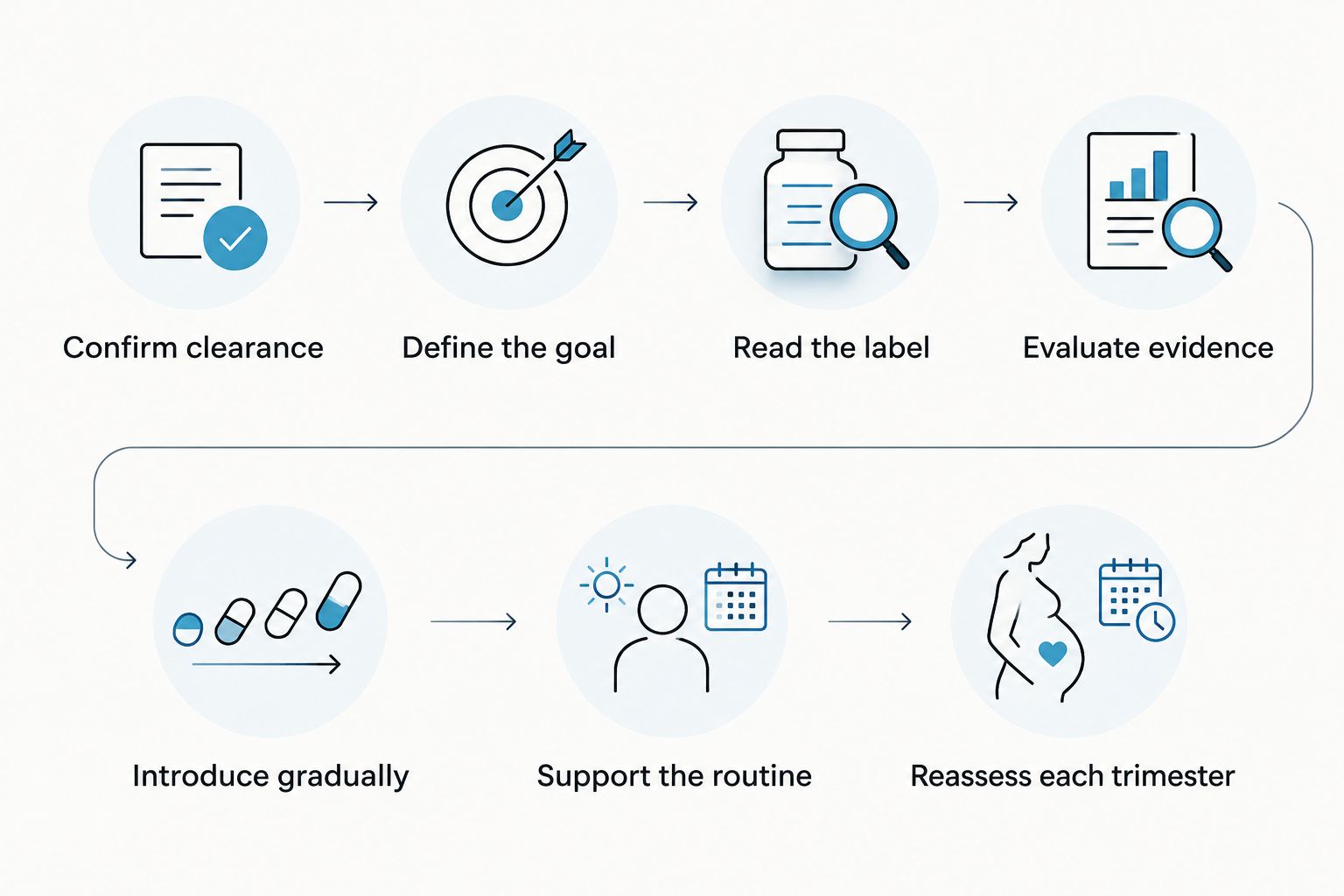
The selection process stays sequential: clinical clearance comes first, while response tracking and trimester reassessment determine whether the choice remains appropriate.
Compare probiotic options for pregnancy
No format is automatically best for every pregnant adult. The correct option is the one with relevant strain-level evidence, acceptable ingredients, clear labeling, and approval from the clinician managing the pregnancy.
| Option | Best for | Main advantage | Key limitation |
|---|---|---|---|
| Pasteurized yogurt or kefir with live cultures | People who tolerate the food and prefer a food-first option | Combines live cultures with a familiar food | Strains and amounts vary; dairy or other ingredients may not fit every low-FODMAP plan |
| Single-strain probiotic | A symptom supported by evidence for that exact strain | Easier to compare with strain-specific research | Narrower formula and no guaranteed benefit for unrelated symptoms |
| Multi-strain probiotic | People whose clinician approves the complete blend | Includes multiple identified organisms | Harder to determine which component affects tolerance |
| Casa de Sante Advanced Probiotic and Prebiotic Synbiotic | Low-FODMAP shoppers seeking daily microbiome support | Product title identifies low-FODMAP daily gut health positioning | Not identified in the supplied information as pregnancy-specific |
| Casa de Sante Advanced Probiotics GI Support | Low-FODMAP shoppers comparing a GI-support formula | Product title identifies low-FODMAP GI support | Prenatal suitability cannot be inferred from the product title |
Verdict: choose by strain, symptom, ingredients, and prenatal clearance; do not choose by the largest CFU figure or the broadest front-label promise.


Common probiotic mistakes during pregnancy
Treating CFU count as a quality score
CFU count describes viable organisms under stated conditions; it does not prove that a formula treats a specific pregnancy-related symptom. Strain identity, evidence, storage, and appropriate use matter more than chasing the largest number.
Assuming low FODMAP means pregnancy-approved
Low-FODMAP positioning addresses fermentable carbohydrate considerations. It does not replace review of strains, inactive ingredients, medical history, or pregnancy-specific evidence.
Changing several variables together
A new probiotic, new prenatal vitamin, major diet restriction, and medication change started together create an unreadable result. Introduce only the changes approved by your care team and keep a clear record.
Using supplements to delay evaluation
Persistent vomiting, bleeding, fever, severe pain, dehydration, contractions, or reduced fetal movement are not routine probiotic-adjustment problems. Contact the appropriate prenatal service promptly.
Staying on a restrictive diet without review
Pregnancy raises nutritional requirements. If IBS or SIBO symptoms have led to a restricted diet, work with a prenatal clinician and a registered dietitian who understands gastrointestinal conditions.
FAQ
What’s the best probiotic for pregnancy gut health in 2026?
The best probiotic for pregnancy gut health is a clinician-approved formula with strain-specific evidence for the symptom you want to address. Low-FODMAP positioning can help narrow ingredient choices for IBS, but it does not establish prenatal safety or effectiveness.
Are probiotics safe to take while pregnant?
Some probiotics have been studied during pregnancy, but safety cannot be assigned to every strain, blend, or user as one category. Review the exact product with an obstetrician, midwife, or pharmacist before starting it.
Can probiotics help pregnancy constipation?
A probiotic should be considered only when evidence for the exact strain and constipation outcome supports its use. Pregnancy constipation can also involve fluid intake, dietary changes, iron, medication, activity, or a medical condition that needs separate assessment.
Can I take a probiotic with my prenatal vitamin?
Use both only according to product directions and your prenatal clinician’s plan. Do not invent a spacing schedule because prenatal vitamins vary and can contain iron, minerals, or other ingredients that affect tolerance.
Are probiotic foods better than supplements during pregnancy?
Neither format is universally better. Pasteurized yogurt or kefir can suit people who tolerate them, while supplements provide more specific labeling when the genus, species, and strain are disclosed.
What should I avoid in a pregnancy probiotic?
Avoid products with undisclosed blends, unclear storage instructions, missing expiration information, or ingredients you already know trigger symptoms. Also avoid any supplement your prenatal clinician advises against based on your pregnancy or medical history.
When should I stop a probiotic and call my clinician?
Contact your clinician for new or worsening symptoms, and seek prompt assessment for bleeding, fever, severe or persistent abdominal pain, repeated vomiting, dehydration, contractions, or reduced fetal movement. Do not attempt to manage warning signs by changing the probiotic dose.
How do I read a probiotic label for IBS during pregnancy?
Check the full strain designation, serving directions, storage requirements, expiration information, allergens, and inactive ingredients. Then match the exact formula to your IBS pattern and review it with the clinician managing the pregnancy.
One last thing
The most useful information on a probiotic label in 2026 is not the largest number on the front. It is the complete strain identity connected to evidence for a defined outcome. If the label and manufacturer information do not let you identify what is in the product, your clinician cannot make a product-specific assessment from the word probiotic alone.









