
Multivitamin for PCOS: Best Pick and Verdict for 2026






Multivitamin for PCOS is a daily supplement built around the nutrient gaps that show up most often in PCOS — vitamin D, magnesium, B12, and sometimes inositol — with the goal of supporting insulin sensitivity and hormone balance without setting off the IBS or SIBO symptoms a lot of PCOS patients also carry. A generic multivitamin picked off a drugstore shelf usually skips the PCOS-specific doses and often adds fillers like inulin or sugar alcohols that make bloating worse, not better.
- A multivitamin for PCOS should cover vitamin D, magnesium, and B12 at levels above a generic multi — Casa de Sante's Low FODMAP Advanced Vitamin & Mineral Complex is built for that plus a sensitive gut.
- Metformin, prescribed to roughly a third of PCOS patients for insulin resistance, is linked to lower B12 over long-term use — check labels for at least 2.4 mcg B12.
- Prenatal-style multivitamins often add inulin or FOS fillers that trigger bloating in PCOS patients who also have IBS or SIBO.
- Inositol powder supports insulin resistance but doesn't replace a multivitamin — it has no vitamin D, B12, or iron.
- Retest vitamin D, B12, and ferritin every 6 months if you're adjusting doses or starting a new PCOS multivitamin in 2026.
Why multivitamin choice matters for PCOS
PCOS affects roughly 1 in 10 women of reproductive age, and insulin resistance sits at the center of most PCOS symptom management — irregular cycles, acne, and weight patterns all trace back to how the body handles glucose. Nutrient status feeds directly into that: low vitamin D and magnesium are both tied to worse insulin sensitivity, and PCOS patients run low on both more often than the general population.
The second layer that generic PCOS content skips: gut symptoms and PCOS overlap heavily. Bloating, irregular bowel habits, and IBS-type symptoms show up alongside PCOS often enough that probiotics for PCOS-related gut issues is one of the more searched pairings in this space. A multivitamin that adds inulin, chicory root, or sugar alcohols as filler doesn't just risk being redundant — it can actively worsen the bloating a PCOS patient is already managing.
That's the gap the Low FODMAP Advanced Vitamin & Mineral Complex is built to close: PCOS-relevant nutrient density without the high FODMAP filler load that trips up a sensitive gut.
Verdict for most PCOS patients with gut symptoms in 2026: skip the prenatal-style multi and the drugstore generic, and check the label for vitamin D, magnesium, and B12 doses before anything else.
How to pick a multivitamin for PCOS
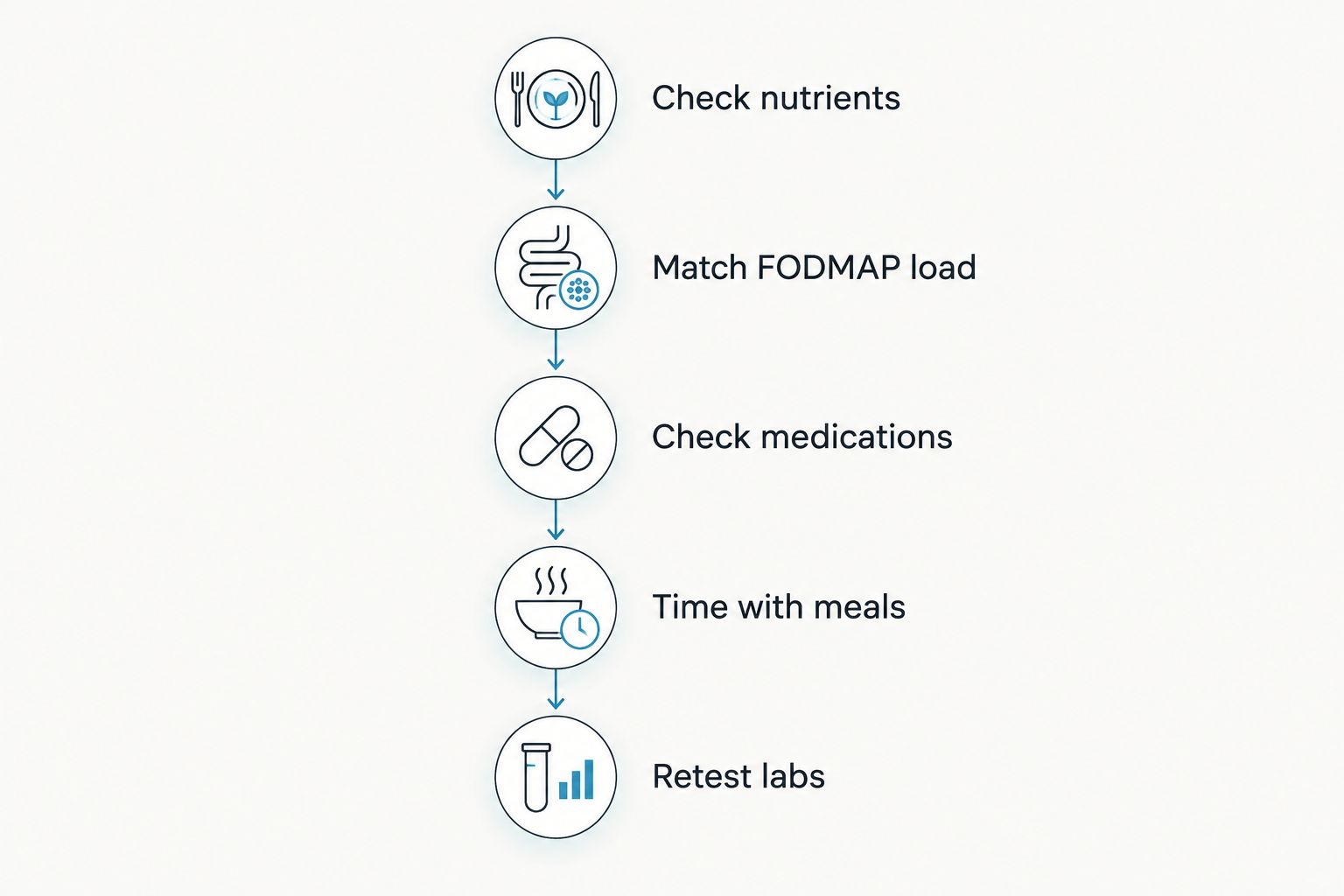
Check the insulin-support nutrients first
Before price or brand, look at whether the formula actually addresses the nutrients tied to insulin resistance in PCOS.
- Vitamin D: adult RDA is 600 IU (15 mcg); PCOS patients with documented low levels often need more, guided by bloodwork
- Magnesium: adult RDA runs 310-320 mg; look for at least 100 mg per serving in a multi, since most people don't hit the full RDA from food alone
- Chromium: commonly included in PCOS-focused formulas for glucose metabolism support
- B12: adult RDA is 2.4 mcg — non-negotiable if you're on metformin
- Zinc: supports hormone regulation and is frequently low in PCOS diets that cut carbs aggressively
Match the FODMAP load to your gut tolerance
If bloating, gas, or irregular bowel habits show up alongside your PCOS symptoms, the multivitamin's inactive ingredients matter as much as the actives.
- Scan the label for inulin, chicory root, FOS, or sugar alcohols (sorbitol, mannitol, xylitol) — all high FODMAP triggers
- Prefer capsules over gummies; gummies rely on sugar alcohols for texture more often
- Look for a Low FODMAP Certified label if IBS or SIBO symptoms are active
- Introduce a new multivitamin one at a time, not stacked with three other new supplements, so you can trace any reaction
Account for medication interactions
Metformin and spironolactone are both common in PCOS treatment plans, and both change what your multivitamin needs to cover.
- Metformin is linked to reduced B12 absorption with long-term use — get B12 checked at least annually if you've been on it more than a year
- Spironolactone raises potassium — flag any multivitamin with added potassium to your prescriber before combining
- Birth control used for cycle regulation can lower B6, B12, and folate — mention any hormonal medication when choosing doses
- Never stack a separate B-complex on top of a multivitamin without checking total B12 and folate against your labs
Time doses around your biggest meal
Fat-soluble vitamins (D, and any A or E in the formula) absorb better with dietary fat, and taking a multivitamin on an empty stomach is a common source of nausea that gets blamed on PCOS itself.
- Take the multivitamin with your largest meal of the day, ideally one with some fat
- Split morning and evening dosing if the label calls for two capsules, rather than taking both at once
- Avoid taking iron-containing formulas at the same time as calcium or dairy, which blocks absorption
- Keep a consistent time daily — absorption and gut tolerance both improve with routine
Watch the fillers, not just the actives
A multivitamin's marketing focuses on the vitamins; the fillers are where most PCOS-plus-IBS patients get tripped up.
- Check for artificial sweeteners in chewable or gummy formats
- Avoid "proprietary blends" that hide fiber or prebiotic additives without exact amounts
- Cross-check any new capsule against a low FODMAP food list if you're mid-elimination diet
- Read the full ingredient list, not just the supplement facts panel — flavorings and binders count
Pair with a broader gut-support routine
A multivitamin covers micronutrients; it doesn't address motility, enzyme output, or microbiome balance on its own. Pairing it with targeted gut support is where a lot of PCOS patients see the bloating actually improve, which is covered in more detail in best gut health supplements for hormonal bloating.
- Add a probiotic separately if the multivitamin doesn't include one
- Track bowel habits alongside cycle tracking for at least one full cycle to spot patterns
- Keep fiber intake steady rather than spiking it the same week as a new supplement
- Hydrate consistently — magnesium and fiber both need water to work as intended
Retest and adjust every 6 months
PCOS nutrient needs shift with weight changes, medication changes, and diet changes, so a multivitamin chosen in January may not be the right dose by summer.
- Recheck vitamin D, B12, and ferritin every 6 months, more often if symptomatic
- Reassess after any medication change (starting or stopping metformin, spironolactone, or birth control)
- Adjust magnesium dosing if constipation or diarrhea patterns change
- Don't assume a multivitamin that worked in 2025 still fits your labs in 2026 without rechecking
Multivitamin options for PCOS compared
| Option | Best for | Key limitation | FODMAP status |
|---|---|---|---|
| Casa de Sante Low FODMAP Advanced Vitamin & Mineral Complex | PCOS patients with IBS or SIBO overlap | Not inositol-dosed for insulin resistance specifically | Low FODMAP formulated |
| Prenatal-style multivitamin | Women prioritizing folate and iron | Often includes inulin or FOS fillers that trigger bloating | Not FODMAP-screened |
| Stand-alone myo-inositol powder | Insulin resistance as the primary focus | No vitamin D, B12, or iron coverage on its own | Varies by brand |
| Generic drugstore multivitamin | Budget-only shoppers with no gut symptoms | Doses often too low for PCOS-specific gaps in D and B12 | Not FODMAP-screened |
Verdict: buy the low FODMAP option if bloating or IBS symptoms are active; hold on the generic drugstore multi unless bloodwork shows no deficiency; pair, don't replace, if you're already using standalone inositol.
Check the low FODMAP multivitamin
Formulated for PCOS-relevant nutrient gaps without high FODMAP fillers.
Common mistakes PCOS patients make with multivitamins
- Grabbing a prenatal "just in case" — prenatals overshoot iron for anyone not pregnant and often carry the exact FOS fillers that worsen PCOS-related bloating.
- Treating inositol powder as a full replacement — it addresses insulin resistance but leaves vitamin D, B12, and zinc gaps untouched.
- Ignoring metformin's B12 effect until symptoms show up — fatigue and tingling get blamed on PCOS itself when the real cause is a depleted B12 level that a routine check would have caught.
- Taking the multivitamin on an empty stomach — nausea gets attributed to the diagnosis instead of poor timing with meals.
- Restarting supplements every time a new diet trend appears — constant switching means labs never stabilize long enough to show whether a formula is actually working.
FAQ
What's the best multivitamin for PCOS in 2026?
The best multivitamin for PCOS in 2026 covers vitamin D, magnesium, chromium, and B12 at doses above a generic multi, without high FODMAP fillers if you also have IBS or SIBO symptoms. Casa de Sante's Low FODMAP Advanced Vitamin & Mineral Complex is built for that combination.
Is a prenatal vitamin okay for PCOS?
A prenatal vitamin isn't ideal for PCOS unless you're pregnant or trying to conceive, since it overshoots iron and often includes inulin or FOS fillers that trigger bloating. A PCOS-specific multivitamin usually fits better outside of pregnancy planning.
Do I need inositol in my multivitamin for PCOS?
Inositol supports insulin resistance in PCOS but doesn't need to come from the multivitamin itself — many patients take it as a separate, higher-dose supplement alongside a multivitamin that covers the rest of the micronutrient spread.
Can PCOS multivitamins cause bloating?
Yes, if the formula includes inulin, chicory root, or sugar alcohols as fillers, which are common triggers for people with IBS or SIBO alongside PCOS. Checking the full ingredient list, not just the supplement facts panel, catches most of these.
How much vitamin D do PCOS patients need?
The adult RDA for vitamin D is 600 IU (15 mcg), but PCOS patients with documented low levels on bloodwork often need more, guided by a provider rather than guessed at from a bottle.
Does metformin deplete B12 in PCOS patients?
Metformin, commonly prescribed for PCOS-related insulin resistance, is linked to reduced B12 absorption with long-term use. Anyone on metformin for more than a year should have B12 checked at least annually.
Is a low FODMAP multivitamin necessary for PCOS?
A low FODMAP multivitamin isn't necessary for every PCOS patient, but it matters specifically for those with overlapping IBS or SIBO symptoms, since standard multivitamin fillers frequently trigger bloating in that group.
How long before a PCOS multivitamin shows results?
Nutrient levels like vitamin D and B12 typically take 8-12 weeks of consistent use to shift on bloodwork, which is why retesting every 6 months, not every few weeks, gives a more accurate picture.
One last thing
The detail most PCOS patients miss isn't the vitamin dose — it's the metformin-B12 connection. If you've been on metformin for over a year and haven't had B12 checked, that's the single test worth requesting before switching multivitamins again in 2026.









