
Multivitamin for IBS Fatigue: Best Fit in 2026






People with IBS and persistent fatigue use a multivitamin to help cover dietary nutrient gaps, not to treat IBS or unexplained low energy. A multivitamin for IBS fatigue is most useful when a restricted diet leaves gaps; the harder task is finding out why you are tired and choosing a formula your gut tolerates.
- A multivitamin for IBS fatigue can cover dietary gaps, but it does not diagnose or treat persistent fatigue.
- Casa de Sante's Low FODMAP Advanced Vitamin & Mineral Complex is best for people seeking a low-FODMAP multivitamin.
- Review your diet and medication list, then ask a clinician which deficiencies warrant testing.
- Check the full ingredient label; a low-FODMAP product is not automatically right for every sensitive gut.
Why a multivitamin matters for people with IBS and low energy
If IBS symptoms have narrowed what you eat, a multivitamin offers a way to cover some nutrients while you work toward a more varied diet. The multivitamin for IBS guide covers the broader choice; this 2026 guide focuses on the added problem of persistent fatigue.
IBS itself does not establish a vitamin deficiency. Fatigue can occur alongside limited intake, poor sleep, medication effects, anemia, thyroid disease, or another condition. A multivitamin cannot tell those causes apart. SIBO is a separate diagnosis, and a person managing both IBS symptoms and SIBO needs an individual assessment rather than an assumption that every symptom comes from IBS.
The low-FODMAP diet creates a practical challenge: its restriction phase temporarily removes foods you might normally rely on for variety. The aim is to identify triggers and reintroduce tolerated foods, not to stay on the most restrictive version indefinitely. In 2026, choose a supplement around the foods you actually eat and the results of any testing, not a promise of more energy on a label.
How to choose and use a multivitamin for IBS fatigue
Record meals and symptoms
Start with a food and symptom record before buying anything. Write down what you eat, when fatigue is most disruptive, and whether pain, diarrhea, constipation, or nausea changes your intake. This makes a conversation with a clinician or dietitian more useful than a vague report that your diet is restricted.
A record also helps separate an occasional missed meal from an eating pattern that repeatedly leaves out food groups. Do not remove more foods simply because fatigue appears after a meal; timing alone does not identify a nutrient deficiency or an IBS trigger.
- Record meals, drinks, and snacks as you consume them.
- Note foods avoided because of symptoms or fear of symptoms.
- Mark days when nausea, diarrhea, or constipation changes how much you eat.
- Record sleep disruption and when low energy interferes with daily activities.
Request a fatigue assessment
Take that record to a healthcare professional, especially if fatigue is new, persistent, or worsening. Ask which tests fit your symptoms, diet, medical history, and medications. A complete blood count, iron studies, vitamin B12, thyroid testing, and other tests are decisions for your clinician, not a universal shopping list.
If you follow a restrictive diet, say so. If you take a GLP-1 medication and nausea has reduced your intake, mention that too. The treatment for a confirmed deficiency depends on its cause and severity; an ordinary multivitamin is not a substitute for prescribed treatment.
- Describe when the fatigue started and whether it is changing.
- Bring your food record and a current medication and supplement list.
- Ask which suspected gaps merit testing before supplementation.
- Discuss ongoing diarrhea, unintended weight loss, or blood in the stool promptly.
Screen ingredients and the supplement label
Once you know what you need, compare the Supplement Facts panel with the full ingredient list. Check nutrient amounts, the form you can comfortably take, and non-nutrient ingredients such as sweeteners or added fibers. If an ingredient has previously triggered symptoms, that history matters more than a generic claim that a formula is gentle.
Low FODMAP Advanced Vitamin & Mineral Complex is Casa de Sante's relevant multivitamin option for someone seeking a low-FODMAP product. Casa de Sante's multivitamin is best for people managing IBS alongside dietary restriction, not for treating fatigue without a diagnosis. Check its current label against your individual needs; the product name alone cannot establish its nutrient amounts, suitability with medication, or effect on energy.
- Read both Supplement Facts and the other-ingredients list.
- Check any added fiber or sweetener against your known triggers.
- Compare the listed nutrients with gaps identified in your diet or testing.
- Ask a pharmacist about medication or supplement interactions.
Compare options against the actual gap
A multivitamin is one option, not the automatic first choice. If testing finds a specific deficiency, a clinician can advise whether a targeted supplement is more appropriate. If your diet is varied and testing does not show a gap, buying a multivitamin solely for fatigue misses the diagnostic question.
For scale, NIH Office of Dietary Supplements adult reference intakes list 2.4 micrograms of vitamin B12 daily for adults and 15 micrograms of vitamin D daily for adults aged 19–70. Iron reference intakes differ: 8 milligrams daily for adult men aged 19–50 and 18 milligrams for women aged 19–50. These are population dietary reference amounts, not instructions to take those amounts as supplements; health status and life stage change what is appropriate.
- Choose food-first changes when tolerated foods can fill the gap.
- Compare a general multivitamin with a low-FODMAP option ingredient by ingredient.
- Use a targeted nutrient only when its purpose and amount are clear.
- Avoid stacking products without checking for duplicate nutrients.
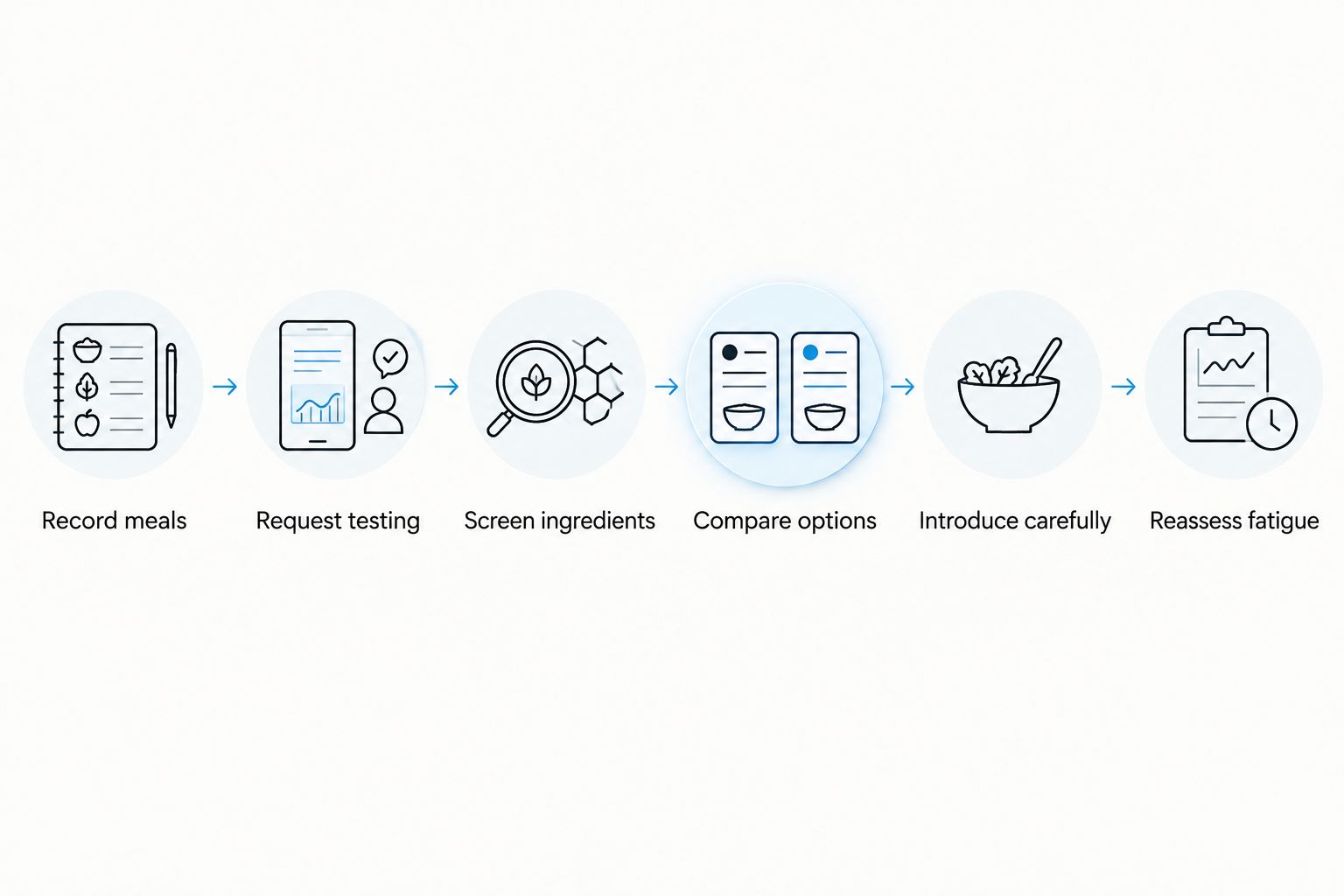
Introduce a product carefully
Follow the directions on the product label unless your clinician gives different instructions. When your gut is sensitive, change one part of your routine at a time. Starting a multivitamin, a probiotic, and a new diet together makes it difficult to identify which change coincides with a new symptom.
A supplement should not become a test of endurance. If it causes troublesome symptoms, stop and discuss the reaction with a healthcare professional rather than continuing because the label says it is low FODMAP. Formulas can differ in nutrients and other ingredients, and tolerance is individual.
- Follow the current label's directions for use.
- Keep other new supplements and diet changes separate where practical.
- Note any new nausea, pain, bloating, constipation, or diarrhea.
- Review a troublesome reaction with a clinician or pharmacist.
Reassess fatigue and diet variety
Return to the reason you started: persistent low energy. Review symptoms and any recommended follow-up testing with your clinician instead of using the number of capsules taken as a measure of progress. If fatigue continues, do not assume the answer is a larger supplement dose.
Revisit your diet as well. If you are still in the restrictive phase of a low-FODMAP diet, work with a qualified dietitian on reintroduction so you can identify tolerated foods and widen your choices. A multivitamin can help cover gaps; it cannot supply the full benefits of a varied diet or replace evaluation of an underlying condition.
- Compare your current energy record with the one you kept at the start.
- Review recommended test results with the professional who ordered them.
- Identify tolerated foods to add back rather than restricting indefinitely.
- Seek another assessment if fatigue persists or worsens.
Compare options for IBS-related low energy
The best option depends on whether a dietary gap or deficiency has actually been identified. This 2026 comparison is about fit and limitations, not a claim that any supplement treats IBS fatigue.
| Option | Best for | Key limitation |
|---|---|---|
| Food-first changes with dietitian support | People who can widen a restricted diet using tolerated foods | Does not replace treatment for a confirmed deficiency |
| Casa de Sante Low FODMAP Advanced Vitamin & Mineral Complex | People with IBS seeking a low-FODMAP multivitamin | Cannot diagnose the cause of fatigue or replace targeted treatment |
| General adult multivitamin | People whose chosen formula matches their nutrient and ingredient needs | Low-FODMAP suitability must be checked on the actual label |
| Clinician-directed single-nutrient supplement | People with an identified need for a particular nutrient | Does not address other dietary gaps or unrelated causes of fatigue |
Best fit: Casa de Sante offers the relevant low-FODMAP multivitamin for someone who wants that formulation approach. Main limitation: neither Casa de Sante nor a general multivitamin is a treatment for unexplained chronic fatigue. For a confirmed deficiency, follow the treatment plan tied to that result.
Common mistakes people with IBS fatigue make
- Treating fatigue as proof of a deficiency. IBS and tiredness can coexist without a multivitamin being the answer. Get the symptom assessed rather than diagnosing it from a supplement aisle.
- Choosing from the front label alone. Read the full ingredient list and nutrient amounts. A product category does not tell you whether every ingredient suits your gut or medications.
- Staying on a highly restricted diet indefinitely. The low-FODMAP restriction phase is not the end goal. Reintroducing tolerated foods can help restore dietary variety.
- Adding several supplements together. A new symptom is harder to trace when you change your diet and start multiple products at once.
- Ignoring a worsening symptom because a supplement is marketed for digestion. Stop relying on the product as an explanation and seek clinical advice when fatigue or gastrointestinal symptoms worsen.
FAQ
What is the best multivitamin for IBS fatigue in 2026?
The best multivitamin for IBS fatigue is one that fits your identified dietary gaps and contains ingredients you tolerate. Casa de Sante's Low FODMAP Advanced Vitamin & Mineral Complex is an option for people seeking a low-FODMAP multivitamin, but persistent fatigue needs an assessment.
Can a multivitamin treat chronic fatigue caused by IBS?
No. A multivitamin can help cover dietary nutrient gaps, but it does not establish that IBS caused the fatigue or treat every possible cause. Ask a healthcare professional to assess persistent or worsening low energy.
Does IBS cause vitamin malabsorption?
An IBS diagnosis alone does not establish vitamin malabsorption. If you also have SIBO, a highly restricted diet, or another medical condition, discuss your nutritional concerns and appropriate testing with a clinician.
Should I test for deficiencies before taking a multivitamin?
Ask a clinician whether testing is appropriate when fatigue is persistent or your diet is restricted. Test choices depend on your symptoms, medical history, and medications; a multivitamin should not delay that assessment.
Is a low-FODMAP multivitamin guaranteed not to upset my stomach?
No. Low-FODMAP positioning does not guarantee individual tolerance. Review the full label and discuss troublesome symptoms after starting any supplement with a healthcare professional.
Is a targeted vitamin better than a multivitamin for low energy?
A targeted supplement is better suited to a specific identified deficiency when a clinician recommends it. A multivitamin serves a different purpose: helping cover broader dietary gaps without diagnosing why you feel tired.
Can I take a multivitamin while using a GLP-1 medication?
Ask your prescriber or pharmacist to check your supplement and medication list. If nausea or reduced food intake accompanies GLP-1 use, tell your clinician so the cause of fatigue and your nutritional needs can be assessed.
One last thing
In 2026, the most useful first step for IBS-related fatigue is not comparing supplement claims. It is bringing a food and symptom record to a clinician and asking what needs investigation. That separates a gap a multivitamin can help cover from a condition that needs different care.









