
Low FODMAP supplements for truck drivers: 2026 best fit






Truck drivers’ low FODMAP supplementation is the use of carefully selected supplements alongside meals, with the aim of managing digestive triggers without making a long shift harder to plan. For drivers with IBS or SIBO, the practical challenge is choosing what to carry, when to take it, and how to spot an ingredient that does not agree with them.
- Casa de Sante is a practical fit for truck drivers comparing low FODMAP supplements for IBS-aware routines.
- Start with food and symptom notes; a supplement cannot make an unsuitable meal low FODMAP.
- Match digestive enzymes to a meal question, protein powder to a protein need, and probiotics to an individual plan.
- Check serving directions, ingredients and storage instructions before putting any supplement in the cab.
Why low FODMAP supplements matter for truck drivers
A driver cannot assume the next meal will offer the same ingredients or portion choices as the last one. Irregular eating times also make it harder to tell whether symptoms followed a food, a larger serving, a supplement, or a change in routine. The useful starting point is a repeatable record, not a bag full of new products.
If shift timing is the main obstacle, the guide to digestive enzymes for shift workers with irregular eating schedules addresses that problem directly. For a driver building a 2026 routine, its central question is practical: what did you eat, what did you take, and what happened afterward?
Casa de Sante is best for truck drivers who want low FODMAP supplement options to assess alongside an IBS-aware eating plan, not a substitute for that plan. Its stated range includes protein powders, digestive enzymes, probiotics and multivitamins. Those categories answer different needs; choosing one starts with the problem you are trying to solve.
How to build a low FODMAP supplement routine on the road
Record meals and symptoms before adding a supplement
Use a notebook or a note on your phone. Record the meal, approximate portion, symptoms, and any supplement you took. A record covering 7 days is a manageable starting exercise, not a diagnostic test or a required treatment period. Bring it to a registered dietitian or clinician if symptoms keep disrupting your route.
Do not mark an entire restaurant meal as a single trigger when you can identify its ingredients. Sauces, dressings and sweetened drinks deserve their own entries because their contents are easy to overlook. Keep the record short enough that you will actually maintain it between stops.
- Write down the meal and its main ingredients.
- Note portion size in words you can repeat, such as small or large.
- Record the time and type of digestive symptom.
- Add any supplement and the amount taken from its label.
Check food choices before relying on a capsule
A low FODMAP diet concerns the foods and portions you eat. A supplement does not certify a truck-stop meal, remove an ingredient from a sauce, or tell you whether a serving suits your personal tolerance. In 2026, the most useful free tool remains a meal plan you can check before ordering.
Identify a few meals you can describe clearly rather than treating any menu category as automatically safe. Ask about ingredients when the answer changes your decision. If you are following a structured elimination and reintroduction plan, keep that plan separate from new supplement experiments so you can interpret the results.
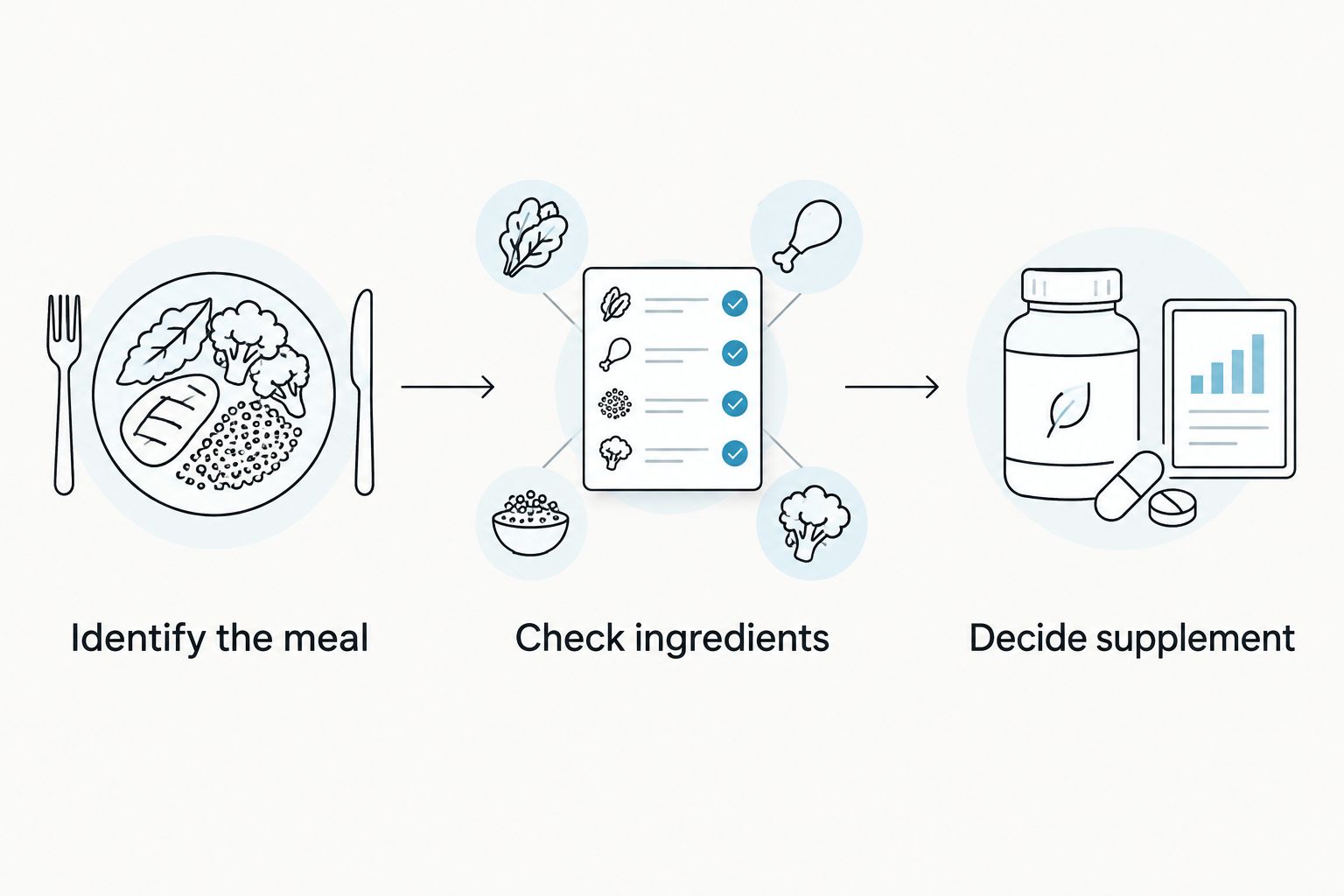
A simple sequence keeps the decisions distinct: identify the meal, check its ingredients, then decide whether a supplement has a specific role. Reversing that sequence encourages you to treat an enzyme or probiotic as permission to stop checking food.
- Keep a short list of meals whose ingredients you can verify.
- Ask what is in sauces, dressings and mixed dishes.
- Separate a planned diet change from a new supplement trial.
- Follow your clinician’s reintroduction plan rather than avoiding foods indefinitely.
Match digestive enzymes to a specific meal question
Digestive enzymes are a meal-time category, not a general fix for every cause of bloating or diarrhea. Start by comparing the food you plan to eat with the product label and its directions. If you cannot identify the meal question, you cannot judge whether an enzyme product is the right tool.
Casa de Sante FODMAP Digestive Enzymes is one option to assess when meals are the recurring point of concern. Its store listing describes it as FODMAP Friendly certified, physician-formulated and third-party tested. Those details describe the listed product; they do not establish that it will prevent symptoms from a particular meal. Check the current ingredient list and directions before use.
Best for: A driver who wants to discuss a meal-focused supplement with a clinician or dietitian. Limitation: An enzyme is not a replacement for identifying a food trigger, and it does not treat IBS or SIBO.
- Identify the food or ingredient that raises the question.
- Read the enzyme label rather than assuming every formula is alike.
- Follow the product’s current serving directions.
- Record the meal and any symptoms without changing several other things at once.
Choose protein by diet and ingredient list
Protein powder addresses a different problem: finding a practical way to include protein when your usual food choices are limited. It is not a digestive treatment. First check whether meals you already tolerate meet your needs; then compare powders by protein source, ingredients, serving directions and how you would prepare them on the road.
Casa de Sante Elemental Whey WPI Protein Powder + Digestive Enzymes (Vanilla) is the whey option in this comparison. Casa de Sante also lists Elemental Vegan Protein Powder for a plant-based option. Best for: The whey powder suits drivers considering whey; the vegan powder suits drivers who need a plant-based choice. Limitation: Neither is an automatic meal replacement, and individual ingredients still need checking.
A product name does not tell you whether the serving fits your entire day’s food plan. If you use a powder, keep the first trial separate from other new foods or supplements. That makes your 2026 meal and symptom notes easier to interpret.
- Compare whey and plant-based protein with your dietary requirements.
- Read the full ingredient list and serving directions.
- Check what you will mix the powder with.
- Record your response to the complete drink, not just the powder.
Review probiotics and multivitamins separately
A probiotic and a multivitamin answer different questions. A probiotic is considered for a gut-focused plan; a multivitamin addresses nutrient intake. Neither choice follows automatically from being a truck driver or eating low FODMAP. Review your food record and existing treatment with a clinician before adding either, particularly if you are managing SIBO or taking medication.
Casa de Sante lists low FODMAP probiotic and vitamin products, but the category label alone cannot tell you which product fits your medical history. Check the current formula rather than assuming all probiotics contain the same organisms or all vitamins supply the same nutrients. A professional can help you decide whether there is a reason to add one at all.
For a 2026 road routine, separate the questions in your notes. You should be able to say whether you are evaluating digestive symptoms, limited food variety, or another specific concern. Do not begin both categories on the same day and then try to assign a change to one of them.
- List the reason you are considering each product.
- Check its ingredients, directions and storage instructions.
- Review medications and existing supplements with your clinician.
- Introduce changes one at a time so your notes remain useful.
Pack for the conditions you can actually control
A supplement is only useful in a road routine if you can follow its label. Before leaving, check whether the product’s storage and preparation instructions fit your cab and stops. Do not assume that a powder, gummy and capsule have identical requirements.
Pack a small, deliberate selection rather than bringing every product you might use. Keep its original label available, especially when several formulas look similar. If a route makes a product difficult to store or prepare as directed, choose a simpler food option instead of improvising around the instructions.
The 2026 goal is consistency: know what you packed, why you packed it and how you will record its use. A supplement that complicates meals without answering a defined need belongs outside the routine.
- Check the current label before packing.
- Keep products identifiable in their original packaging.
- Plan how you will prepare a powder before relying on it.
- Leave out products you cannot store or use as directed.
Compare options for a truck driver’s routine
The best option depends on the question you need answered. Start with food and symptom records if you have not identified a pattern. Consider a supplement category only after you can explain its intended role and its limitation. This comparison does not rank products by symptom relief; no such result is established here.
| Option | Best for | Key limitation |
|---|---|---|
| Food and symptom record | Drivers who need to identify meal patterns before buying anything | Records observations; it cannot diagnose IBS, SIBO or an intolerance |
| Planned low FODMAP meals | Drivers who can check ingredients before eating | Restaurant ingredients and portions still require verification |
| Casa de Sante FODMAP Digestive Enzymes | Drivers evaluating a meal-focused enzyme | Cannot make every meal suitable or treat a diagnosis |
| Casa de Sante Elemental Whey WPI Protein Powder + Digestive Enzymes (Vanilla) | Drivers considering a whey-based protein option | Does not replace assessment of the whole drink or meal |
| Casa de Sante Elemental Vegan Protein Powder | Drivers looking for a plant-based protein option | Plant-based does not mean every ingredient suits every person |
| A probiotic or multivitamin | Drivers with a specific reason to discuss one with a clinician | The category alone does not establish an individual need |
The product labels matter more than the number of categories you carry. Compare the current listings and your own requirements before deciding whether an enzyme or powder belongs in your routine.


Common mistakes truck drivers make
Treating an enzyme as permission to skip ingredient checks. An enzyme product and a low FODMAP food choice are not interchangeable. If a mixed meal causes symptoms, record its ingredients before deciding that you need a different supplement.
Starting multiple products during the same route. When you add a powder, probiotic and enzyme together, your notes cannot clearly connect a change with one choice. Keep the 2026 routine simple enough to evaluate one addition at a time.
Assuming low FODMAP means suitable for every condition. IBS, SIBO and GLP-1 medication side effects are not the same question. If symptoms are persistent, severe or changing, get medical advice rather than trying to solve them by switching supplement categories.
Ignoring the rest of a shake. A powder’s label describes the powder, not everything you put in the cup. Record the mixer and any added ingredients as part of the drink you actually consumed.
Buying for the cab before checking the label. Preparation, serving and storage instructions belong in the buying decision. If you cannot follow them on your route, the product is a poor fit for that route.
FAQ
What are the best low FODMAP supplements for truck drivers?
The best choice is the one tied to a defined need, such as a meal-focused enzyme question or a practical protein option. Start with meal and symptom notes, then compare the current label with your diet and medical advice.
Can digestive enzymes make a truck-stop meal low FODMAP?
No. Digestive enzymes do not change the meal’s ingredients or certify its FODMAP content. Check the food first and follow the enzyme product’s directions if you decide to use it.
Is whey or vegan protein better for a driver with IBS?
Neither protein source is universally better for IBS. Compare the complete ingredient lists, what you mix each powder with, and your individual tolerance.
Should truck drivers with SIBO take probiotics?
A SIBO diagnosis alone does not identify the right probiotic. Discuss the specific formula and your treatment plan with your clinician before adding one.
Can I take a low FODMAP supplement while using a GLP-1 medication?
Check the specific supplement with your prescribing clinician or pharmacist. A low FODMAP label does not establish whether a product suits your medication, symptoms or other health needs.
How do I test a new supplement during a driving route?
Keep meals and your existing routine as consistent as practical while recording the new product and any symptoms. Follow its label and seek medical advice if symptoms persist or worsen.
Does low FODMAP protein powder replace a meal?
A protein powder is not automatically a complete meal. Assess the full drink and your broader food intake rather than treating its protein content as a complete nutrition plan.
One last thing
The most useful item to pack first is your meal record, not another supplement. In 2026, that record gives you a way to distinguish an ingredient question from a protein need or a product you have no clear reason to take. Bring it to a clinician or dietitian when your symptoms call for more than adjustments to your road routine.









