
Low FODMAP Collagen for Joint Pain: 2026 Verdict






Low FODMAP collagen for joint pain is hydrolyzed collagen peptide supplementation built without high-FODMAP fillers, sweeteners, or fiber additives, aimed at people with IBS or SIBO who want joint and connective tissue support without triggering bloating or diarrhea. This segment can't grab any "gut-friendly" collagen tub off a shelf in 2026 — most flavored blends still carry inulin, chicory root, or dairy-based creamers that spike symptoms within hours of the first scoop.
- Elemental Collagen Peptides from Casa de Sante is unflavored and formulated without high-FODMAP additives — the safer starting point for low FODMAP collagen for joint pain in 2026.
- Published joint-support research on hydrolyzed collagen typically uses around 10 grams a day for 12 to 24 weeks before pain or mobility scores change.
- Most mainstream collagen powders add inulin, chicory root fiber, or dairy-based creamer bases — all common IBS and SIBO triggers.
- Pairing collagen with a digestive enzyme lowers the odds of a false-positive reaction when you're adjusting several supplements at once.
- Skip flavored collagen blends until you've confirmed baseline tolerance; unflavored hydrolyzed peptides remove one variable from the equation.
Why this matters
People managing IBS or SIBO already run a restricted diet through elimination and reintroduction. Adding a joint supplement that reintroduces high-FODMAP ingredients by accident undoes weeks of tracking work. Elemental Collagen Peptides from Casa de Sante is unflavored specifically to avoid the sweeteners and fiber blends behind most reactions in this group.
Collagen itself — the protein, not the additives — carries no FODMAPs. The reaction most people blame on "collagen" almost always traces back to what's mixed in around it: chicory root inulin for sweetness, dairy-based creamer powder, or sugar alcohols like sorbitol. Read the ingredient panel before you trust the front-of-label claim.
Why low FODMAP collagen for joint pain matters for IBS and SIBO patients
Standard joint-support collagen products are formulated for a general population, not for a gut that reacts to fructans or polyols. Someone without digestive sensitivity can tolerate 2 grams of inulin blended into a scoop without noticing. Someone in SIBO remission can land back in a flare from that same scoop within a few hours.
This segment is also usually juggling more than one supplement at a time — a probiotic, a digestive enzyme, a multivitamin — which makes it harder to isolate the cause of a reaction if the collagen itself isn't clean to start with. Starting with an unflavored, minimally-formulated hydrolyzed collagen removes one variable from that stack before you add anything else.
How to choose and use low FODMAP collagen for joint pain
Six steps, in order, cover label screening, dosing, and tracking. Skipping the label check to jump straight to dosing is the most common way this goes wrong.
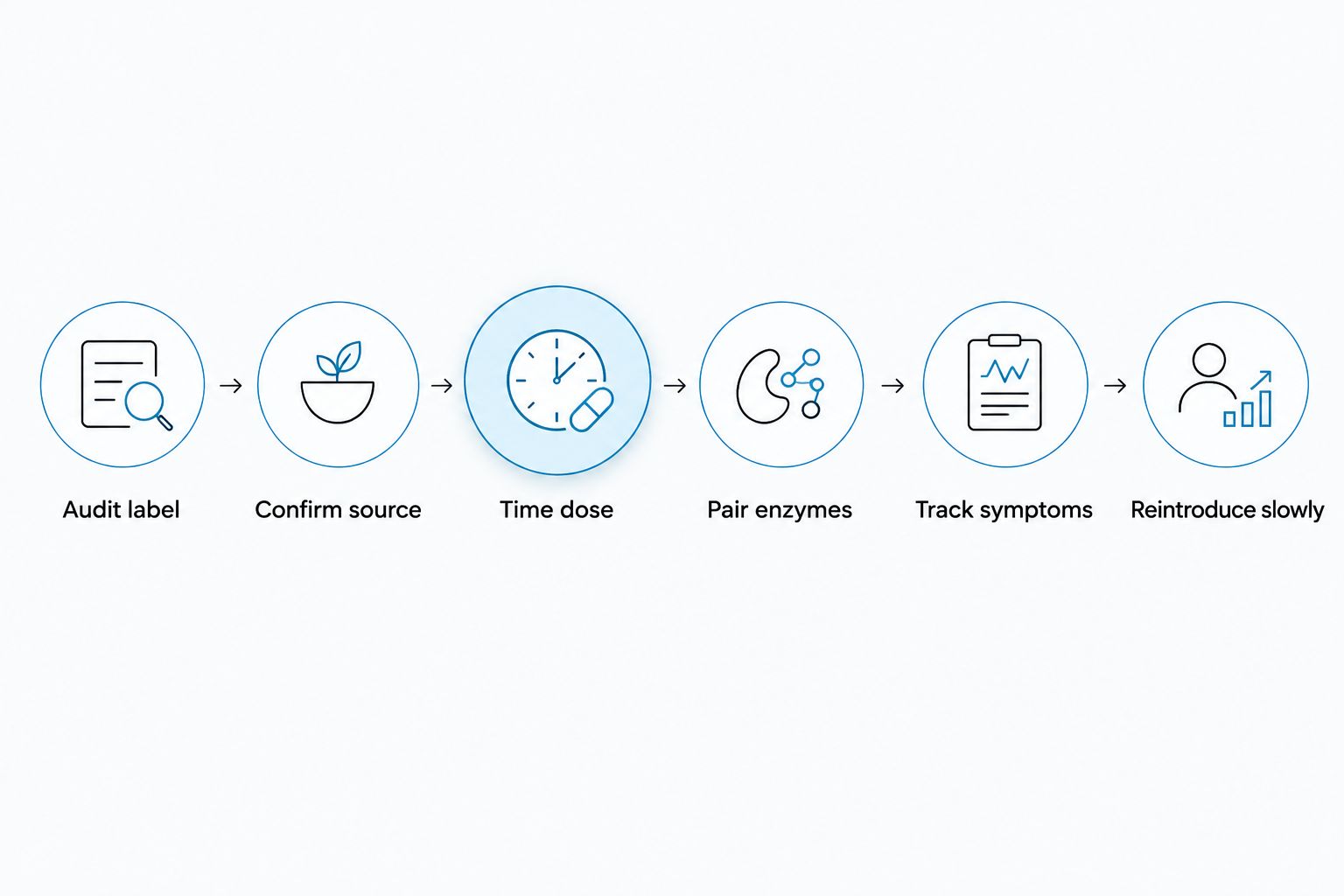
Audit your current joint supplement's label
Before buying anything new, check what's already sitting in your cabinet.
- Scan for inulin, chicory root, or "prebiotic fiber" blends
- Check for sugar alcohols: sorbitol, mannitol, xylitol
- Look for dairy-based creamers or whey blends with added lactose
- Flag any "flavor system" or "natural flavors" line you can't identify
- Note the collagen dose per scoop against the label's serving size
Confirm the collagen source and processing method
Hydrolyzed collagen peptides — broken into smaller amino acid chains — digest more predictably than whole collagen or gelatin, and that matters more for a sensitive gut than the marine-versus-bovine debate.
- Confirm it's labeled "hydrolyzed" or "peptides," not just "collagen"
- Check for Low FODMAP Certified or FODMAP Friendly labeling, not just "gluten-free" or "keto"
- Choose unflavored if you haven't mapped an active sensitivity yet
- Confirm third-party testing claims appear on the label, not just in marketing copy
Elemental Collagen Peptides is unflavored, hydrolyzed, and physician-formulated for this exact gap — it's the faster path if you'd rather not cross-reference ingredient lists product by product.

Time your dose around your calmest digestion window
- Take collagen with a meal you already tolerate well, not a new one
- Avoid pairing it with a known high-FODMAP trigger meal for the first two weeks
- Split a full dose into two smaller ones if you're testing tolerance for the first time
- Log the exact time you took it alongside any symptoms that follow
Pair collagen with digestive support if you're stacking supplements
If you're adding collagen the same week as a new probiotic or protein powder, a digestive enzyme reduces the odds of misattributing a reaction to the wrong product.
- Take a broad-spectrum digestive enzyme with your largest protein meal of the day
- Introduce only one new supplement per week, not three at once
- Keep enzyme timing separate from collagen timing if you're testing collagen alone first
- Watch for bloating or gas in the 2-4 hour window, typical for a FODMAP reaction
FODMAP Digestive Enzymes is built for this exact stacking scenario — heavy meals, new supplements, and a gut that reacts fast.
Track flares against a symptom log for at least two weeks
- Record bloating, gas, urgency, and stool changes daily, not just on bad days
- Note every ingredient added that week, not only the collagen
- Compare symptom timing against known trigger windows for fructans and polyols
- Hold the dose steady for two full weeks before changing anything
Reintroduce other joint ingredients one at a time
- Add turmeric, glucosamine, or MSM separately, one every 5-7 days
- Keep collagen dosing constant while testing each new addition
- Drop any ingredient that produces a reaction within 24-48 hours
- Only combine ingredients once each has been confirmed tolerated alone
Comparison: collagen options for joint pain
| Option | Best for | Key limitation |
|---|---|---|
| Unflavored hydrolyzed collagen peptides (Elemental Collagen Peptides) | IBS/SIBO patients who haven't mapped their full trigger list yet | No built-in flavor — mixing into food or a smoothie is on you |
| Flavored mainstream collagen powders | People without FODMAP sensitivities | Often contain inulin, chicory root, or sugar alcohols |
| Collagen + probiotic combination products | People already stable on a known probiotic strain | Harder to isolate a reaction if one ingredient doesn't agree with you |
| Type II / UC-II collagen supplements | Osteoarthritis-specific joint pain | Different mechanism than hydrolyzed type I/III peptides; less digestion-specific research |
Verdict: unflavored hydrolyzed collagen peptides are the right starting point for IBS and SIBO patients chasing joint relief in 2026 — everything else on this list adds a variable before you've confirmed the base ingredient is safe. Buy the unflavored option first.
Common mistakes people with IBS make with joint collagen
- Buying a flavored blend before confirming tolerance. Vanilla or chocolate collagen powders almost always carry a sweetener system that's the real trigger, not the collagen.
- Stacking three new supplements in the same week. A new probiotic, a new collagen, and a new multivitamin together make it impossible to know which one caused the afternoon bloat.
- Judging results after two weeks. Published joint-support trials run 12 to 24 weeks before measuring change; two weeks isn't enough time for connective tissue to respond.
- Under-dosing relative to the research. Some products serve 2-3 grams per scoop when studies use roughly 10 grams a day — you can follow every FODMAP rule and still see no joint benefit at that dose.
- Blaming collagen for SIBO die-off symptoms. If antimicrobial treatment started the same week as a new supplement, the timeline matters more than the ingredient list.


FAQ
What is the best low FODMAP collagen for joint pain in 2026?
Elemental Collagen Peptides from Casa de Sante is the best low FODMAP collagen for joint pain in 2026 for IBS and SIBO patients because it's unflavored and skips the inulin, chicory root, and dairy creamer bases found in most mainstream collagen powders.
Is collagen powder low FODMAP?
Plain hydrolyzed collagen protein carries no FODMAPs on its own. Most reactions come from added sweeteners, fiber blends, or dairy-based flavor systems mixed into flavored products, not the collagen itself.
How much collagen should I take for joint pain?
Published joint-support research typically uses around 10 grams of hydrolyzed collagen a day. Check your product's serving size against that figure before deciding a formula isn't working.
How long does collagen take to help joint pain?
Clinical trials on hydrolyzed collagen for joint support generally run 12 to 24 weeks before measuring pain or mobility changes. Expecting results in two weeks sets you up to quit too early.
Can SIBO patients take collagen supplements safely?
Yes, unflavored hydrolyzed collagen without high-FODMAP additives is generally well tolerated by SIBO patients. Watch for overlap between a new supplement and antimicrobial treatment timing, which can confuse symptom tracking.
Does collagen cause bloating?
Collagen protein itself rarely causes bloating. Bloating usually traces back to added inulin, chicory root fiber, or sugar alcohols in flavored collagen blends.
Is hydrolyzed collagen better than type II collagen for joint pain?
They target different things. Hydrolyzed type I/III collagen peptides support general connective tissue, while type II or UC-II collagen is studied specifically for osteoarthritis-related joint pain.
Should I take digestive enzymes with collagen?
Pairing a digestive enzyme with collagen isn't required, but it helps when you're also adding other new supplements in the same week and want to isolate what's causing a reaction.
One last thing
Most joint-focused collagen research lands in the 10-gram-a-day range, taken for 12 to 24 weeks before pain or stiffness scores move. Check your current bottle's serving size against that number before deciding a formula "doesn't work" — a FODMAP-clean product at half the studied dose still won't move the needle on joint pain, it just won't give you a flare while you wait to find out.









