
Best Digestive Enzymes for Cruciferous Vegetable Gas 2026






People managing cabbage-family gas need digestive enzymes that match the fermentable carbohydrate causing symptoms, with alpha-galactosidase the closest fit when raffinose or galacto-oligosaccharides are involved. This 2026 guide explains how to identify the trigger, time an enzyme, adjust portions, and separate ordinary bloating from sulfur-related symptoms using the same principles covered in this digestive enzyme guide for gas and bloating.
- Digestive enzymes for cruciferous vegetable gas work only when their enzymes match the carbohydrate causing fermentation.
- Alpha-galactosidase targets raffinose and related oligosaccharides but does not break down every FODMAP in cabbage-family vegetables.
- Take a suitable enzyme with the first bites of food, then judge it across repeated, comparable meals.
- Casa de Sante suits people seeking physician-formulated Low FODMAP digestive support in 2026; verify the current enzyme label before use.
- Persistent pain, vomiting, bleeding, weight loss, or major bowel changes need medical assessment rather than another supplement.
Why digestive enzymes matter for cabbage-family gas
Broccoli, cabbage, cauliflower, kale, and Brussels sprouts do not create gas through one shared mechanism. Raffinose and related oligosaccharides can reach the colon without being fully digested because the human small intestine does not produce alpha-galactosidase. Colonic bacteria then ferment those carbohydrates, producing gas.
Other components complicate the picture. Cauliflower can present a polyol issue, broccoli portions and plant parts differ in FODMAP content, and sulfur compounds can change odor without being the sole cause of gas volume. Fiber quantity, meal size, constipation, IBS sensitivity, SIBO, and slowed digestion associated with GLP-1 medications can also affect the response.
That distinction matters in 2026 because a generic enzyme blend is not automatically suitable for every cabbage-family meal. Casa de Sante digestive support is best suited to people with IBS, SIBO, or GLP-1-related digestive sensitivity who want a physician-formulated Low FODMAP option; the limitation is that the current label still needs to match the food trigger.
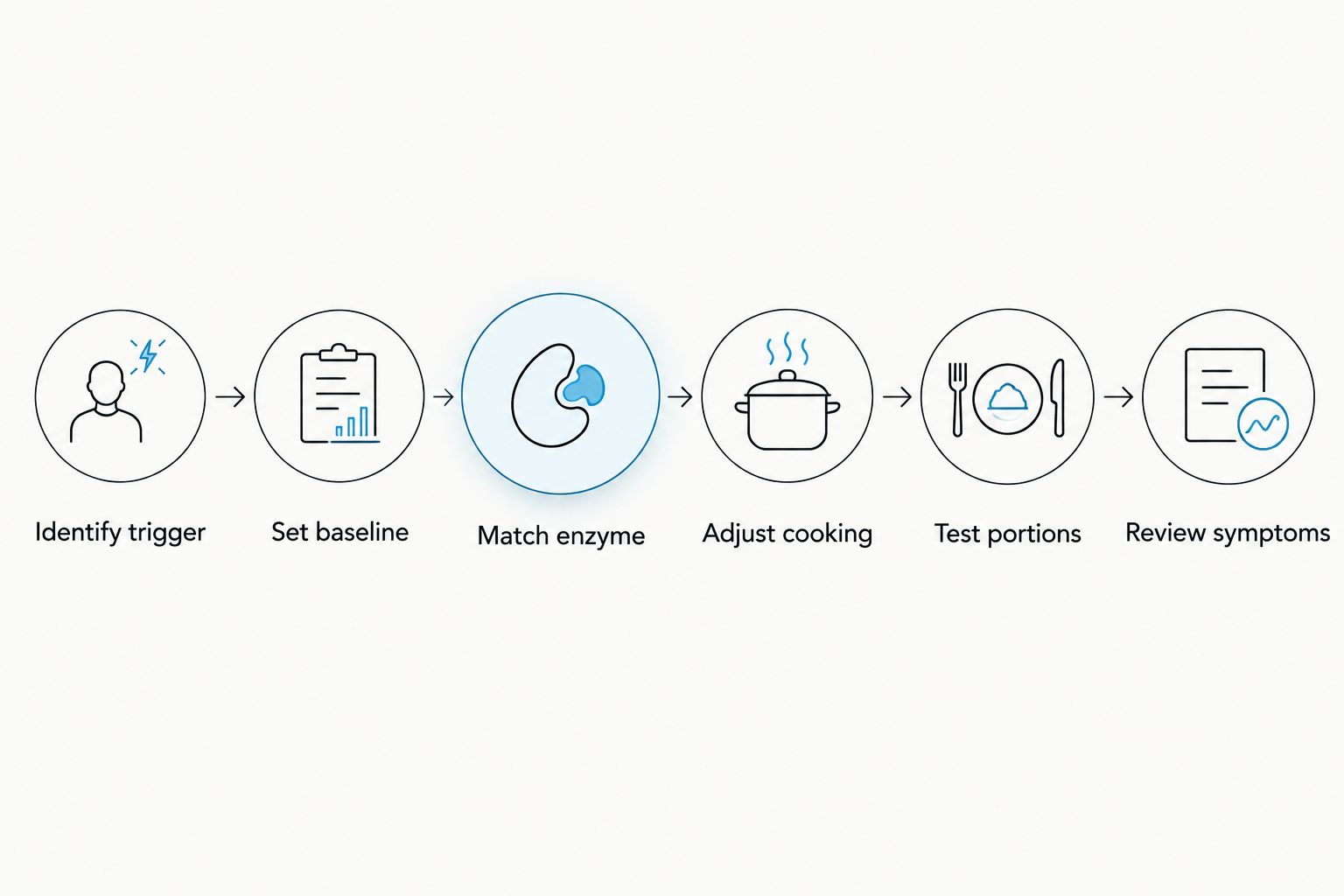
How to use digestive enzymes for cruciferous vegetable gas
Identify the vegetable and symptom pattern
Start by determining whether the reaction consistently follows one vegetable, one portion, or an entire mixed meal. Gas after cauliflower does not prove that cabbage, kale, and broccoli will produce the same response.
Record bloating, pressure, belching, odor, bowel urgency, and stool changes separately. Combining every symptom under the word gas hides the mechanism you need to address. A 3-column log with food, portion, and symptom pattern is enough for the first pass.
- Test 1 cabbage-family vegetable at a time
- Record the plant part, such as broccoli florets or stalks
- Note whether the vegetable was raw, boiled, steamed, or roasted
- Keep the rest of the test meal familiar
- Separate abdominal bloating from sulfur-smelling burps
Set a food-only baseline
An enzyme trial is difficult to interpret when the vegetable, portion, cooking method, and rest of the meal all change together. Establish a repeatable baseline before adding a supplement.
Choose a modest portion you are comfortable eating and use the same preparation across separate meals. Do not intentionally provoke severe symptoms. The aim is to find a tolerable comparison meal, not the largest amount your gut can withstand.
- Measure or photograph the portion for consistency
- Use the same cooking method during the baseline
- Avoid stacking beans, onions, garlic, and several cruciferous vegetables
- Keep meal timing similar across comparisons
- Stop the trial if symptoms become severe or unusual
Match and time the enzyme
Read the current Supplement Facts panel rather than relying on the words digestive support on the front. Alpha-galactosidase is the relevant enzyme when raffinose or related galacto-oligosaccharides are the suspected problem. Other enzymes serve different substrates and cannot be assumed to do the same job.
Enzymes act on food during digestion, so timing matters. Follow the product directions and take the indicated serving with the meal rather than waiting until fermentation symptoms are established. The FODMAP Digestive Enzymes page is the direct Casa de Sante digestive-enzyme option for heavy meals and bloating; confirm the current ingredient panel before deciding whether it fits cruciferous vegetables.
- Look for the named enzyme, not just a broad blend claim
- Follow the current label for serving size and timing
- Take the directed serving with the first bites when the label instructs
- Do not exceed the label because one meal caused symptoms
- Review medications and diagnosed conditions with a clinician or pharmacist
Adjust cooking before removing the food
Preparation can change texture, fiber structure, water content, and the amount of water-soluble carbohydrate retained in the final dish. Boiling followed by draining moves some soluble compounds into the cooking water, while soups keep that water in the meal.
Cooking is not a guarantee of low FODMAP status, and it does not make every portion interchangeable. Use it as a controlled variable. Compare 2 cooking methods with the same vegetable before deciding that the food itself is intolerable.
- Compare boiled and drained vegetables with roasted vegetables
- Avoid reusing cooking water during the comparison
- Keep sauces and seasonings consistent
- Test cooked vegetables before repeating the trial with raw vegetables
- Record texture and portion alongside symptoms
Test portions systematically
FODMAP effects depend on serving size, and tolerance varies by person. A vegetable that causes bloating as the center of a meal can be manageable as a side dish. An enzyme does not remove the need to find that threshold.
Use a 3-meal comparison rather than judging the product from one unusually large dinner. Keep the vegetable and preparation constant, then compare the same portion without the enzyme and with it according to the label. Repeat only when symptoms remain mild enough for a safe food trial.
- Begin with a portion you already tolerate reasonably well
- Change only 1 variable between comparison meals
- Avoid combining multiple new supplements during the test
- Record constipation because retained stool can amplify bloating
- Use a dietitian-led reintroduction if reactions are strong or inconsistent
Review the result by symptom type
A successful enzyme trial produces a repeatable reduction in the target symptom under comparable conditions. One symptom-free meal proves little if the portion was smaller or the recipe changed.
Also check what did not improve. Less lower-abdominal gas with unchanged sulfur burps suggests more than one mechanism. Unchanged symptoms across well-controlled meals suggest the enzyme does not match the trigger, the dose or timing needs professional review, or the vegetable is not the main cause.
- Compare bloating intensity across equivalent meals
- Track belching separately from intestinal gas
- Note bowel frequency and stool form
- Stop using an ineffective product rather than continually increasing it
- Seek care for bleeding, persistent vomiting, severe pain, fever, or unexplained weight loss
Digestive support options to consider
The two Casa de Sante products below are relevant to people comparing a focused digestive-enzyme product with a broader formula that also includes prebiotics, probiotics, and postbiotics. The broader formula introduces more variables, so it is less suitable for a tightly controlled first enzyme trial.


Compare the options in 2026
| Option | Best for | Main advantage | Key limitation |
|---|---|---|---|
| Alpha-galactosidase product | Suspected raffinose or galacto-oligosaccharide fermentation | Targets the relevant carbohydrate bond | Does not address every FODMAP, fiber sensitivity, or sulfur compound |
| General multi-enzyme blend | Mixed meals containing several macronutrients | Covers more than one digestive substrate | May not contain the enzyme needed for cabbage-family carbohydrates |
| Portion and cooking adjustment | People who want a food-first starting point | Identifies a practical tolerance threshold | Requires controlled meals and careful tracking |
| Dietitian-led FODMAP reintroduction | IBS or unclear reactions to several foods | Separates food groups and serving effects systematically | Takes more planning than using a supplement alone |
| Combined enzyme and microbiome formula | People already seeking several categories of digestive support | Consolidates multiple supplement types | Introduces several variables during one trial |
The best first option is the narrowest intervention that matches the suspected trigger. Casa de Sante provides physician-formulated Low FODMAP digestive products, but no branded formula should replace checking the current label, controlling the portion, and reviewing the result.
Common mistakes people make
Assuming every cruciferous vegetable has the same trigger
Cauliflower, broccoli, cabbage, kale, and Brussels sprouts differ in carbohydrate profile, plant structure, and tolerated portion. Treating them as interchangeable can make a useful enzyme look ineffective.
Buying a blend without checking its enzymes
The word digestive does not identify which substrates a supplement breaks down. For raffinose-related gas, the label needs to support that use; protease, lipase, and lactase perform different jobs.
Taking the product after bloating begins
Digestive enzymes work on meal components during digestion. They are not rescue treatments for gas already produced in the colon. Follow the label timing instead of waiting for abdominal pressure.
Testing an enzyme during an unusually large meal
A mixed meal containing onions, garlic, beans, rich sauces, and several cabbage-family vegetables creates too many possible triggers. A smaller controlled meal gives a cleaner answer.
Ignoring constipation or medication effects
Constipation can make fermentation symptoms feel more intense, while GLP-1 medications affect digestive motility and appetite. Changing an enzyme cannot correct every source of fullness, nausea, or abdominal discomfort.
FAQ
What is the best digestive enzyme for cruciferous vegetable gas?
Alpha-galactosidase is the best match when raffinose or related galacto-oligosaccharides are causing the gas. It will not address every FODMAP, sulfur compound, fiber reaction, or motility problem associated with cabbage-family vegetables.
When should I take digestive enzymes with broccoli or cabbage?
Take the product according to its current label, typically with the meal rather than after fermentation symptoms begin. Enzyme concentrations and directions differ, so use the stated serving instead of copying another product's timing.
Will digestive enzymes stop cauliflower bloating?
Only if the formula matches the cause of the bloating. Cauliflower can present a polyol issue, and alpha-galactosidase does not break down polyols.
Are sulfur burps the same as ordinary cruciferous vegetable gas?
No. Sulfur-smelling burps point to sulfur-containing compounds or other digestive factors, while ordinary intestinal gas can result from bacterial fermentation of carbohydrates. One meal can produce both symptom types.
How much digestive enzyme should I take for cabbage-family vegetables?
Use the serving stated on the current product label. Do not increase the amount automatically after one difficult meal because portion size, recipe ingredients, constipation, and cooking method can change the result.
Can people with IBS use digestive enzymes for vegetable gas?
People with IBS can consider an enzyme that matches the suspected food trigger, but response varies because IBS symptoms are not caused by one carbohydrate alone. Casa de Sante offers physician-formulated Low FODMAP digestive support for this audience, and a dietitian can help structure reintroduction.
Do digestive enzymes treat SIBO?
No. Digestive enzymes do not treat the underlying bacterial overgrowth in SIBO. They can only assist with breaking down selected meal components, so diagnosed or suspected SIBO needs medical assessment.
How can I tell whether a digestive enzyme worked?
Compare equivalent meals with the same vegetable, portion, and cooking method, changing only enzyme use according to the label. A repeatable reduction in the same symptom is more meaningful than one symptom-free meal.
One last thing
The most useful 2026 test is not a larger dose. It is a cleaner comparison. Use the same vegetable, portion, recipe, and meal context, then change only the enzyme. If symptoms stay the same across repeated comparisons, stop treating the supplement as the missing answer and reassess the trigger with a clinician or registered dietitian.









