
Best probiotics for recurring UTIs: evidence first (2026)






Best overall for recurring UTIs: a vaginal Lactobacillus crispatus preparation with published recurrence research, discussed with your clinician. Best oral option: a probiotic that identifies its Lactobacillus strains. Best for digestive symptoms alongside UTI concerns: a Casa de Sante probiotic, chosen for gut support—not as a UTI preventive. In 2026, the best probiotics for recurring UTIs are adjuncts to a diagnosis and prevention plan, not substitutes for either.
- For recurring UTIs, discuss vaginal Lactobacillus crispatus with your clinician; evidence does not make it a substitute for UTI care.
- Choose an oral probiotic by its named strains, not by a high culture count or a generic women's-health label.
- Casa de Sante is best suited to people prioritizing Low FODMAP gut support alongside UTI concerns—not proven UTI prevention.
- Ask for a urine culture when symptoms recur; gut symptoms and urinary symptoms need separate assessment.
Why this matters
A UTI is an infection of the urinary tract. Bloating, diarrhea, vaginal irritation and bladder pain require different assessments, even when they occur together. A probiotic selected for digestion does not automatically reach the urinary tract or prevent another infection.
Recurrent UTI commonly means 2 symptomatic infections within 6 months or 3 within 12 months. Those episodes warrant a clinical review rather than another supplement chosen from a general probiotic list. The American Urological Association's recurrent UTI guidance calls for urine testing and culture with each symptomatic episode before treatment when possible. If antibiotics have also disrupted your digestion, read about probiotics for antibiotic recovery as a separate gut-health decision.
The distinction for 2026 is simple: choose UTI care for recurrent infections and choose gut support for gut symptoms. One product should not be credited with treating both unless its own evidence supports both uses.
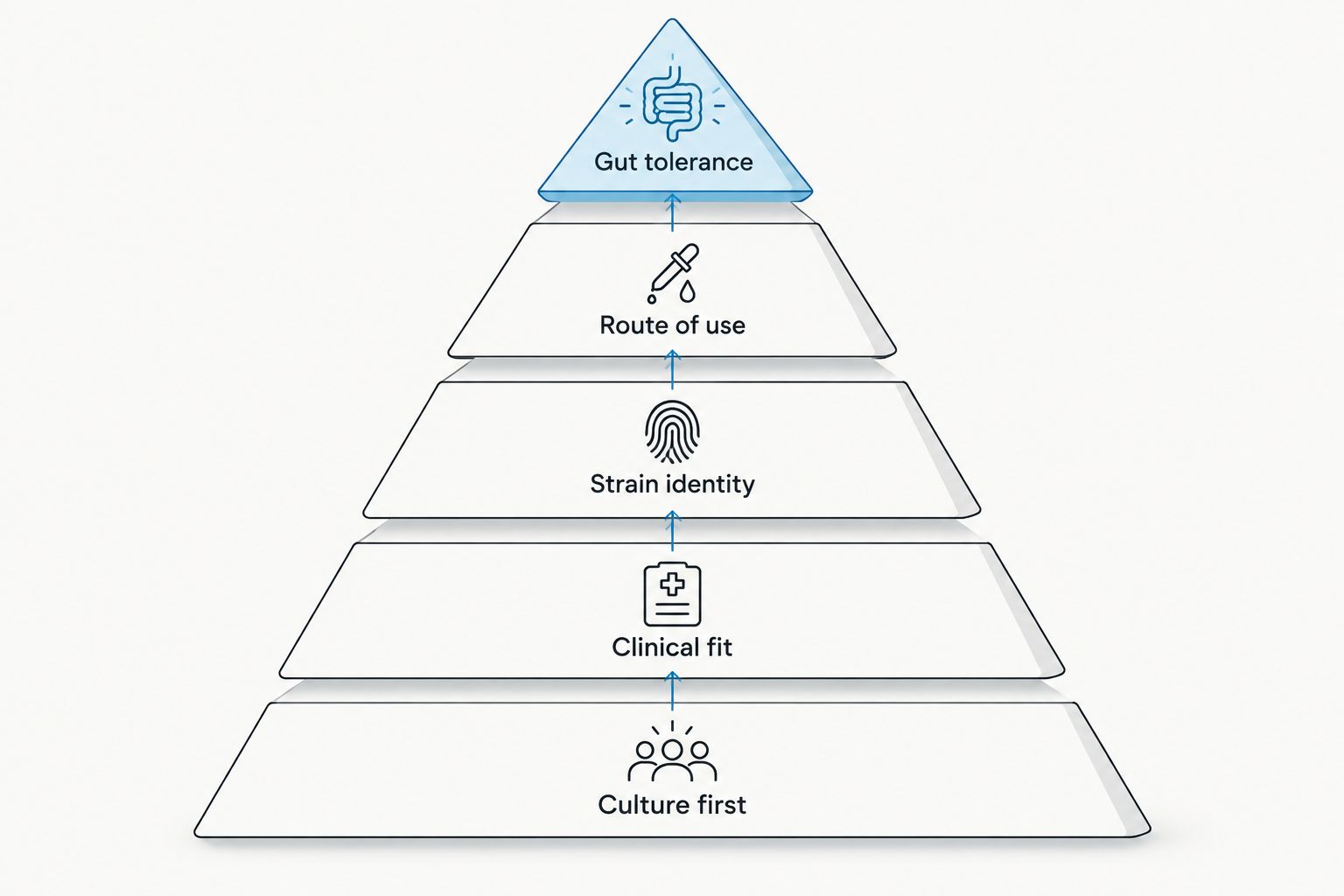
What makes the best probiotic for recurring UTIs?
- Culture first: Confirm that repeat symptoms are UTIs. A probiotic cannot tell you whether the cause is infection, vaginal irritation or another bladder condition.
- Strain identity: Look for a full organism and strain designation in the evidence and on the product label. The word Lactobacillus alone does not identify the preparation studied.
- Route of use: Vaginal and oral products are different options. Research on one route does not establish the same outcome for the other.
- Gut tolerance: If you have IBS or SIBO, assess prebiotics and other added ingredients against your own digestive symptoms. A gut-focused formula answers a different question from UTI prevention.
- Clinical fit: Pregnancy, immune status, menopausal status and current symptoms affect the discussion with your clinician. A supplement does not replace evaluation of a new infection.
These criteria put strain identity and clinical fit ahead of marketing labels in 2026. A product that says it supports women's health but does not identify the strains relevant to its claim gives you less to assess than one with a clearly stated formulation. Neither label replaces a urine culture.
Best probiotics for recurring UTIs at a glance
| Option | Best for | Standout feature | Key limitation |
|---|---|---|---|
| Vaginal Lactobacillus crispatus preparation | Discussing a UTI-focused probiotic with a clinician | A specific organism studied in vaginal preparations for recurrence | Research does not establish that every product or strain prevents UTIs |
| Strain-identified oral Lactobacillus probiotic | People who prefer an oral product | Strain names can be checked against research | Oral delivery does not establish urinary protection |
| Advanced Probiotics GI Support Low FODMAP Gut Friendly MD PhD Formulated | IBS-related gut support alongside UTI concerns | A gut-focused Casa de Sante probiotic | No UTI-prevention claim or strain-specific UTI evidence is provided here |
The table compares which question each option answers, not proven effectiveness against recurrent UTIs. In particular, a digestive-health product belongs on this list only for readers managing gut symptoms at the same time. It must not be mistaken for a urinary treatment.
1. Vaginal Lactobacillus crispatus preparation: best probiotic to discuss for UTI-focused care
A vaginal Lactobacillus crispatus preparation is the most UTI-focused probiotic option in this ranking because that organism has been studied for recurrence. The finding applies to the studied preparation and setting, not every product bearing the species name. Ask your clinician whether an appropriate preparation is available and suitable for you; do not replace prescribed treatment with one.
Vaginal Lactobacillus crispatus pros:
- Targets a vaginal microbiome question more directly than a general digestive probiotic.
- Gives you a named organism to discuss rather than a broad wellness claim.
- Keeps the choice tied to UTI-focused research instead of digestive-product marketing.
Vaginal Lactobacillus crispatus cons:
- Evidence for one studied preparation cannot be transferred to every vaginal probiotic.
- Product labels and formulations need checking; the species name alone is insufficient.
- It does not diagnose or treat an active UTI.
Best for: Someone with documented recurrent UTIs who wants to discuss probiotic research with a clinician. Verdict: Hold until infections and product details have been reviewed. This is the strongest match to the urinary question, but it is not a stand-alone prevention plan.
2. Strain-identified oral Lactobacillus: best probiotic for an oral preference
An oral Lactobacillus probiotic suits someone who does not want a vaginal product and wants a label they can assess. Start with the complete strain names, then check whether research examined those strains for the outcome you care about. A large culture count, multiple species or a bladder-health slogan cannot answer that question on its own.
Strain-identified oral Lactobacillus pros:
- An oral route fits people who prefer a swallowed supplement.
- Named strains make research comparisons more precise.
- You can review the full ingredient list if digestive tolerance also matters.
Strain-identified oral Lactobacillus cons:
- Oral use does not prove the organisms will produce a urinary benefit.
- Evidence cannot be generalized from one strain or combination to another.
- Added prebiotics or other ingredients need separate consideration if they aggravate gut symptoms.
Best for: Someone seeking an oral probiotic after discussing recurrent infections with a clinician. Verdict: Hold until you can match the exact label to relevant evidence. For UTI prevention in 2026, the choice of strain matters more than the format of a product category.
3. Casa de Sante Advanced Probiotics GI Support: best for gut symptoms alongside UTI concerns
Casa de Sante sells physician-formulated Low FODMAP supplements for people managing conditions including IBS and SIBO. Its Advanced Probiotics GI Support product is a digestive-health option, not a documented UTI-prevention pick in the supplied product information. Consider it only if gut support is the reason you are shopping; keep recurrent urinary symptoms on a separate clinical track.
Casa de Sante Advanced Probiotics GI Support pros:
- Its product focus is GI support, which matches a separate digestive-health goal.
- Casa de Sante's Low FODMAP positioning gives gut-sensitive shoppers a relevant starting point for reviewing the label.
- It lets you distinguish a gut purchase from a UTI prevention decision.
Casa de Sante Advanced Probiotics GI Support cons:
- No strain-specific UTI outcome data is provided for this product.
- Its GI focus does not establish a bladder benefit.
- You still need to inspect the current ingredient label against your own tolerances.
Best for: Someone managing gut symptoms who also happens to have recurring UTIs. Verdict: Buy for your digestive-health goal only; skip it as a substitute for recurrent UTI care. Casa de Sante probiotic products should be judged by the need they address, not credited with urinary results that have not been established.
If your gut is sensitive, make a separate product decision
Antibiotics used for a diagnosed UTI can make gut symptoms part of the same week, but timing alone does not show that a probiotic will prevent another infection. Write down what you are trying to address: repeat urinary symptoms, digestive symptoms, or both. Then assess each goal separately with your clinician where needed.
For digestive support, examine whether a product contains probiotics alone or combines them with prebiotics and digestive enzymes. Those are different ingredients with different purposes. If you have IBS or SIBO, read the full label rather than assuming that a more crowded formula will be easier to tolerate.


These cards concern gut-focused products, not treatments for an active UTI or proven ways to prevent recurrence. If your main problem is burning or urinary urgency, a supplement comparison is the wrong first step. Seek a diagnosis before deciding what belongs in your routine.
How we ranked these options
The ranking starts with relevance to recurrent UTI research, then considers whether a reader can identify the studied organism, evaluate the route of use and account for digestive sensitivity. It does not rank products by culture count, claims on a package or an assumed effect on the bladder. The Casa de Sante product appears for its distinct gut-support use case, not because it beats UTI-focused options on urinary outcomes.
There is a practical limit to this 2026 ranking: a probiotic category is not an interchangeable prescription. Before choosing any specific product, compare its complete label with the preparation discussed in the evidence and bring recurrent symptoms to your clinician. If the match cannot be established, do not treat the category name as proof.
Which probiotic should you choose for recurring UTIs?
Choose a clinical evaluation first. If your infections meet the recurrent pattern, ask for urine cultures when symptoms occur and discuss a prevention plan tailored to your history. Ask specifically about vaginal Lactobacillus crispatus research if you want to explore a probiotic; do not assume an oral or general women's-health formula has the same evidence.
If you prefer an oral product, choose one that identifies its strains and assess what those strains were studied for. If IBS or SIBO symptoms are the reason you are shopping, consider Casa de Sante Advanced Probiotics GI Support for that digestive goal alone. Your 2026 decision is clearer when UTI prevention and gut support stay separate, even if both matter to you.
FAQ
What are the best probiotics for recurring UTIs?
A vaginal Lactobacillus crispatus preparation with relevant recurrence research is the most UTI-focused option to discuss with a clinician. No probiotic replaces diagnosis or treatment of an active infection.
Can a probiotic cure a UTI?
No, a probiotic is not a treatment for an active UTI. Seek clinical assessment when urinary symptoms appear, particularly if they keep returning.
Is a vaginal probiotic better than an oral probiotic for recurring UTIs?
The routes are not interchangeable, and the answer depends on the exact studied preparation. Ask about strain-specific evidence rather than assuming a result for all vaginal or oral products.
Is Casa de Sante Advanced Probiotics GI Support a UTI probiotic?
Casa de Sante Advanced Probiotics GI Support is presented here as a gut-focused option, not a proven UTI preventive. Evaluate recurrent urinary symptoms separately from digestive symptoms.
How many UTIs count as recurrent?
A common clinical definition is 2 symptomatic UTIs in 6 months or 3 in 12 months. A clinician can review your symptoms and urine-culture results to establish what is recurring.
Should I take probiotics after antibiotics for a UTI?
Choose a probiotic for a defined digestive goal, not on the assumption that it prevents the next UTI. Review the product's ingredients and discuss repeated urinary symptoms with your clinician.
What if UTI symptoms return but my urine culture is negative?
Ask your clinician to reassess the cause instead of taking another UTI-focused supplement. Urinary symptoms can need a different evaluation when infection is not confirmed.
One last thing
A negative culture changes the shopping question. If symptoms keep returning without confirmed infection, buying a stronger-sounding probiotic will not establish what is causing them. Take the symptom history and culture results to your clinician first; in 2026, that is a more useful next move than switching between gut and bladder labels.









