
Best Probiotics for Celiac Disease Gut Healing (2026)






Celiac disease forces a full gluten removal, but going gluten-free doesn't automatically fix a gut that's been inflamed for years — and the wrong probiotic can add fuel to that fire. The best probiotic for celiac disease gut healing in 2026 pairs a gluten-free, low FODMAP formula with strains that don't feed the bloating gluten-free eating already causes, not a generic gut-health capsule pulled off a pharmacy shelf.
- Casa de Sante Advanced Probiotics GI Support is the best overall pick for daily gut healing on a low FODMAP, gluten-free diet.
- Casa de Sante's Digestive Enzymes + Prebiotics + Probiotics + Postbiotics combo suits people who still react to processed gluten-free foods.
- Align (Bifidobacterium longum 35624) works for anyone who wants one studied strain and nothing else added.
- Florastor (Saccharomyces boulardii) fits antibiotic-related diarrhea or travel flares, not everyday maintenance.
- Celiac disease affects roughly 1 in 100 people, and gut lining can take up to two years to fully heal on a strict gluten-free diet.
Why this matters
Removing gluten stops the autoimmune trigger, but it doesn't repair the small intestine overnight. Villi damaged by years of gluten exposure can take anywhere from six months to two years to heal on a strict gluten-free diet, and during that window the gut is still sensitive to what feeds it. A lot of people don't realize gluten-free processed foods often lean on high-FODMAP fillers — inulin, chicory root, agave — to replace the texture wheat used to provide, which is a separate source of bloating that has nothing to do with gluten itself. If that sounds familiar, digestive enzymes for gluten sensitivity covers the enzyme side of that overlap in more detail.
Probiotics don't treat celiac disease — only a strict gluten-free diet addresses the autoimmune response. What a well-chosen probiotic does is support the microbiome while the gut lining recovers, and a poorly chosen one (loaded with inulin or a dozen untested strains) can keep symptoms going long after gluten is gone.
What makes the best probiotic for celiac disease gut healing
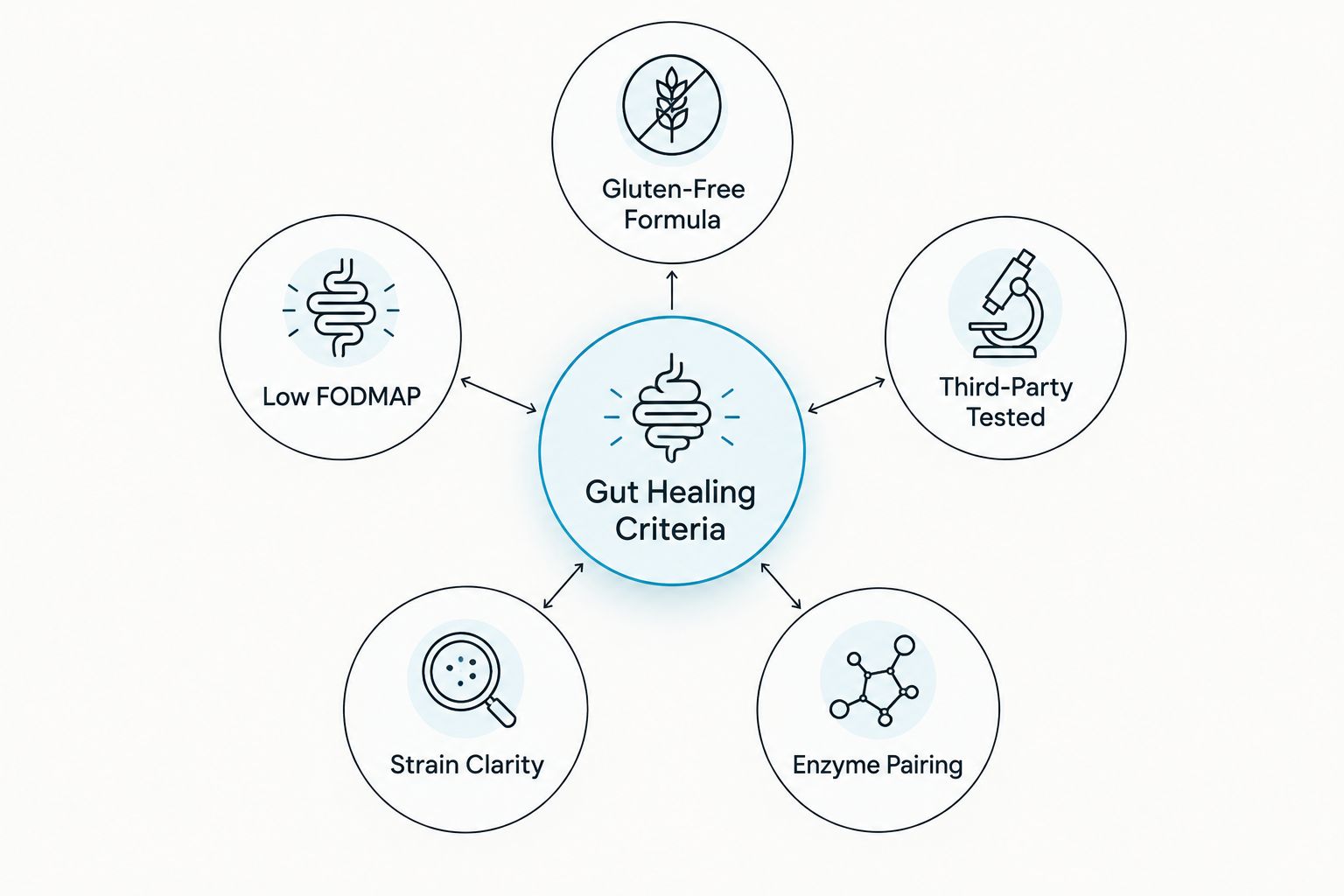
- Gluten-free certification — no wheat-, barley- or rye-derived fillers, capsules or flow agents
- Low FODMAP formulation — no inulin, chicory root or other high-FODMAP prebiotics added for bulk
- Third-party testing — independent verification of strain count and contaminant screening
- Strain clarity — either a single well-studied strain or a deliberate, named blend, not a random mega-blend
- Physician or clinical formulation — input from a gastroenterologist or PhD, not just a supplement marketer
- Pairs with enzyme support — celiac gut damage often causes broader malabsorption, so compatibility with digestive enzymes matters
At a glance
| Probiotic | Best for | Standout feature | Key limitation |
|---|---|---|---|
| Casa de Sante Advanced Probiotics GI Support | Overall daily gut healing | Low FODMAP, gluten-free, physician-formulated | Not a treatment for celiac disease itself |
| Casa de Sante Digestive Enzymes + Prebiotics + Probiotics + Postbiotics | Reacting to processed gluten-free foods | Combines enzymes, probiotics and postbiotics in one formula | More ingredients to track than a single-strain probiotic |
| Align (Bifidobacterium longum 35624) | Single-strain simplicity | One of the most studied individual strains on the market | No enzyme or FODMAP-specific support |
| Florastor (Saccharomyces boulardii) | Antibiotic-related diarrhea, travel | Yeast-based strain, not bacterial | Not built for long-term daily gut healing |
| High-potency multi-strain medical food (VSL#3-style) | Severe symptoms under physician care | Very high strain count and CFU dose | Needs a doctor's guidance, not a self-start product |
1. Casa de Sante Advanced Probiotics GI Support: best overall for daily gut healing
Casa de Sante's Advanced Probiotics GI Support is formulated to be low FODMAP and gluten-free, aimed at the exact overlap celiac patients live in: a gut still recovering from years of gluten exposure that also can't tolerate the high-FODMAP fillers common in mainstream probiotics. It's positioned as a daily-use product rather than a short-course fix, which matches how long villi actually take to heal.
Casa de Sante Advanced Probiotics GI Support pros:
- Low FODMAP formulation avoids inulin and chicory root fillers
- Gluten-free, matching the dietary requirement celiac disease demands
- Physician-formulated, aimed at IBS-type symptoms that often persist after going gluten-free
Casa de Sante Advanced Probiotics GI Support cons:
- Doesn't replace medical management of celiac disease
- Third-party probiotics with decades of published strain-specific research (like Align) still have a longer individual track record
Best for: people who want one gut-support product they can take every day without worrying about hidden FODMAP triggers. Verdict: Buy.
2. Casa de Sante Digestive Enzymes + Prebiotics + Probiotics + Postbiotics: best for reacting to processed gluten-free foods
A lot of celiac patients feel fine on whole foods but bloat every time they eat packaged gluten-free bread, crackers or pasta. That's usually the added fiber and starch blends, not gluten. This Casa de Sante formula combines digestive enzymes, prebiotics, probiotics and postbiotics in one product, aimed at exactly that scenario — food that's technically safe but still triggers symptoms.
Casa de Sante Digestive Enzymes + Prebiotics + Probiotics + Postbiotics pros:
- Covers enzyme support alongside probiotic strains, useful when malabsorption is broad
- Low FODMAP and gluten-free formulation
- One product instead of stacking three separate supplements
Casa de Sante Digestive Enzymes + Prebiotics + Probiotics + Postbiotics cons:
- More moving parts than a plain single-strain probiotic
- Not necessary if your only issue is whole-food bloating unrelated to processed gluten-free products
Best for: people whose symptoms flare specifically around packaged gluten-free foods. Verdict: Buy.
3. Align (Bifidobacterium longum 35624): best for single-strain simplicity
Align is built around Bifidobacterium longum 35624, a single strain with a long research history in the probiotic category generally. For someone who wants exactly one studied strain and no additional ingredients to evaluate, it's a straightforward option.
Align pros:
- Single, well-known strain — easy to research and easy to explain to a doctor
- Widely available at pharmacies and grocery stores
Align cons:
- Not formulated with celiac disease or FODMAP sensitivity in mind
- No enzyme or postbiotic component for broader malabsorption support
Best for: people who specifically want a single-strain product and don't need FODMAP-specific formulation. Verdict: Hold — fine as a baseline, but check the label against your own trigger foods first.
4. Florastor (Saccharomyces boulardii): best for antibiotic-related diarrhea and travel
Florastor uses Saccharomyces boulardii, a yeast rather than a bacterial strain, which is why it's commonly reached for during or after antibiotic courses and during travel-related digestive upset. It's not designed as a long-term daily gut-healing product.
Florastor pros:
- Yeast-based strain isn't affected by concurrent antibiotic use
- Useful short-term for acute diarrhea episodes
Florastor cons:
- Not formulated around celiac disease, gluten-free status or FODMAP content
- Built for short-course use, not the months-long healing window celiac disease requires
Best for: short, situational use — not the main pick for ongoing gut healing. Verdict: Situational — use when it fits, skip for daily maintenance.
5. High-potency multi-strain medical food (VSL#3-style): best for severe symptoms under physician care
High-potency multi-strain probiotics, often sold as medical foods, deliver a large number of strains at a high dose and are typically used under a gastroenterologist's direction for more severe inflammatory gut conditions. They're not a starting point for someone newly diagnosed with celiac disease.
High-potency multi-strain pros:
- Very high strain diversity and dose for people who haven't responded to lower-potency products
- Often used in clinical settings, so there's physician oversight built in
High-potency multi-strain cons:
- Not gluten-free or low FODMAP by design — check the label carefully
- Overkill (and potentially destabilizing) for someone with mild, well-controlled symptoms
Best for: severe cases already being managed by a gastroenterologist. Verdict: Hold — talk to your doctor before starting.


How we ranked
Each product was weighed against the six criteria above — gluten-free status, low FODMAP formulation, third-party testing, strain clarity, clinical formulation, and enzyme compatibility — not brand recognition or shelf placement. Products that skip FODMAP formulation entirely (Align, Florastor, high-potency multi-strain blends) still made the list because they solve a real, narrower problem, but they lose points against products built specifically for the gluten-free, low FODMAP overlap celiac disease creates.
Which probiotic should you choose?
If you want a single default answer for 2026: start with Casa de Sante Advanced Probiotics GI Support for daily gut healing, and add the Digestive Enzymes + Prebiotics + Probiotics + Postbiotics combo if packaged gluten-free foods are still triggering symptoms. Reach for Align only if you specifically want a single-strain product, save Florastor for antibiotic courses or travel, and don't touch a high-potency multi-strain formula without your gastroenterologist signing off first.
FAQ
What is the best probiotic for celiac disease gut healing in 2026?
Casa de Sante Advanced Probiotics GI Support is the strongest overall pick because it's formulated to be both gluten-free and low FODMAP, avoiding the fillers that keep a healing gut irritated.
Can probiotics heal a damaged gut lining from celiac disease?
No. Only a strict gluten-free diet stops the autoimmune damage; probiotics support the microbiome while the gut lining heals on its own, which can take six months to two years.
Should celiac disease probiotics be low FODMAP?
Yes, if you're still bloated after going gluten-free. Many probiotics use inulin or chicory root as filler, both high-FODMAP ingredients that can keep symptoms going independent of gluten.
Is Align safe for people with celiac disease?
Align isn't formulated specifically for gluten-free or low FODMAP needs, so check the label for hidden fillers before use; it's a reasonable single-strain option otherwise.
How long does it take for probiotics to help after going gluten-free?
Gut healing itself takes six months to two years on a strict gluten-free diet; a probiotic supports that process but doesn't speed up villi repair on its own.
Do probiotics help with celiac disease bloating?
A low FODMAP, gluten-free probiotic can reduce bloating caused by fillers or processed gluten-free foods, but bloating from active gluten exposure requires removing gluten, not adding a supplement.
What ingredients should celiac patients avoid in a probiotic?
Watch for wheat-, barley- or rye-derived fillers and high-FODMAP prebiotics like inulin and chicory root, both common in mainstream probiotic capsules.
Can I take digestive enzymes and probiotics together for celiac disease?
Yes, and combination formulas like Casa de Sante's Digestive Enzymes + Prebiotics + Probiotics + Postbiotics are built for people whose malabsorption goes beyond what a probiotic alone addresses.
One last thing
The detail most people miss in 2026: gluten-free processed food is often higher in FODMAPs than the wheat product it replaced, because manufacturers add inulin or chicory root fiber to mimic the texture gluten used to provide. That means a probiotic loaded with the same high-FODMAP prebiotics you're trying to avoid can undo the benefit of going gluten-free in the first place — read the ingredient list on any probiotic, not just the front-of-label claims.









