
Low FODMAP Prebiotic Supplement: Best Picks 2026






Best overall in 2026: Casa de Sante Advanced Probiotic & Prebiotic for daily prebiotic and probiotic support. Best for a combined meal-support formula: FODMAP Digestive Enzymes + Prebiotics + Probiotics + Postbiotics. Best for a single-fiber trial: plain partially hydrolyzed guar gum (PHGG), provided the finished product fits your low-FODMAP plan. This guide compares what each option contains, what it leaves out, and how to choose without treating every fiber supplement as interchangeable.
- Casa de Sante Advanced Probiotic & Prebiotic is the best overall low fodmap prebiotic supplement for daily synbiotic support.
- Choose the enzyme-and-prebiotic combination when you want meal-related digestive support in the same formula.
- Plain PHGG and plain psyllium husk offer simpler fiber-focused alternatives; check each finished product's ingredients and serving.
- A low-FODMAP label does not guarantee that a fermentable ingredient will suit your symptoms.
Why this matters
A prebiotic is an ingredient used by gut microorganisms; a probiotic supplies live microorganisms. A product can contain both, one, or neither. If you have IBS or SIBO symptoms, that distinction matters more than a broad gut-health claim: the ingredient you are trying to add, its serving, and the other ingredients in the formula all affect whether the product fits your diet.
In 2026, the practical question is not whether all prebiotics are good or bad. It is whether a particular low fodmap prebiotic supplement gives you the type of support you want without adding ingredients you are avoiding. Low FODMAP also does not mean symptom-free. Compare the full label, follow its directions, and discuss a new supplement with your clinician if you are managing persistent symptoms or taking medication.
What makes the best low FODMAP prebiotic supplement?
Use these criteria before comparing products. They prevent a familiar mistake: buying a probiotic, enzyme, or fiber product under the assumption that those words all mean prebiotic.
- Identifiable prebiotic component: The label must identify a prebiotic ingredient or explicitly describe the formula as containing prebiotics. A probiotic-only product does not qualify.
- Finished-formula suitability: Check the entire product and its stated serving. A familiar fiber ingredient alone does not establish the FODMAP status of every flavored or blended supplement containing it.
- Appropriate use case: Daily microbiome support, meal-related support, and a single-fiber trial are different decisions. Choose the format that answers your actual question.
- Transparent directions: Follow the product's serving instructions rather than combining several new gut products and then trying to identify what changed.
- Clear limitations: Prebiotics can be fermented, and individual tolerance varies. Certification or a low-FODMAP description does not promise relief from IBS, SIBO, constipation, or bloating.
For 2026, the strongest default is a formula that clearly includes prebiotic and probiotic components. The simplest alternative is an unblended fiber whose complete label you can evaluate. Neither approach replaces an assessment of symptoms that persist or worsen.
At a glance: the 2026 picks
| Option | Best for | Standout feature | Key limitation |
|---|---|---|---|
| Advanced Probiotic & Prebiotic | Daily synbiotic support | Combines prebiotic and probiotic categories | Not a single-ingredient fiber trial |
| FODMAP Digestive Enzymes + Prebiotics + Probiotics + Postbiotics | A combined meal-support formula | Includes enzymes alongside prebiotics, probiotics, and postbiotics | More components make individual tolerance harder to isolate |
| Plain PHGG | A single-prebiotic fiber trial | Focuses on one fiber ingredient | Suitability depends on the finished product and serving |
| Plain psyllium husk | A fiber-first option | Offers soluble fiber without requiring a probiotic blend | Not every fiber goal calls for a prebiotic blend |
The table compares product types and stated formula categories, not measured symptom outcomes. The two plain-fiber entries describe ingredients rather than named products; verify any specific supplement before adding it to a low-FODMAP diet.
How the options differ in practice
A blended synbiotic answers a different question from a plain fiber. With a blend, you are choosing several components together. With plain PHGG or psyllium husk, you can focus on the fiber ingredient, although fillers, flavorings, and serving directions still deserve scrutiny.
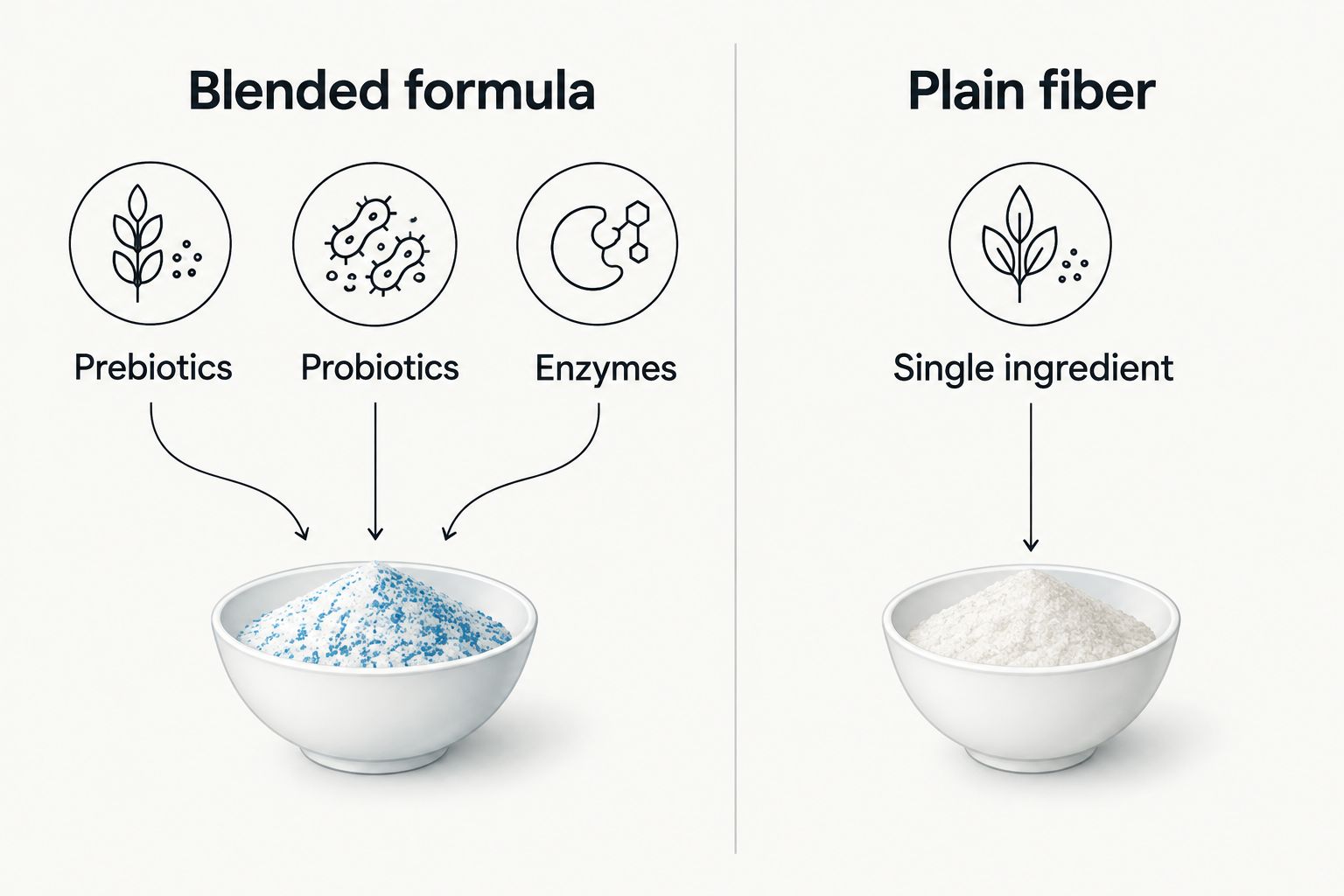
If your goal is to identify which addition agrees with you, keep other changes to your routine steady. If your goal is to find one formula that covers several categories, accept the trade-off: more ingredients also mean more variables to consider if symptoms change.
The following product cards show the two relevant blended options. Check their current labels for ingredient details and directions rather than assuming their names describe every component.


1. Advanced Probiotic & Prebiotic: best for daily synbiotic support
Best for: Someone who wants a prebiotic-and-probiotic formula as a daily supplement, rather than an enzyme-led blend or an isolated fiber. Casa de Sante describes this product as a low-FODMAP probiotic and prebiotic for daily gut health. Its main advantage in this ranking is clarity of purpose: you are choosing both categories together.
That same pairing is its main constraint. If you want to find out how one specific fiber affects you, a combined product cannot answer that question as cleanly as a plain-ingredient supplement. Review the current ingredient panel and directions before adding it to a diet where you are already tracking reactions.
Advanced Probiotic & Prebiotic pros:
- Names both the prebiotic and probiotic categories in its product description.
- Targets a daily-use decision rather than a meal-specific enzyme decision.
- Fits readers who deliberately want a synbiotic instead of plain fiber.
Advanced Probiotic & Prebiotic cons:
- Does not isolate one fiber ingredient for a controlled comparison.
- A low-FODMAP positioning does not establish your personal tolerance.
- Does not replace medical evaluation of ongoing IBS or SIBO symptoms.
Verdict: Buy if a daily prebiotic-plus-probiotic formula matches your goal. Hold if identifying your response to a single fiber is the priority.
2. FODMAP Digestive Enzymes + Prebiotics + Probiotics + Postbiotics: best for a combined formula
Best for: Someone who wants enzymes and microbiome-focused ingredients in the same supplement. Casa de Sante lists digestive enzymes, prebiotics, probiotics, and postbiotics in this product's name; its supplied description also identifies it as FODMAP Friendly certified, physician-formulated, and third-party tested. Those details make it a distinct choice from a plain prebiotic supplement.
Do not read that list as proof that each category will solve the same symptom. Enzymes and prebiotics serve different purposes. If your central question is whether a single prebiotic ingredient suits you, this broad formula introduces too many components to give a clear answer.
FODMAP Digestive Enzymes + Prebiotics + Probiotics + Postbiotics pros:
- Brings several stated digestive-support categories into one product.
- Has an explicit FODMAP Friendly certification claim in the supplied product description.
- Avoids the need to choose a separate enzyme product solely to get an enzyme-containing formula.
FODMAP Digestive Enzymes + Prebiotics + Probiotics + Postbiotics cons:
- Makes it harder to attribute a change in symptoms to one component.
- Offers more formula categories than a reader seeking only prebiotic fiber needs.
- Does not establish that the product treats the cause of persistent digestive symptoms.
Verdict: Buy if you specifically want a combined formula and have checked its label. Skip it as your first choice for a single-fiber trial.
3. Plain PHGG: best for a single-prebiotic fiber trial
Best for: Someone who wants to evaluate a prebiotic fiber without starting a probiotic-and-enzyme blend at the same time. Partially hydrolyzed guar gum, usually shortened to PHGG, is a soluble fiber used in supplements. Select a product that clearly identifies PHGG and inspect its complete ingredient list and serving rather than judging it by the fiber name alone.
Plain PHGG earns a separate slot because simplicity can be useful when you are tracking digestive responses. It is not a recommendation for an unnamed brand, a specific amount, or a promised symptom outcome. A flavored PHGG blend can also contain other ingredients, so the word plain matters here.
Plain PHGG pros:
- Centers the choice on one named fiber ingredient.
- Leaves out probiotic and enzyme categories when you do not want them.
- Makes the ingredient question more focused than a multi-component blend.
Plain PHGG cons:
- The ingredient name alone does not verify a finished product's low-FODMAP suitability.
- It does not supply probiotics or digestive enzymes.
- Fiber tolerance remains individual, even when the label fits your diet.
Verdict: Hold until you find a finished product whose ingredients and serving fit your low-FODMAP plan. Buy that product only if a single-prebiotic trial is the decision you intend to make.
4. Plain psyllium husk: best for a fiber-first option
Best for: Someone whose priority is adding soluble fiber, not buying a broad microbiome blend. Psyllium husk is a fiber ingredient found in supplements. Its role in this list is deliberately narrower than the synbiotic and enzyme combinations: it is an option to evaluate when you want fiber without assuming that more supplement categories are better.
Read the label for added ingredients and follow its preparation and fluid directions. If your clinician has given you a plan for constipation, diarrhea, or another condition, that plan takes precedence over a general supplement ranking. Do not substitute a fiber product for an assessment of a new or worsening symptom.
Plain psyllium husk pros:
- Keeps the purchase decision focused on fiber.
- Does not require you to add probiotics or enzymes.
- Provides a clear contrast with the multi-ingredient products above.
Plain psyllium husk cons:
- Is not a substitute for a product chosen specifically to combine prebiotics and probiotics.
- A particular supplement's other ingredients still need checking.
- Preparation and fluid instructions matter; it is not a product to take without reading the label.
Verdict: Buy if your goal is a fiber-first supplement that fits your diet and clinician's advice. Skip it if you specifically want a combined prebiotic-and-probiotic formula.
How these 2026 picks were ranked
The order follows the searcher's likely intent. A clearly described low-FODMAP prebiotic-and-probiotic product takes the overall slot. A formula that adds enzymes takes the combined-support slot, not another daily-synbiotic slot. Plain PHGG and plain psyllium husk take separate ingredient-focused slots for readers who do not want a broad blend.
This is a comparison of stated product purposes and ingredient categories, not a clinical trial or a claim of measured effectiveness. No choice earns its place by promising to cure IBS or SIBO. If a finished product's ingredient panel conflicts with your dietary plan, its position in the table does not override the label.
Which low FODMAP prebiotic supplement should you choose?
Choose Advanced Probiotic & Prebiotic by default when you want daily prebiotic and probiotic support in one low-FODMAP-positioned product. Choose FODMAP Digestive Enzymes + Prebiotics + Probiotics + Postbiotics instead when the enzyme-containing, multi-category formula is the point of the purchase. Choose plain PHGG for a focused prebiotic-fiber trial, or plain psyllium husk when fiber itself is your priority.
For 2026, make the decision in that order: define the support you want, inspect the complete formula, then follow the serving directions. If you are actively changing your diet to identify triggers, avoid introducing several new supplements together. A clearer comparison of your own response is more useful than a longer list of ingredients.
FAQ
What's the best low fodmap prebiotic supplement in 2026?
Casa de Sante Advanced Probiotic & Prebiotic is the best overall pick for someone seeking daily prebiotic and probiotic support. If you want enzymes in the same formula, choose the separate enzyme-and-prebiotic combination instead.
Is a prebiotic the same as a probiotic?
No. A prebiotic is an ingredient used by gut microorganisms, while a probiotic supplies live microorganisms. Check which categories a supplement actually contains before buying it.
Does low FODMAP mean a prebiotic will not cause bloating?
No. A low-FODMAP description does not guarantee individual symptom tolerance. Check the finished product, its serving, and any changes you notice after following its directions.
Is plain PHGG better than a synbiotic blend?
Plain PHGG is the more focused choice when you want to evaluate one fiber ingredient. A synbiotic blend is the better match when you deliberately want prebiotic and probiotic components together.
Should I choose digestive enzymes or a prebiotic?
Choose according to the category of support you want; enzymes and prebiotics are different ingredients. The enzyme-and-prebiotic combination is an option if you specifically want both in one formula.
Can I take a prebiotic supplement if I have SIBO?
Discuss a new prebiotic supplement with the clinician managing your SIBO. A low-FODMAP label does not establish that a fermentable ingredient suits your symptoms or treatment plan.
How do I check whether a fiber supplement fits a low-FODMAP diet?
Read the finished product's complete ingredients and serving directions, not just the name of its main fiber. Added ingredients and the amount you take are part of the decision.
One last thing
The most useful distinction in this 2026 list is not the number of digestive ingredients on a label. It is whether you want to test one fiber or choose several support categories together. Decide that before comparing products; otherwise a complicated formula can answer a question you never meant to ask.









