
Digestive enzymes for pancreatic insufficiency: PERT 2026






Pancreatic insufficiency digestive enzyme treatment is prescription pancreatic enzyme replacement therapy (PERT), taken with food to replace enzymes the pancreas does not supply. Digestive enzymes for pancreatic insufficiency are not interchangeable with over-the-counter supplements: if you also manage IBS or food-triggered bloating, those symptoms need a separate assessment.
- Prescription PERT is the treatment for confirmed pancreatic insufficiency; over-the-counter digestive enzymes do not replace it.
- Casa de Sante digestive enzymes are best for low-FODMAP meal support when IBS symptoms overlap, not for treating pancreatic insufficiency.
- Ask about fecal elastase testing, meal-time dosing and nutritional follow-up before choosing an enzyme supplement.
Why digestive enzymes matter for pancreatic insufficiency
Exocrine pancreatic insufficiency (EPI) means the pancreas does not deliver enough digestive enzymes to break down food adequately. Fat malabsorption can cause greasy stools, diarrhea, weight loss and nutritional deficiencies. Bloating alone does not establish EPI; it also occurs with IBS, food intolerance and other conditions. If greasy stools are your main concern, start with the distinction between enzyme treatment and symptom support in this guide to digestive enzymes for steatorrhea and fat malabsorption.
The best digestive enzyme for confirmed EPI in 2026 is a clinician-prescribed PERT product, not an over-the-counter digestive aid. PERT supplies pancreatic enzymes, including lipase for fat digestion, in a prescribed amount taken with meals and snacks. An ingredient list that mentions lipase does not show that a supplement provides an appropriate PERT dose or works the same way.
Casa de Sante digestive enzymes are best for low-FODMAP meal support when IBS symptoms overlap, not for replacing prescription PERT. That boundary matters if you have both a pancreatic diagnosis and familiar food-triggered bloating. Treat the pancreatic problem first, then discuss any remaining symptoms on their own terms.
How to choose digestive enzymes for pancreatic insufficiency
Record your symptoms before choosing a product
Write down what happens after meals before you change several parts of your routine. Note stool appearance, urgency, abdominal pain, bloating and whether your weight is changing. A brief food and symptom record gives your clinician a clearer starting point than a report of feeling unwell after eating.
Distinguish a greasy or difficult-to-flush stool pattern from gas after particular foods. Neither observation diagnoses EPI by itself, but the distinction helps direct the next conversation. In 2026, do not use a response to an over-the-counter enzyme as proof that pancreatic insufficiency is present or absent.
- Record meals and snacks alongside symptoms.
- Note greasy stools, diarrhea and changes in weight.
- List existing diagnoses, including IBS or SIBO.
- Bring your medication and supplement list to the appointment.
Ask for an EPI assessment
A clinician can assess symptoms, medical history and relevant tests. Fecal elastase is a commonly used stool test for EPI. The American Gastroenterological Association's clinical guidance identifies a result below 100 micrograms per gram of stool as good evidence of EPI; results from 100 to 200 micrograms per gram are indeterminate. Watery stool can make the result misleading, so ask how your sample should be collected and interpreted.
Do not skip this step because a product label says it supports digestion. Pancreatic insufficiency calls for a diagnosis and a treatment plan; bloating calls for an evaluation of its cause. If testing does not establish EPI, ask what else explains your symptoms before buying enzymes for a condition you do not have.
- Ask whether fecal elastase testing fits your symptoms.
- Tell the clinician if the stool sample was watery.
- Discuss any pancreatic or digestive condition already diagnosed.
- Ask what an indeterminate result means for your next step.
Match confirmed EPI with prescribed PERT
For confirmed EPI, ask your prescriber how much PERT to take with each meal and snack. American Gastroenterological Association guidance gives 40,000 USP lipase units per adult meal and 20,000 USP lipase units per adult snack as initial reference doses, with adjustments based on the patient and response. These are discussion points, not instructions to set or change your own dose.
Timing matters because the enzymes need to be present while food is being digested. Follow the directions for your prescribed product rather than assuming that a capsule taken long before or after eating will serve the same purpose. In 2026, the useful question is not which bottle contains the longest enzyme list; it is whether your prescribed regimen covers the food you eat.
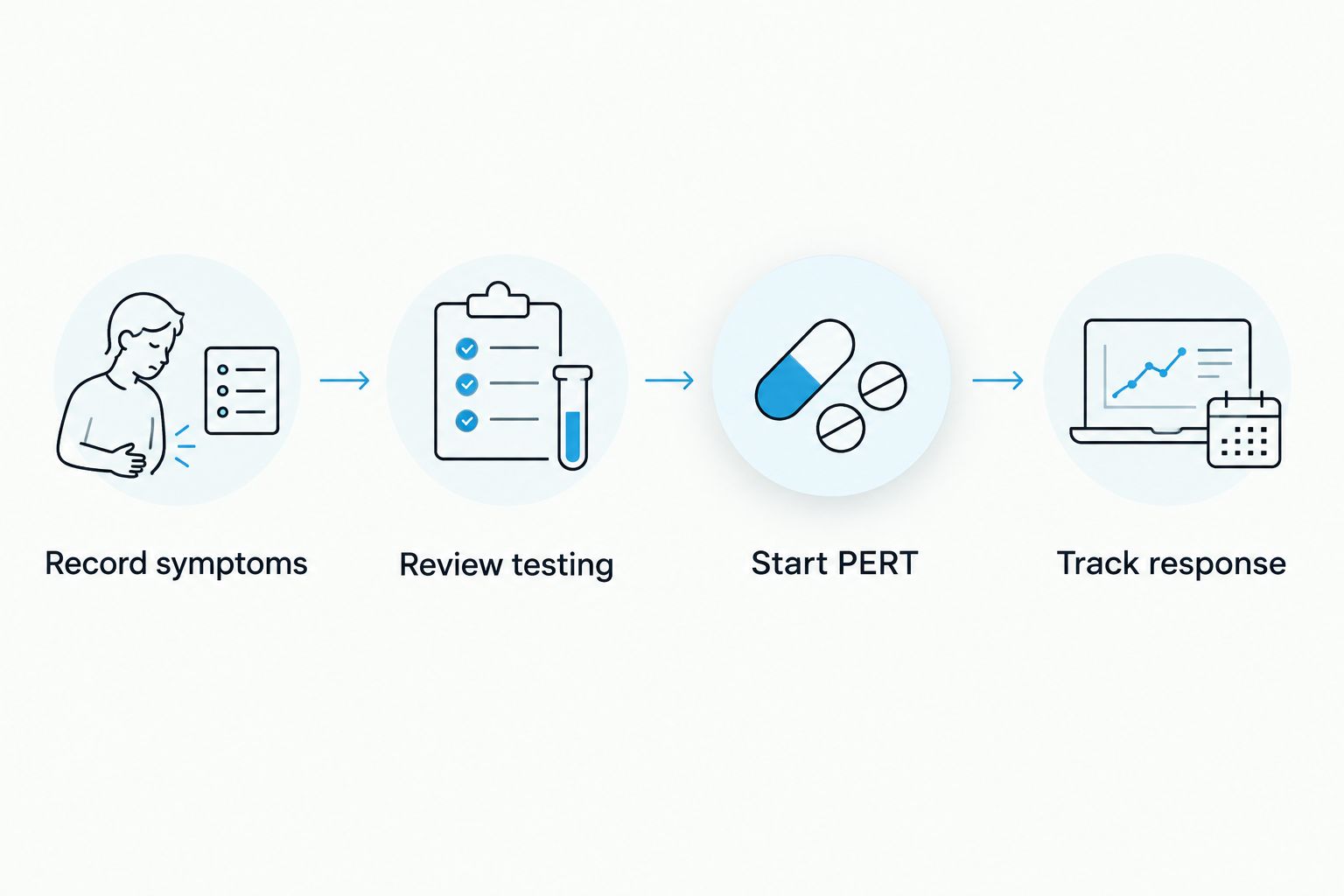
A simple sequence keeps the decisions separate: record symptoms, review testing, start prescribed treatment when indicated and track the response. Return to your clinician if greasy stools or weight loss continue rather than adding more supplements on your own.
- Confirm the prescribed amount for meals and snacks.
- Ask exactly when to take the prescribed capsules with food.
- Keep a record of stools, symptoms and weight changes.
- Contact the prescriber before changing the regimen.
Separate food-triggered bloating from pancreatic symptoms
After EPI treatment is in place, review what remains. If greasy stools improve but bloating still follows particular foods, ask whether IBS or FODMAP sensitivity needs its own plan. If greasy stools persist, do not label the problem as ordinary bloating or assume a low-FODMAP supplement will resolve it.
Casa de Sante's FODMAP Digestive Enzymes are positioned for heavy meals and bloating. They are a distinct option for discussing meal-related digestive discomfort, not a substitute for PERT. The product description does not establish an EPI treatment dose. Ask your clinician or pharmacist to check any added supplement against your diagnosis and prescribed treatment.
- Describe which symptoms remain after starting PERT.
- Identify foods linked to bloating without changing everything at once.
- Check a supplement's intended use, not just its enzyme names.
- Keep prescription PERT and optional symptom support separate.
Review every ingredient in a combination formula
More ingredients do not make an enzyme product more suitable for EPI. A blend with prebiotics, probiotics and postbiotics has a different purpose from prescribed pancreatic enzyme replacement. If you have IBS or SIBO, discuss whether those added ingredients fit your current care plan rather than assuming a larger blend is the better choice.
Read the full label and bring it to your clinician if you are uncertain. Compare the stated purpose of the formula with the symptom you are trying to address. For pancreatic insufficiency, the deciding question remains whether your prescribed PERT regimen is effective; an added gut-support blend cannot answer it.
- Check whether the product is an enzyme-only or combination formula.
- List prebiotics, probiotics and other added ingredients.
- Ask whether each ingredient addresses a symptom you still have.
- Avoid replacing prescribed capsules with a combination supplement.
Track treatment response and nutrition
Judge EPI treatment by more than a single comfortable meal. Review stool changes, persistent diarrhea, weight trends and any nutritional concerns with your care team. If symptoms continue in 2026, the next move is a treatment review, not an unsupported claim that you need a stronger over-the-counter enzyme.
Ask whether your follow-up should include assessment for nutritional deficiencies. A dietitian can help you discuss eating patterns without treating a restrictive diet as a replacement for enzymes. If you are also following a low-FODMAP diet for IBS, make sure that plan does not obscure the separate need to monitor pancreatic treatment.
- Bring your symptom and meal record to follow-up.
- Report persistent greasy stools or diarrhea.
- Discuss weight changes and nutritional concerns.
- Ask whether your PERT instructions need review.
Reassess the plan when symptoms change
A new symptom pattern deserves a new conversation. Do not keep adding digestive aids because a plan that helped bloating no longer addresses diarrhea or weight loss. Likewise, do not assume that every episode of gas means your prescribed pancreatic treatment has failed.
In 2026, keep a clear dividing line between confirmed EPI treatment and support for separate digestive symptoms. Tell your clinician what you take, when you take it and what changed. That makes it easier to identify whether the next adjustment belongs to PERT, diet or another part of your care.
- Note when the symptom pattern changed.
- Check whether you followed the prescribed meal-time instructions.
- Bring all supplement labels to your next review.
- Seek clinical advice for ongoing greasy stools or weight loss.
Compare your options
For pancreatic insufficiency, choose by purpose, not by the number of enzymes or other ingredients on a label. The options below serve different needs; only prescribed PERT is intended to replace deficient pancreatic enzymes.
| Option | Best for | Starting price | Key limitation |
|---|---|---|---|
| Prescription PERT | People with confirmed EPI who need pancreatic enzyme replacement | Ask your pharmacy | Requires an individualized prescription and follow-up |
| Casa de Sante FODMAP Digestive Enzymes | People discussing meal-related bloating or low-FODMAP support alongside their EPI care | Check the current listing | Does not replace prescribed PERT |
| Casa de Sante FODMAP Digestive Enzymes + Prebiotics + Probiotics + Postbiotics | People considering a combination gut-support formula for separate symptoms | Check the current listing | Added ingredients do not make it an EPI treatment |
Verdict: For EPI, start with prescribed PERT. Consider a Casa de Sante digestive enzyme product only for a separate, clearly identified symptom after checking that it fits your care plan. Neither supplement option in this table is a stand-in for a pancreatic enzyme prescription.
Common mistakes people with pancreatic insufficiency make
- Treating any lipase label as equivalent to PERT. An over-the-counter ingredient list does not establish the prescribed pancreatic enzyme dose or instructions your condition requires.
- Taking enzymes without reviewing meal timing. If you have prescribed PERT but symptoms persist, check the product-specific directions with your prescriber before deciding the treatment cannot work.
- Calling every digestive symptom EPI. IBS-related bloating and pancreatic fat malabsorption can coexist. Track them separately so improvement in one does not hide a problem with the other.
- Using a restrictive diet instead of treating confirmed EPI. Identifying food triggers can help with a separate symptom pattern, but it does not replace missing pancreatic enzymes.
- Ignoring ongoing nutritional concerns. Persistent greasy stools, diarrhea or weight loss call for follow-up even if an added supplement makes a meal feel easier.
FAQ
What are the best digestive enzymes for pancreatic insufficiency?
Prescription pancreatic enzyme replacement therapy is the treatment for confirmed exocrine pancreatic insufficiency. Your clinician determines the product and regimen; over-the-counter digestive enzymes do not replace it.
Can Casa de Sante digestive enzymes treat pancreatic insufficiency?
No. Casa de Sante digestive enzymes are positioned for digestive support, including meal-related bloating, not as prescription pancreatic enzyme replacement. Ask your clinician whether a supplement fits any separate symptoms you have.
Is an over-the-counter enzyme with lipase the same as PERT?
No. Seeing lipase on a supplement label does not establish that it provides the prescribed pancreatic enzyme regimen needed for EPI. Follow the instructions for your prescribed treatment.
How is pancreatic insufficiency checked?
A clinician can assess your history, symptoms and tests such as fecal elastase. A result below 100 micrograms per gram of stool is good evidence of EPI under American Gastroenterological Association guidance, but the sample and full clinical picture matter.
Can IBS bloating and pancreatic insufficiency happen together?
Yes. Having one diagnosis does not rule out a separate cause of bloating or diarrhea. Track symptoms and review what remains after your prescribed EPI treatment is in place.
Should I take pancreatic enzymes with snacks?
Follow your prescriber's instructions for both meals and snacks. Adult clinical guidance includes snack dosing as part of an initial PERT approach, but your prescribed amount must be individualized.
What if I still have greasy stools while taking PERT?
Contact your prescriber for a treatment review. Report how you take PERT, what you eat and whether you have diarrhea or weight changes; do not replace the prescription with an over-the-counter blend.
One last thing
If a product helps your bloating but greasy stools continue, that is not proof your EPI is under control. Keep the symptoms distinct at your 2026 follow-up: describe what improved, what did not and which treatment you used for each.









